Gut Health by the Numbers: What the Data Says About Digestion, Stress, and Daily Habits
Only about 7% of American adults hit their fiber target, and 55% of US calories now come from ultra-processed food. Here is what controlled trials actually show about fiber, fermented foods, stress, sleep, and probiotic supplements.

In a nationally representative survey of 71,812 Americans published in the American Journal of Gastroenterology in 2018, 61% of respondents reported at least one gastrointestinal symptom in the previous week — most commonly heartburn or reflux (30.9%), abdominal pain (24.8%), and bloating (20.6%). Digestive discomfort is not an edge case, and much of the advice offered in response is either vague or built on claims that do not survive a look at the source material. Here is what the trials actually measured, and what is worth the effort.
Key statistics at a glance
- 15–30% lower all-cause and cardiovascular mortality among the highest fiber consumers versus the lowest (Reynolds et al., The Lancet, 2019)
- 30+ plant types per week was associated with a measurably different microbiome — including fewer antibiotic resistance genes — versus 10 or fewer (McDonald et al., mSystems, 2018)
- 3 of 8 clinical uses for probiotics earned even a conditional recommendation from the American Gastroenterological Association in its 2020 guideline
The serotonin claim, corrected
You have probably read that "90% of your serotonin is made in your gut, which is why gut health controls your mood." The first half is roughly right. The conclusion does not follow.
A 2016 review in Nutrients by Jenkins and colleagues puts it precisely: central serotonin production represents about 5% of total body synthesis, and enterochromaffin cells lining the gastrointestinal epithelium account for roughly 90% of it. But that peripheral serotonin does its work in the periphery — regulating gut motility and secretion, circulating bound to platelets.
Brain serotonin is a separate pool. As a 2025 review in Cells by Xu, Zhou, and Shi describes, circulating tryptophan crosses the blood–brain barrier via large amino acid transporters and is converted to serotonin inside the central nervous system by tryptophan hydroxylase 2. The gut does influence the brain — through the vagus nerve, immune signaling, and microbial metabolism of tryptophan — but not by shipping finished serotonin upstream.
Practically: eating yogurt will not raise brain serotonin the way the soundbite implies. The mechanisms worth targeting are inflammation, vagal signaling, and nutrient availability.
Fiber is the largest measurable gap
The Institute of Medicine's adequate intake is 14 grams of fiber per 1,000 calories — about 28 grams on a 2,000-calorie diet. The NHANES 2013–2018 analysis by Miketinas and colleagues found US men averaging 8.7 g per 1,000 kcal and women 9.9 g per 1,000 kcal. Only 7.4% of adults met the target.
The consequence is not just constipation. The 2019 Lancet series by Reynolds and colleagues pooled 185 observational studies and 58 clinical trials covering roughly 135 million person-years and found that people eating the most fiber had 15–30% lower all-cause and cardiovascular mortality than those eating the least, with benefit accruing across the 25–29 g/day range and continuing above it.
Fiber also needs water to work. In a controlled trial of 117 adults with functional constipation (Anti et al., 1998), both groups ate a standard diet supplying about 25 g of fiber daily; the group instructed to drink 2 liters of mineral water a day (achieving 2.1 L versus 1.1 L) had significantly greater increases in stool frequency and greater reductions in laxative use. Adding fiber without adding fluid is the most common way people make themselves feel worse.
Diversity of plants beats any single superfood
The American Gut Project — a citizen-science dataset of more than 10,000 gut microbiome samples, published by McDonald and colleagues in mSystems in 2018 — compared people eating more than 30 types of plants per week (n=41) against those eating 10 or fewer (n=44). The high-diversity group carried more short-chain-fatty-acid-producing organisms, including Faecalibacterium prausnitzii and Oscillospira, showed elevated conjugated linoleic acid in stool that could not be explained by dietary intake, and had significantly lower abundance of antibiotic resistance genes for aminoglycosides, chloramphenicol, and MFS transporters.
"Thirty plants" is easier than it sounds, because it counts types, not servings. Herbs, spices, nuts, seeds, whole grains, legumes, coffee, and tea all count — a single mixed grain bowl can contribute six or seven.
The fermented-food trial that surprised everyone
Stanford's 2021 randomized trial, published in Cell by Wastyk and colleagues, assigned 36 healthy adults to a 10-week high-fermented-food or high-fiber diet (18 per arm, within a 17-week protocol). The fermented-food group went from 0.4 ± 0.6 servings per day at baseline to 6.3 ± 2.9 servings per day — yogurt, kefir, fermented cottage cheese, kimchi, fermented vegetables, vegetable brine drinks, and kombucha.
| Fermented foods | 19 |
| High fiber | 0 |
| Fermented-food arm | High-fiber arm | |
|---|---|---|
| Change in intake | 0.4 → 6.3 servings/day | 21.5 → 45.1 g fiber/day |
| Microbial diversity | Increased; larger servings, larger effect | Stable on average |
| Inflammatory proteins | 19 of the measured set decreased, including IL-6 | None of the 19 decreased |
| Immune cell activation | Reduced in 4 cell types | Response varied by baseline microbiome |
This is not an argument against fiber — the mortality data above is far stronger for fiber than for any fermented food. It is an argument that the two do different things, and that fiber's benefits may depend on the microbiome you start with. A 2025 preprint from a Dutch citizen-science randomized trial of 147 adults over 8 weeks reported a similar pattern: diversity rose in the fermented-food arm, while immune responses in the high-fiber arm split into distinct trajectories depending on participants' baseline microbial diversity. That preprint has not completed peer review, so treat it as a signal rather than a settled result.
Ultra-processed food and the additive question
The CDC's National Center for Health Statistics reported in August 2025 that during August 2021–August 2023, ultra-processed foods supplied 55.0% of total calories for Americans age 1 and older — 61.9% for youth and 53.0% for adults, with sandwiches (8.6% of total calories) and sweet bakery products (5.2%) the leading sources.
There is now controlled human evidence on one specific mechanism. In a double-blind controlled-feeding study published in Gastroenterology by Chassaing and colleagues (2022), healthy adults ate either an emulsifier-free diet (n=9) or the identical diet with 15 g/day of carboxymethylcellulose (n=7) for 11 days. The CMC group showed reduced microbiota diversity, lower fecal short-chain fatty acids and free amino acids, and increased postprandial abdominal discomfort; two participants showed bacteria encroaching into the normally sterile inner mucus layer. The sample was tiny, but it is direct human causal evidence, not correlation.
Stress, sleep, and movement are gut inputs too
A 2026 systematic review and meta-analysis in the Journal of Sleep Research by Supasitdikul and colleagues pooled 20 human and rodent studies and found that sleep deprivation significantly reduced alpha diversity (Shannon and Simpson indices) and raised the Firmicutes-to-Bacteroidetes ratio. Our post on nightly routines for better rest covers the sleep side in detail.
On movement, a 2020 systematic review in Medicine & Science in Sports & Exercise found higher physical activity and cardiorespiratory fitness associated with higher fecal alpha diversity and greater short-chain fatty acid representation in healthy adults.
On stress, a 2024 review in Gut Microbes on microbiome–immune crosstalk describes the bidirectional loop: chronic stress alters microbial composition, increases intestinal permeability and translocation of bacterial products, and amplifies circulating inflammation — which then feeds back into stress physiology. Short, repeatable practices matter here more than intensity; see mindful minutes for specific protocols.
Eating pace is a lever too. In a randomized crossover study by Shah and colleagues in the Journal of Investigative Medicine (2015), participants ate an identical breakfast over 30 minutes versus 10 minutes; the slow condition produced significantly higher fullness ratings at 90, 120, 150, and 180 minutes afterward and lower hunger ratings at 90, 150, and 180 minutes.
Probiotic supplements: the honest version
The American Gastroenterological Association reviewed the evidence across eight clinical uses in its 2020 guideline in Gastroenterology and issued a conditional recommendation for only three: preventing C. difficile infection in adults and children on antibiotics (with named strains and combinations), preventing necrotizing enterocolitis in preterm infants, and managing pouchitis.
For Crohn's disease, ulcerative colitis, IBS, and treatment of active C. difficile infection, the AGA found insufficient evidence and suggested patients consider stopping probiotics, given ongoing cost without demonstrated benefit. The guideline also stresses that effects are strain-specific, not species-specific — a bottle labeled "Lactobacillus" tells you almost nothing.
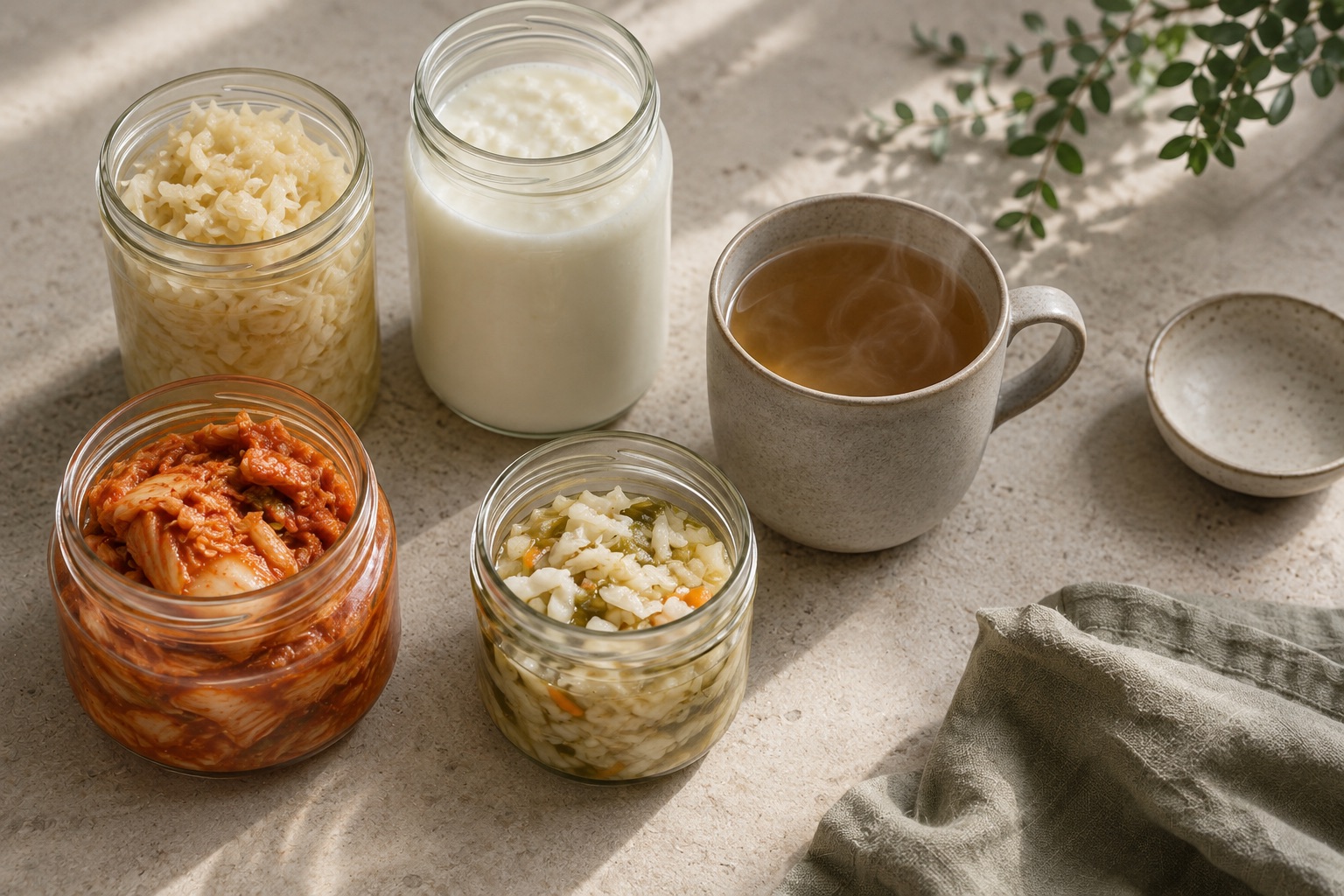
Read carefully what that guideline is evaluating. It assesses isolated, manufactured strains taken as a supplement for a named clinical diagnosis — a pill, judged as a drug would be judged. It is not an assessment of fermented food, and it does not pretend to be. Kimchi, sauerkraut, kefir, miso and yoghurt have been eaten daily across Korea, Japan, China, India, the Caucasus and Eastern Europe for centuries, in populations that never ran a trial and never needed one. Nobody is going to fund a randomized trial of sauerkraut, because sauerkraut has no sponsor.
So the honest position is narrower than either side usually states: the supplement aisle is overselling, and the crock in your kitchen was never on trial. Our recommendation is fermented food, which is why the AGA's finding does not change it.
The mental-health picture is more favorable but still early. A 2024 systematic review and meta-analysis in Nutrition Reviews covering 23 randomized trials and 1,401 clinically diagnosed patients found probiotics reduced depressive symptoms (SMD −0.96; 95% CI −1.31 to −0.61) and anxiety symptoms (SMD −0.59; 95% CI −0.98 to −0.19) over up to 8 weeks. Prebiotics showed no significant effect on depression. The authors note small samples and short follow-up as key limitations.
A four-week starting protocol
Specific, and ordered by evidence strength:
- Weeks 1–2: close the fiber gap gradually. Add 5 g/day each week rather than jumping to 28 g — a sudden increase reliably produces gas and bloating. Pair every increase with fluid; the 2 L/day target from the Anti trial is a reasonable anchor.
- Weeks 1–4: count plant types, not servings. Keep a running weekly tally toward 30. Herbs, spices, seeds, and whole grains count.
- Week 2 onward: introduce fermented foods at 1 serving/day, build toward 4–6. The Stanford effect was dose-dependent. Choose refrigerated products with live cultures; shelf-stable pickles and pasteurized sauerkraut are not fermented in the relevant sense.
- Ongoing: protect sleep and eat slower. Target consistent sleep timing, and stretch main meals toward 20–30 minutes.
- Skip the probiotic bottle unless you have a specific indication — an antibiotic course, or a strain your clinician names for a diagnosed condition.
Give it four to six weeks before judging. Most of the trials above ran 8 to 17 weeks, and the outcomes that moved were measured in blood and stool, not in how any single week felt.
Daily habits are the part of your health you control directly. The parts you can't — an unexpected diagnosis, a hospitalization, an income interruption — are what financial protection is for. You can get a quote in a few minutes or read about our health plan options.
Sources
- American Journal of Gastroenterology — Burden of Gastrointestinal Symptoms in the United States: Results of a Nationally Representative Survey of Over 71,000 Americans (2018)
- Healio — Only 7% of US adults meet daily fiber intake recommendation (Miketinas et al., NHANES 2013–2018, 2021)
- CDC / National Center for Health Statistics — Ultra-processed Food Consumption in Youth and Adults: United States, August 2021–August 2023, Data Brief No. 536 (2025)
- The Lancet — Carbohydrate quality and human health: a series of systematic reviews and meta-analyses (Reynolds et al., 2019)
- Cell — Gut-microbiota-targeted diets modulate human immune status (Wastyk et al., 2021)
- Stanford Medicine — Fermented-food diet increases microbiome diversity, decreases inflammatory proteins, study finds (2021)
- mSystems — American Gut: an Open Platform for Citizen Science Microbiome Research (McDonald et al., 2018)
- Nutrients — Influence of Tryptophan and Serotonin on Mood and Cognition with a Possible Role of the Gut-Brain Axis (Jenkins et al., 2016)
- Cells — Tryptophan and Its Metabolite Serotonin Impact Metabolic and Mental Disorders via the Brain–Gut–Microbiome Axis (Xu, Zhou & Shi, 2025)
- Gastroenterology — Randomized Controlled-Feeding Study of Dietary Emulsifier Carboxymethylcellulose Reveals Detrimental Impacts on the Gut Microbiota and Metabolome (Chassaing et al., 2022)
- Gastroenterology — AGA Clinical Practice Guidelines on the Role of Probiotics in the Management of Gastrointestinal Disorders (2020)
- American Gastroenterological Association — AGA does not recommend the use of probiotics for most digestive conditions (2020)
- Nutrition Reviews — Effects of Prebiotics and Probiotics on Symptoms of Depression and Anxiety in Clinically Diagnosed Samples: Systematic Review and Meta-analysis of Randomized Controlled Trials (2024)
- Journal of Sleep Research — Sleep Deprivation Alters Gut Microbiome Diversity and Taxonomy: A Systematic Review and Meta-Analysis of Human and Rodent Studies (Supasitdikul et al., 2026)
- Medicine & Science in Sports & Exercise — Influence of Exercise on the Human Gut Microbiota of Healthy Adults: A Systematic Review (2020)
- Gut Microbes — Stress in the microbiome-immune crosstalk (2024)
- Journal of Investigative Medicine — The Effect of Eating Speed at Breakfast on Appetite Hormone Responses and Daily Food Consumption (Shah et al., 2015)
- Hepatogastroenterology — Water supplementation enhances the effect of high-fiber diet on stool frequency and laxative consumption in adult patients with functional constipation (Anti et al., 1998)
- medRxiv (preprint, not peer reviewed) — Distinct modulatory effects of high-fiber and fermented-food diets on gut microbiota, immune function, transit time, and sleep quality in a citizen science randomized controlled trial (2025)