Do Ultra-Processed Foods Make You Eat More? The Trial That Answered It
Twenty adults lived in a hospital ward for four weeks while every meal was matched for calories, sugar, fat, fiber and sodium. On the ultra-processed weeks they ate 508 calories a day more without being asked to. Here is what that proves, what it doesn't, and the newer trial that complicates it.

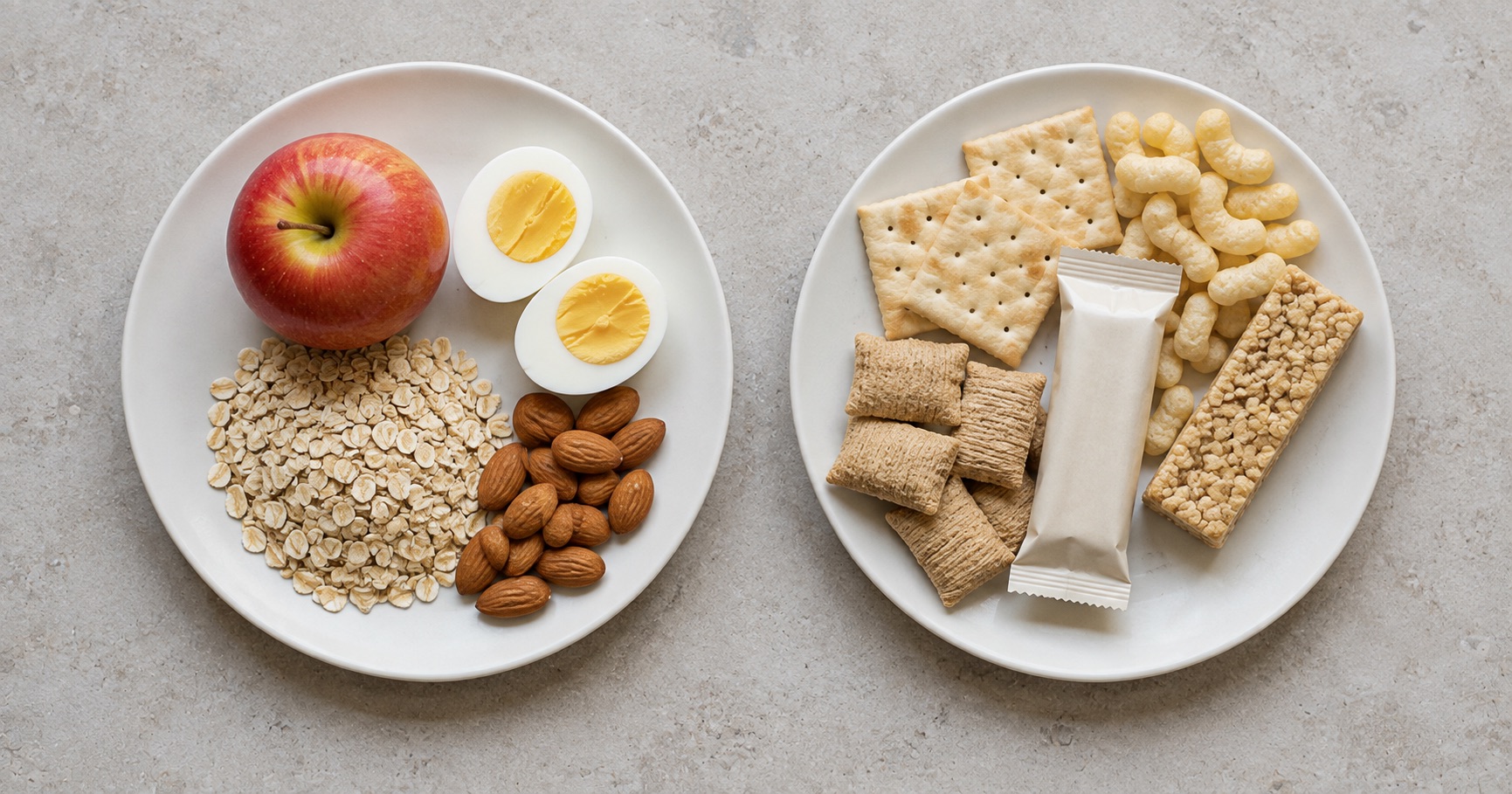
Yes — and the evidence is unusually good, because somebody ran the experiment properly. In 2019, researchers at the National Institutes of Health admitted 20 adults to a hospital metabolic ward for four weeks and fed them two diets, two weeks each, in random order. One was built from ultra-processed foods, the other from unprocessed ones. Critically, the two menus were matched for presented calories, energy density, macronutrients, sugar, sodium and fiber — so the usual explanations were engineered out in advance. Participants were told simply to eat as much or as little as they wanted.
On the ultra-processed weeks they ate 508 ± 106 more calories per day (p = 0.0001) and gained 0.9 kg. On the unprocessed weeks they lost about the same. Nobody reported being hungrier. Nobody chose to overeat. The food was rated equally palatable on both arms.
That is the finding, and it is worth being precise about what it means: this was not a survey of what people who eat badly weigh. It was a randomized controlled feeding trial, which makes it one of the very few pieces of causal evidence in all of nutrition science. It is also 20 people for four weeks, and a newer and larger trial has since complicated the picture in a way this article will not skip past.
This article is educational, not medical or nutrition advice. Sakred Health is not affiliated with or endorsed by any company named here. Every figure comes from a named peer-reviewed source or a government publication.
Key statistics at a glance
- 508 ± 106 kcal/day more consumed on the ultra-processed diet — split as 280 kcal from carbohydrate and 230 kcal from fat, with no change in protein intake (−2 ± 12 kcal/day) — Hall et al., Cell Metabolism, 2019
- Weight change tracked intake almost exactly: +0.9 ± 0.3 kg over two ultra-processed weeks, and a comparable loss over two unprocessed weeks — Hall et al., 2019
- Participants ate the ultra-processed food at 48 calories per minute versus 31 — more than 50% faster — Hall et al., 2019
- PYY, the satiety hormone, rose on the unprocessed diet relative to both the ultra-processed diet and baseline; ghrelin, the hunger hormone, fell on the unprocessed diet relative to baseline — Hall et al., 2019
- In a 2025 crossover trial where both diets were built to meet the UK's national dietary guidance, participants lost weight on both — −2.06% on minimally processed vs −1.05% on ultra-processed, a difference of −1.01% (95% CI −1.87 to −0.14, p = 0.024) — Dicken et al., Nature Medicine, 2025
- Ultra-processed foods supplied 53.0% of calories for US adults and 61.9% for youth in August 2021–August 2023 — CDC/NCHS Data Brief 536, 2025
How much of the American diet this describes
Before the mechanism, the scale — because a 508-calorie effect only matters in proportion to how much of the diet it applies to.
| US youth (ages 1–18) | 61.9% |
| US adults (19+) | 53% |
| "High intake" threshold in cognition research | 20% |
The bottom bar is the comparison worth sitting with. When researchers study the effects of high ultra-processed intake, the threshold they typically use is around 20% of calories. The American average is more than double that, and the average for children is triple it. This is not a study of a fringe eating pattern. It is a study of the default one.
Why the matching is the whole story
Most nutrition headlines come from observational studies: researchers ask thousands of people what they eat, follow them for years, and look for patterns. Those studies are useful for generating hypotheses and nearly useless for establishing cause, because people who eat more ultra-processed food differ from people who don't in dozens of ways — income, sleep, work schedule, neighborhood, stress, healthcare access. Any of those could be doing the work.
Hall's trial removed that problem by removing choice. Everyone lived on the same ward, ate from the same kitchen, and crossed over to the other diet — so each participant served as their own control. And the menus were deliberately matched on every variable the field usually blames:
| Matched between arms | Not matched (the actual variable) |
|---|---|
| Calories presented | Degree of industrial processing |
| Energy density | Ingredient structure |
| Total sugar | How fast the food could be eaten |
| Total fat | Texture and required chewing |
| Sodium | |
| Fiber |
When you control for sugar and fat and fiber and still get a 508-calorie gap, the gap has to come from something else. That is what makes this trial matter: it isolates processing itself, not the nutrients everyone argues about.
The honest version of "it wrecks your hormones"
This is where the internet gets ahead of the data, so here is exactly what was measured.
The trial did find hormonal differences, and they point the direction you'd expect. PYY — a hormone released by the gut after eating that signals fullness — was higher on the unprocessed diet than on the ultra-processed diet. Ghrelin — the hormone that drives hunger — was lower on the unprocessed diet than at baseline. In plain terms, the unprocessed food did a better job of telling participants' bodies they'd eaten.
That is a real, measured, peer-reviewed hormonal effect on appetite regulation. It is also narrower than the claim usually made online. This trial did not show that ultra-processed food disrupts sex hormones, thyroid function in any harmful direction, or fertility. It measured appetite signaling over two weeks in 20 people. Anyone telling you a package of cookies is "destroying your hormones" is extrapolating well past this evidence — and the real finding is interesting enough without the inflation.
| Carbohydrate | 280 kcal |
| Fat | 230 kcal |
| Protein | 0 kcal |
Protein intake was the one thing that did not move — −2 ± 12 kcal/day, statistically indistinguishable from zero. Participants ate hundreds of extra calories of carbohydrate and fat while their protein intake stayed pinned. That pattern shows up repeatedly in appetite research, and it is one reason protein content is a more useful thing to look at on a label than the word "natural."
The speed finding, which may be the mechanism
The single most concrete difference between the two arms was how fast the food went down: 48 calories per minute versus 31.
| Unprocessed diet | 31 kcal/min |
| Ultra-processed diet | 48 kcal/min |
Satiety signaling is slow. PYY and the other post-meal fullness hormones take roughly 15 to 20 minutes to register. Food that can be consumed at 48 calories a minute delivers several hundred calories inside that window — before the system that would have told you to stop has reported in. Food that requires chewing, that has structure, that resists being swallowed quickly, gives the signal time to arrive.
That reframes the problem usefully. The issue may be less about any specific villain ingredient and more about engineering that removes the friction food used to have. Softness, solubility and consistency are deliberate design targets in industrial food production — and they are the same properties that let you eat 500 extra calories without noticing.
It also explains why our recipes read the way they do. The cinnamon roll built on a tangzhong dough with date paste is not merely lower in sugar than a Cinnabon; it takes longer to eat. Whole dates in hot chocolate bring fiber that syrup does not. A pumpkin loaf on whole-grain flour with 4 grams of fiber a slice behaves differently in the mouth than one on refined flour, before any metabolic argument starts.
The trial that complicates it
Good evidence includes the study that doesn't fit the story, so here is that one.
In August 2025, Dicken and colleagues at University College London published the UPDATE trial in Nature Medicine. Fifty participants ate researcher-provided food at home for eight weeks per arm — four times longer than Hall's trial — crossing over between an ultra-processed diet and a minimally processed one. The twist: both diets were designed to meet the UK's national dietary guidance, the Eatwell Guide.
Participants lost weight on both diets. The minimally processed arm lost more — −2.06% versus −1.05% of body weight, a difference of −1.01% (95% CI −1.87 to −0.14, p = 0.024, Cohen's d −0.48) — but the ultra-processed arm did not gain the weight the researchers had expected.
| Minimally processed diet | 2.06% |
| Ultra-processed diet | 1.05% |
Note the color choice: the ultra-processed bar is marked neutral, not bad. Participants on it still lost weight. That is the finding, and softening it would be dishonest.
That result deserves to be read carefully rather than dismissed or oversold. It says that ultra-processed food formulated to nutritional guidelines halved the benefit of eating well — it did not reverse it. Which means "ultra-processed" is not a synonym for "harmful," and the category as defined by the NOVA system is genuinely broad: it includes packaged whole-grain bread and plain canned beans alongside candy and soda. The trials that show dramatic effects use the ultra-processed food people actually eat. The trial that showed a modest effect used ultra-processed food built by nutrition researchers to hit targets.
Both things are true at once, and the practical reading is that formulation matters as much as the processing label. That is a less satisfying headline and a more accurate one.
What this does and doesn't establish
Well supported:
- Ultra-processed diets increase spontaneous calorie intake relative to matched unprocessed diets — randomized, controlled, crossover, causal
- The effect persists when sugar, fat, sodium, fiber and energy density are held equal
- Eating rate is substantially faster on ultra-processed food
- Appetite-hormone signaling (PYY, ghrelin) differs measurably between the two diet patterns
Not established by this evidence:
- That ultra-processed food harms sex hormones, thyroid function or fertility
- That any single additive, emulsifier or preservative causes the intake effect
- That all foods classified as ultra-processed carry equal risk
- That the four-week metabolic-ward result scales linearly to years of ordinary life
Contested and worth watching: a NIH follow-up testing ultra-processed diets that vary independently in energy density and hyper-palatability has been presented publicly, with reported excess intake ranging from roughly 250 to 1,000 kcal/day depending on where a diet lands on those two dimensions. Those findings have not yet been formally published or peer-reviewed, and we are flagging them rather than counting them.
Frequently asked questions
Do ultra-processed foods make you eat more?
Yes. In a randomized controlled inpatient trial, 20 adults ate 508 more calories per day on an ultra-processed diet than on an unprocessed diet, even though the two menus were matched for calories presented, sugar, fat, fiber, sodium and energy density, and participants were free to eat as much or as little as they wanted.
Is all ultra-processed food equally bad?
No, and this is the most common error in coverage of the topic. The NOVA classification is broad enough to include packaged whole-grain bread and canned beans alongside soda and candy. A 2025 trial in which the ultra-processed diet was built to meet national dietary guidelines still produced weight loss — less than the minimally processed diet, but loss rather than gain.
Does ultra-processed food disrupt your hormones?
It measurably affects appetite hormones. The 2019 NIH trial found higher PYY, the satiety hormone, on the unprocessed diet and lower ghrelin, the hunger hormone, relative to baseline. Claims that ultra-processed food disrupts sex hormones or thyroid function go beyond what these trials measured.
Why does eating speed matter?
Fullness signaling takes roughly 15 to 20 minutes to register after a meal begins. Food eaten at 48 calories per minute — the rate measured on the ultra-processed arm, versus 31 on the unprocessed arm — delivers several hundred calories before that signal arrives.
Is this just about willpower?
The trial design specifically rules that out. Participants did not choose their diets, did not know which hypothesis was being tested, rated both diets as equally pleasant, and reported similar hunger and fullness. The intake difference emerged without intention.
Sources
- Cell Metabolism — Hall et al., Ultra-Processed Diets Cause Excess Calorie Intake and Weight Gain: An Inpatient Randomized Controlled Trial of Ad Libitum Food Intake (2019)
- PubMed — Hall et al., 2019 (PMID 31105044)
- Nature Medicine — Dicken et al., Ultraprocessed or minimally processed diets following healthy dietary guidelines on weight and cardiometabolic health: a randomized, crossover trial (2025)
- PubMed — Dicken et al., 2025 (PMID 40760353)
- CDC/NCHS — Data Brief 536, Ultra-processed Food Consumption in Youth and Adults: United States, August 2021–August 2023 (2025)
- NIH — Controlled study links processed food to increased calorie consumption (2019)
Related: What Big Food Doesn't Have to Tell You About Sugar — why the added-sugar figure disappears the moment a food is sold at a counter instead of on a shelf.