Healthy Pumpkin Bread: No Refined Sugar, 10 Grams a Slice, and the Truth About What's in the Can
A genuinely moist pumpkin loaf built on whole dates, maple, whole-grain flour and Greek yogurt — about 10 grams of added sugar per slice against 22 in a standard published recipe — plus what FDA actually says about calling canned squash "pumpkin.

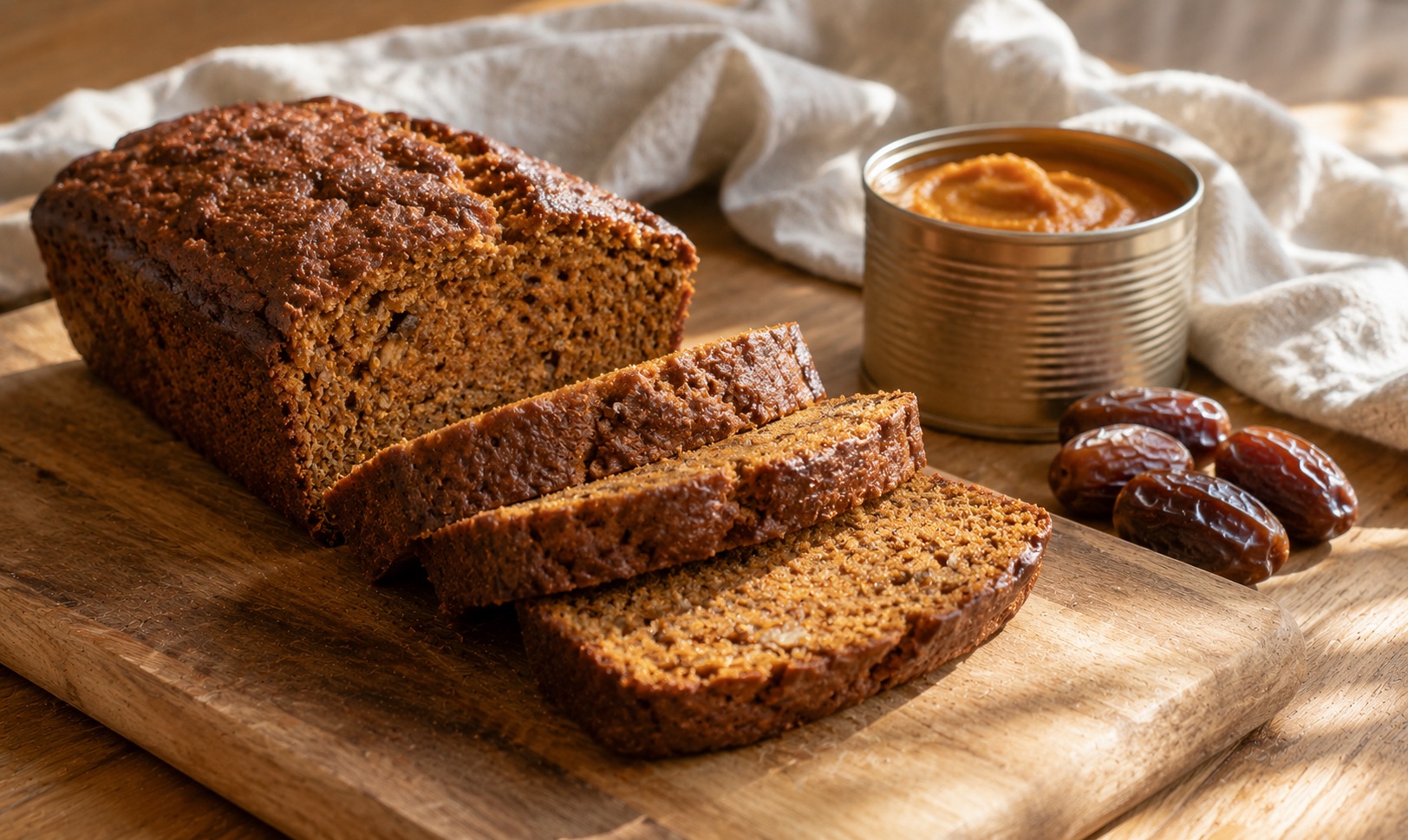
Pumpkin bread is a dessert wearing a vegetable's name. A widely published home recipe runs about 22 grams of added sugar per slice at 12 slices to the loaf, and a Starbucks Pumpkin & Pepita Loaf lists 31 grams of total sugars with 2 grams of fiber — so a single slice can carry a woman's entire daily added-sugar allowance under the American Heart Association's 25-gram limit. The pumpkin itself is genuinely nutritious; half a cup of the canned purée delivers more than a full day's vitamin A plus 3.6 grams of fiber. The problem is the ratio of sugar to everything else, not the squash.
Rebuilt around that ratio, the loaf lands at about 10 grams of added sugar and 4 grams of fiber per slice — one can of pure pumpkin purée, whole-grain flour, eggs, a little extra-virgin olive oil, Greek yogurt, warm spices, vanilla, salt, baking soda, and six blended Medjool dates plus two tablespoons of maple syrup as the entire sweetener. It is still a sweet quick bread. It is just one where you set the number.
Below that: what is actually inside a can labeled "pumpkin," what you genuinely give up when you take sugar out of a quick bread, and whether pumpkin is as nutritious as autumn marketing implies. All three answers are more interesting than the internet version.
This article is educational, not medical or nutrition advice. Talk to your doctor before making dietary changes, especially if you're pregnant, nursing, managing blood sugar, or taking medication.
Key statistics at a glance
- The 2025–2030 Dietary Guidelines for Americans, released by HHS and USDA on January 7, 2026, state that "while no amount of added sugars or non-nutritive sweeteners is recommended or considered part of a healthy or nutritious diet, one meal should contain no more than 10 grams of added sugars" — a shift from the old percentage-of-calories framing
- The American Heart Association's limits remain 25 g/day for women and 36 g/day for men, against a current US average of 12–13% of daily calories from added sugars — American Heart Association, reviewed May 2026
- Sweet bakery products were one of the top five sources of ultra-processed calories for both youth and adults, in a food supply where UPF supplied 53.0% of adult calories and 61.9% of youth calories — CDC/NCHS Data Brief 536, August 2025
- One half-cup of canned pumpkin delivers about 953 mcg RAE of vitamin A — more than the full 900 mcg adult Daily Value — plus 3.6 g of fiber — USDA FoodData Central
- Canned pumpkin carries more than twice the vitamin A per 100 g of fresh pumpkin that's been boiled and drained (778 vs. 288 mcg RAE) — USDA FoodData Central
- Whole-grain intake at 90 g/day was associated with a relative risk of 0.81 for coronary heart disease and 0.83 for all-cause mortality across 45 cohort studies — BMJ (Aune et al.), 2016
- FDA has told canners since 1938 that it will not act against labeling golden-fleshed sweet squash as "pumpkin" — FDA Compliance Policy Guide 585.725, reissued December 1988
What you're actually replacing
Two honest comparisons. The first is the coffee-shop slice; the second is the recipe most home bakers are already using.
| Starbucks Pumpkin & Pepita Loaf | King Arthur "Easy Pumpkin Bread" | This loaf | |
|---|---|---|---|
| Serving | 1 slice | 1 slice (12 per loaf) | 1 slice (12 per loaf) |
| Sugars | 31 g total | ~22 g added, from 528 g granulated sugar across 2 loaves | ~10 g added, from 6 dates + 2 Tbsp maple |
| Fiber | 2 g | Not a meaningful source (all-purpose flour) | ~4 g |
| Flour | Refined | All-purpose | White whole wheat (whole grain) |
| Fat source | Not disclosed by slice | 198 g vegetable oil per 2 loaves | 67 g extra-virgin olive oil + Greek yogurt |
| Sweetener control | Fixed | Fixed by recipe | Yours, per loaf |
| Starbucks Pumpkin & Pepita Loaf (total sugars) | 31 g |
| AHA daily added-sugar limit, women | 25 g |
| Standard pumpkin bread — granulated sugar | 22 g |
| DGA 2025–2030 added-sugar limit, per meal | 10 g |
| This loaf — whole dates + maple | 10 g |
Read that chart carefully, because the bars are not identical measures. The Starbucks figure is total sugars. The King Arthur figure is added sugar only, calculated from that recipe's own published 528 grams of granulated sugar for two loaves — and King Arthur bases its serving count on 16 slices per loaf, which would put it at about 16.5 g. We used 12 slices for both loaves so the comparison is apples to apples.
The two 10-gram bars landing on top of each other isn't a coincidence found after the fact; it's the constraint the sweetener was built around. And it's worth saying plainly: 10 grams of added sugar per slice is not zero. Dates and maple syrup are added sugars — FDA's 2019 guidance treats pure maple syrup and honey as added sugars on the Nutrition Facts label, and the same logic covers date syrup, coconut sugar, and agave. The advantage of baking this yourself is that you set the dial, not that natural sweeteners are metabolically free. Our food chart sorts sweeteners on exactly that basis.
About the sweetener
Both versions use real sugar. That is not the difference, and saying otherwise invites an easy correction — the commercial product is sweetened with cane sugar, not an artificial sweetener.
What differs is what the sugar arrives inside. This recipe sweetens with whole Medjool dates. Dates are more than 70% sugar, which we are not going to pretend away — and yet across five varieties tested in both healthy and type 2 diabetic subjects they measured a glycemic index of roughly 44 to 55, low-to-medium, with no significant post-meal glucose excursions in the diabetic group (Alkaabi et al., Nutrition Journal, 2011). The fruit's fiber is still attached and still doing its job. Strain it out into a syrup and that advantage leaves with it.
So the claim is not that this sugar is free. FDA counts dates, maple and coconut sugar as added sugars, and so do we. The claim is less sugar, and sugar that still has its fiber. Full breakdown of which sugar substitute is actually healthiest.
Ingredients
- 1 can (15 oz / 425 g) 100% pure pumpkin purée — not pumpkin pie filling
- 6 large Medjool dates (about 144 g pitted), plus 3 tablespoons very hot water
- 2 tablespoons (40 g) pure maple syrup
- 2 large eggs, at room temperature
- 1/3 cup (67 g) extra-virgin olive oil, or melted unrefined (virgin) coconut oil
- 1/3 cup (80 g) plain whole-milk Greek yogurt, or unsweetened applesauce
- 2 teaspoons pure vanilla extract
- 2 1/4 cups (270 g) white whole wheat flour, or a 1:1 gluten-free baking blend
- 1 teaspoon baking soda
- 1/2 teaspoon baking powder
- 3/4 teaspoon fine sea salt
- 2 1/2 teaspoons ground cinnamon
- 1 teaspoon ground ginger
- 3/4 teaspoon freshly grated nutmeg
- 1/4 teaspoon ground cloves
- 1/4 teaspoon ground allspice
- 1/3 cup (40 g) raw pepitas, optional, for the top
Instructions
- Heat the oven to 350°F (177°C) with a rack in the center position. Line a 9×5-inch metal loaf pan with a parchment sling and grease the two exposed sides.
- Pit the dates, cover them with 3 tablespoons of very hot water, and soak for 10 minutes. Very soft fresh Medjools can skip this.
- Blend the dates and their soaking water into a completely smooth paste, 45 to 60 seconds, scraping down once. You should have about 3/4 cup (roughly 185 g) with no visible flecks.
- In a large bowl, whisk the date paste, pumpkin purée, maple syrup, eggs, oil, yogurt, and vanilla for about 30 seconds, until the mixture is one uniform color with no streaks of yogurt.
- In a second bowl, whisk the flour, baking soda, baking powder, salt, cinnamon, ginger, nutmeg, cloves, and allspice for a full 30 seconds. Baking soda that isn't evenly dispersed leaves soapy, metallic pockets in the crumb.
- Add the dry mixture to the wet and fold with a spatula just until no dry flour remains — roughly 20 strokes. Stop there. Sugar normally interferes with gluten development; with less of it in the bowl, overmixing toughens this batter faster than it would a conventional one.
- Scrape the batter into the pan, smooth the top, and scatter the pepitas across it if using.
- Bake for 55 to 70 minutes. If the top is browning quickly at the 40-minute mark, tent it loosely with foil.
- Start checking at 55 minutes with an instant-read thermometer pushed into the center of the loaf: you want 200–205°F. Do not judge by color — a low-sugar loaf browns less, so the visual cue you're used to will tell you it's underdone when it isn't.
- Cool in the pan on a rack for 15 minutes, then lift the loaf out by the parchment sling and cool it completely on the rack, at least 2 hours, before slicing.
- Cut into 12 slices.
Is canned pumpkin actually pumpkin?
Every October this resurfaces as an exposé. It deserves a straight answer, because the real story is a labeling convention with a paper trail — not a scandal.
What FDA actually says. Compliance Policy Guide 585.725, titled "Pumpkin" — Labeling Articles Made from Certain Varieties of Squash, was first issued in 1969 and last reissued in December 1988. Its background notes that canned "pumpkin" has long been packed from field pumpkin (Cucurbita pepo), from firm-shelled golden-fleshed sweet squash (Cucurbita maxima), or from mixtures of the two. Then the policy: "Since 1938, we have consistently advised canners that we would not initiate regulatory action solely because of their using the designation 'pumpkin' or 'canned pumpkin' on labels for articles prepared from golden-fleshed, sweet squash, or mixtures of such squash with field pumpkins. In the absence of any evidence that this designation misleads or deceives consumers we see no reason to change this policy." FDA treats "pumpkin" as in essential compliance with the common-or-usual-name requirements of the Federal Food, Drug, and Cosmetic Act. USDA is structured the same way: its grade standards for canned pumpkin and canned squash are a single joint document, reissued effective January 20, 2017, scoring both products identically.
What Libby's actually uses. Libby's, a Nestlé brand, accounts for roughly 85% of canned pumpkin worldwide and as much as 90% in the US. When a viral post in 2016 claimed the cans held a butternut-and-Hubbard blend, the company responded directly: "Libby's proudly uses 100% pumpkin in our Libby's solid pack pumpkin. We do not use Hubbard squash, or other types of squash. In fact, Libby's uses a specific cultivar of pumpkin called Dickinson. The 'Libby's Select' strain of Dickinson is our own, developed over decades by our own agricultural people." Snopes rated the viral claim "Mixture" in September 2016: true that most canned pumpkin comes from one unglamorous cultivar, false that it's a blend of other squashes.
The wrinkle worth knowing. Dickinson is a cultivar of Cucurbita moschata — the same species as butternut squash, and a species FDA's guide doesn't even name in its examples. But "pumpkin" has no botanical definition at all; it's a market name spanning at least four Cucurbita species, and by that standard Dickinson qualifies. What it is not is the jack-o'-lantern variety, which is stringy, watery, and bred for looks.
The honest conclusion: it's squash, it's fine, and the label is allowed for a documented reason. No safety issue, no nutrition penalty — if anything the opposite, since a cultivar selected for dense, sweet, stringless flesh is exactly what a loaf wants.
One thing genuinely worth checking on the shelf: pure pumpkin versus pie mix. Libby's Easy Pumpkin Pie Mix carries 16 grams of added sugar per 1/3-cup (87 g) serving. Libby's 100% Pure Pumpkin has none. The wrong orange can would roughly triple this recipe's sugar before you added a single date.
Pumpkin bread is cake, and reducing the sugar has a real cost
This is where most "healthy" baking writing gets dishonest. It presents sugar as decoration you can subtract for free. In a quick bread, sugar is structural.
The 2019 review by Sahin, Zannini, Coffey and Arendt in Food Research International — "Sugar reduction in bakery products" — states the problem directly: sugar "interacts significantly with all ingredients," affecting starch gelatinization temperature, gluten network development, emulsification, aeration, browning, and microbial shelf life. Pull it out and you pull on all of that at once. Four things go with it:
Moisture retention. Sucrose is hygroscopic — it binds water in the batter and holds it in the crumb afterward. Less sugar means freer water, and freer water leaves. This is the main reason low-sugar loaves go dry faster.
Tenderness. By competing for water, sugar slows gluten development. Remove it and the same flour, mixed the same way, gives a tougher crumb.
Browning. Reducing sugars drive Maillard browning with amino acids as well as caramelization. A low-sugar loaf is paler, so the visual doneness cue you've trained on stops being reliable — which is why step 9 uses a thermometer.
Shelf life. Sugar lowers water activity. Less sugar, shorter window.
Here is what the recipe puts back in their place:
- Pumpkin purée is the primary humectant. A 15-ounce can is mostly water held in a pectin and fiber matrix that doesn't release it the way free water does. That's the single largest reason this loaf reads moist.
- Greek yogurt adds bound water plus acid (more on the acid below). Unsweetened applesauce is the dairy-free swap, at a little more sugar and a little less protein.
- Date paste behaves differently from granulated sugar. Whole dates arrive with their fiber intact — about 6.7 g per 100 g, so roughly 9.6 g across the six dates here, on top of 12.3 g from the pumpkin and 28.9 g from the flour. Pectin-rich fruit purée also thickens as it cools, partially replacing the body sugar was providing. That fiber matrix is the honest reason to use whole dates rather than date syrup: syrup is the sugar without the fruit.
- Spice, vanilla, and salt raise perceived sweetness. This is the lever that makes reduced-sugar baking work at all. Sakai and colleagues showed in Perceptual and Motor Skills in 2001 that a vanilla odor raised sweetness ratings of aspartame solutions delivered either orthonasally or retronasally — and the effect disappeared under a nose clip, confirming it was olfactory. Salt works the other side: Breslin and Beauchamp reported in Nature in 1997 that sodium selectively filters flavor, suppressing unpleasant tastes more than palatable ones, so bitterness recedes and sweetness comes forward. The 4 1/2 teaspoons of spice and 2 teaspoons of vanilla are not garnish. Evidence: strong for the salt-bitterness mechanism, moderate for aroma-driven sweetness enhancement.
Say the rest out loud too: this is a lightly sweet loaf. At 10 grams of added sugar per slice the sugar-to-flour ratio is about 0.44 to 1, where bakery pumpkin bread runs above 1 to 1. It reads as a spiced tea loaf, not as cake. If that's too far, add two more dates and one more tablespoon of maple — about 13.5 g per slice, still well under the published version. Signals, not flaws: if the first loaf tastes flat rather than unsweet, add a pinch more salt before reaching for more dates.
How much nutrition is actually in the pumpkin?
Genuinely a lot — and it still doesn't make a slice of pumpkin bread a health food.
Per USDA FoodData Central, canned pumpkin without salt carries 778 mcg RAE of vitamin A and 6,941 mcg of beta-carotene per 100 grams, along with 2.9 g of fiber for 34 calories. A half-cup serving works out to roughly 953 mcg RAE — over 100% of the 900 mcg adult Daily Value set by the NIH Office of Dietary Supplements, whose RDAs are 900 mcg RAE for men and 700 mcg for women. Dietary beta-carotene converts to retinol activity at about 12 to 1, which is why the beta-carotene number is so much larger than the RAE number.
| Canned pumpkin | 953 mcg |
| Adult Daily Value | 900 mcg |
| Fresh pumpkin, boiled and drained | 353 mcg |
The canned-versus-fresh gap surprises people. Boiled, drained fresh pumpkin comes in at 288 mcg RAE and 1.1 g fiber per 100 g, against 778 mcg and 2.9 g for canned. Part of that is concentration — canned purée is denser, 34 calories per 100 g against 20 — and part is the cultivar, selected for exactly this flesh. Canned is not the compromise version here.
For one slice of this loaf: the 425-gram can contributes roughly 3,300 mcg RAE across twelve slices, or about 275 mcg per slice, around 31% of the Daily Value — plus about 4 grams of fiber once the flour and dates are counted. The Starbucks loaf lists 2 grams.
That's a real difference, and it's still a slice of sweetened quick bread. Pumpkin being nutrient-dense does not launder the flour, the oil, and the ten grams of sugar around it. Treat it as what it is: a good version of a treat, eaten on purpose. Terrain is what the internal environment sees on an ordinary Tuesday, and one loaf doesn't decide that. Our guide to inflammatory foods and what to eat instead covers the pattern-level version of this argument.
Does whole-grain flour actually matter here?
Yes, and this is one of the better-supported claims in everyday nutrition — which is why it's worth stating precisely rather than loudly.
In the 2016 BMJ dose-response meta-analysis by Aune and colleagues, pooling 45 cohort studies, each 90 g/day of whole grains was associated with a relative risk of 0.81 (95% CI 0.75–0.87) for coronary heart disease, 0.78 (0.73–0.85) for cardiovascular disease, 0.85 (0.80–0.91) for total cancer, and 0.83 (0.77–0.90) for all-cause mortality. Risk reductions continued up to about 210–225 g/day. A larger 2022 dose-response meta-analysis in the American Journal of Clinical Nutrition, covering 68 studies and 1,624,407 participants, found per 30 g/day of whole grains a relative risk of 0.94 (0.92–0.97) for coronary heart disease and 0.94 (0.92–0.97) for all-cause mortality — while finding little evidence of comparable associations for refined grains.
Two caveats an honest reader deserves. These are observational cohorts, not randomized trials, so residual confounding is live. And 90 grams a day is roughly three servings; two slices of this loaf are not that. Evidence: strong and consistent for whole grains as a dietary pattern; the effect of swapping the flour in one recipe is unmeasured and almost certainly small.
Practically: white whole wheat flour is milled from hard white wheat, so it's a true whole grain with a milder flavor and paler color than red wheat — the easiest whole-grain substitution to make in a spiced loaf, because nobody notices. A 1:1 gluten-free blend also works; expect a more tender, more fragile crumb.
Why baking soda needs an acid
Baking soda is sodium bicarbonate, a base. On its own in a batter it does very little. Combined with an acid and moisture it produces carbon dioxide, and the trapped gas lifts the crumb. That reaction fires fast — once the soda neutralizes the available acid, the batter turns alkaline and gas production drops off sharply.
Here the acid comes from three places: the lactic acid in Greek yogurt, the mild acidity of pumpkin purée, and the dates. That's why the yogurt isn't optional as a category — swap it for unsweetened applesauce if you need dairy-free, but don't just delete it.
The half teaspoon of baking powder is insurance, not redundancy. Powder carries its own acid, and double-acting powder releases a second wave of gas from oven heat rather than from mixing. In a heavy, wet, whole-grain batter that sits while the oven finishes preheating, that second wave is what keeps the center from sinking.
Two failure modes worth naming: too much soda relative to available acid leaves unreacted alkali, which tastes soapy or metallic, and soda that isn't whisked thoroughly into the flour produces those same off notes in isolated pockets. Hence the full 30 seconds in step 5.
How do you keep it moist, and how long does it keep?
The moisture here comes from purée and yogurt rather than sugar, which changes the storage math. Follow this rather than your usual habit.
Cool it completely before wrapping — at least two hours. Wrapping warm traps steam against the crust; slicing warm drags the crumb, because the starch hasn't set.
Room temperature, tightly wrapped, up to 3 days. With less sugar holding water, this loaf stales faster than a conventional one.
Do not refrigerate it. Starch retrogradation — the recrystallization that makes baked goods go firm and dry — runs fastest at temperatures just above freezing, which is exactly your refrigerator. Aguirre and colleagues, in Starch – Stärke in 2011, found the retrogradation rate highest at 4°C among the conditions tested, while frozen storage at −18°C held water activity essentially constant for 23 days.
Freeze it instead. Slice first, wrap the slices individually, freeze up to 3 months. Freezing effectively halts retrogradation, and a slice thawed at room temperature or warmed in a toaster oven comes back close to day one.
Keeping the ritual
Nobody actually craves granulated sugar. What people want in October is a warm kitchen, a spice smell, and a slice of something with butter on it at four in the afternoon. All of that survives the swap. What changes is that the loaf carries fiber and roughly a third of a day's vitamin A instead of 22 grams of sugar — and that you set the number.
Bake it once at six dates and see where your palate lands, then adjust. Consistency over intensity: the loaf you make eight times a year at 10 grams a slice matters more than the perfect one you make once. The Sakred app is where we track swaps like this across a season.
Frequently asked questions
Is canned pumpkin actually pumpkin, or is it squash? Both answers are defensible, and neither is a problem. FDA's Compliance Policy Guide 585.725 has allowed golden-fleshed sweet squash to be labeled "pumpkin" since 1938, and USDA grades canned pumpkin and canned squash under one joint standard. Libby's, which supplies about 85% of canned pumpkin worldwide, states it uses only its proprietary Dickinson cultivar — botanically Cucurbita moschata, the same species as butternut. Since "pumpkin" has no botanical definition and spans at least four Cucurbita species, Dickinson counts. There is no safety or nutrition downside; the cultivar is denser and sweeter than a carving pumpkin.
Is pumpkin bread made with dates and maple actually sugar-free? No. Six Medjool dates contribute about 96 grams of sugar and two tablespoons of maple syrup about 24 grams, per USDA FoodData Central — roughly 10 grams of added sugar per slice across twelve slices. FDA counts maple syrup, honey, date syrup and agave as added sugars on the Nutrition Facts label, and so should you. The honest advantage is the amount: about 10 grams a slice instead of the 22 in a standard published recipe, plus the fiber that came with the whole fruit.
Why is my healthy pumpkin bread dry, and how do I fix it? Almost always one of three things. You over-baked it — pull at 200–205°F internal rather than waiting for a deep brown top, because a low-sugar loaf browns late. You over-measured the flour by scooping the cup into the bag; weigh it at 270 g. Or you refrigerated it, which speeds up the starch retrogradation that makes crumb go firm. Store it wrapped at room temperature for up to three days, or slice and freeze.
Can I use all-purpose flour or a gluten-free blend instead of whole wheat? Yes to both. All-purpose flour gives a lighter, more familiar crumb and drops the fiber by roughly 2 grams per slice; the cohort evidence favoring whole grains is about long-term dietary patterns, not about any single loaf. A 1:1 gluten-free baking blend also works — expect a more tender, more fragile crumb, and cool it completely before slicing, since gluten-free structure sets as it cools.
Sources
- FDA — CPG Sec 585.725 "Pumpkin": Labeling Articles Made from Certain Varieties of Squash (reissued December 1988)
- USDA Agricultural Marketing Service — United States Standards for Grades of Canned Pumpkin and Canned Squash, effective January 20, 2017
- Snopes — Canned Pumpkin Isn't Actually Pumpkin? (2016)
- HHS & USDA — Dietary Guidelines for Americans, 2025–2030 (January 2026)
- Harvard T.H. Chan School of Public Health, The Nutrition Source — Dietary Guidelines for Americans 2025–2030 (2026)
- American Heart Association — How Much Sugar Is Too Much? (reviewed May 2026)
- CDC/NCHS — Data Brief 536, Ultra-processed Food Consumption in Youth and Adults: United States, August 2021–August 2023 (2025)
- FDA — Guidance for Industry: Declaration of Added Sugars on Honey, Maple Syrup, Other Single-Ingredient Sugars and Syrups, and Certain Cranberry Products (2019)
- USDA FoodData Central — Pumpkin, canned, without salt (nutrient profile)
- USDA FoodData Central — Pumpkin, cooked, boiled, drained, without salt (nutrient profile)
- USDA FoodData Central — Dates, Medjool (nutrient profile)
- USDA FoodData Central — Wheat flour, whole-grain (nutrient profile)
- NIH Office of Dietary Supplements — Vitamin A and Carotenoids, Fact Sheet for Health Professionals
- BMJ — Aune et al., Whole grain consumption and risk of cardiovascular disease, cancer, and all cause and cause specific mortality (2016)
- American Journal of Clinical Nutrition — Consumption of whole grains and refined grains and associated risk of cardiovascular disease events and all-cause mortality (2022)
- Food Research International — Sahin, Zannini, Coffey & Arendt, Sugar reduction in bakery products: Current strategies and sourdough technology as a potential novel approach (2019)
- Nature — Breslin & Beauchamp, Salt enhances flavour by suppressing bitterness (1997)
- Perceptual and Motor Skills — Sakai et al., Enhancement of Sweetness Ratings of Aspartame by a Vanilla Odor Presented Either by Orthonasal or Retronasal Routes (2001)
- Starch – Stärke — Aguirre et al., Effect of storage temperature on starch retrogradation of bread staling (2011)
- King Arthur Baking — Easy Pumpkin Bread recipe (2026)
- ThermoWorks — Doneness Temperatures for Baked Goods
- Starbucks — Pumpkin & Pepita Loaf nutrition information (2026)
- MyFoodDiary — Libby's Easy Pumpkin Pie Mix nutrition facts (2026)