Homemade Fruit Gummies: Real Fruit, Four Ingredients, and What the Labels Don't Say
Homemade gummies take fruit purée, unflavored gelatin, lemon juice, and optional honey — about 1.3 grams of added sugar per pouch-size serving against 8 to 10 grams in the leading commercial fruit snacks. Here's the method and the label reporting behind it.

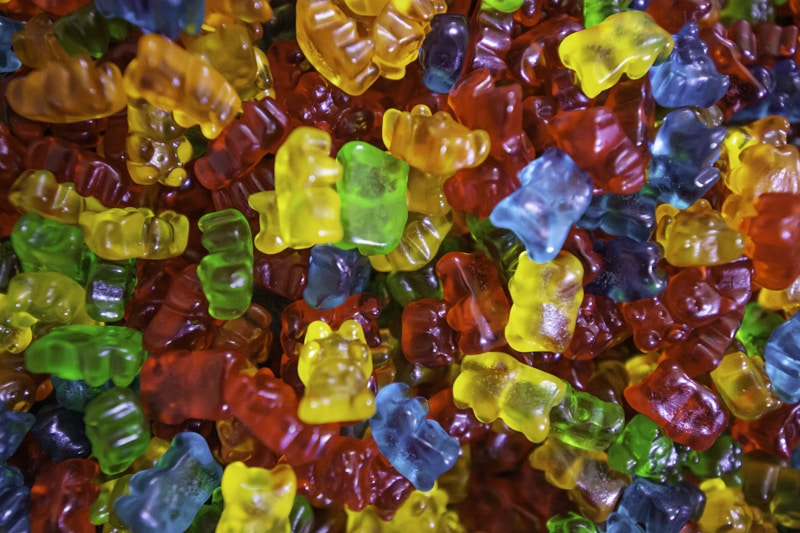
Homemade fruit gummies are made from four things: one cup of real fruit purée or 100% juice, three tablespoons of unflavored gelatin, a tablespoon of lemon juice, and — optionally — a teaspoon or two of honey. You bloom the gelatin in cold purée, warm it just enough to dissolve without ever letting it simmer, pour it into molds, and refrigerate for two hours. The result is a firm, chewy gummy carrying roughly 1.3 grams of added sugar per pouch-size serving, against the 8 to 10 grams in the leading commercial fruit snacks, per those manufacturers' own published labels.
Nobody craves corn syrup. What kids want from a fruit snack is a small bright chewy thing they can eat with their fingers — and that is entirely reproducible. What follows is the recipe, the food science that decides whether it sets, and the part most gummy recipes skip: what "made with real fruit" actually means once you read the ingredient list in order.
This article is educational, not medical or nutrition advice. Talk to your pediatrician about your child's diet, especially with food allergies, feeding concerns, or any medical condition.
Key statistics at a glance
- Corn syrup and sugar are the first two ingredients in Mott's Assorted Fruit Flavored Snacks; fruit appears fourth, fifth, and sixth, as pear, apple, and carrot juice concentrates — Mott's published ingredient list, 2026
- All 9 grams of total sugars in a Mott's pouch are declared as added sugars; the same is true of the 10 grams in an Annie's Organic Berry Patch pouch — manufacturer nutrition labels, 2026
- The FDA's added-sugars definition at 21 CFR 101.9(c)(6)(iii) explicitly counts sugars from concentrated fruit juices in excess of what a same-volume 100% juice would contain — US Food and Drug Administration
- The American Heart Association's 2016 statement in Circulation sets the ceiling at ≤25 g of added sugars per day for ages 2–18, and none at all under age 2 — American Heart Association
- Across 37 studies and 59,383 children and adolescents, the frequency of sugar consumption was a stronger determinant of dental caries than the total quantity — BMC Public Health systematic review, 2026
- Gelatin's gel strength and viscosity are gradually weakened on prolonged heating above roughly 40°C, and further degraded by extremes of pH and by proteolytic enzymes — Gelatin Manufacturers Institute of America, Gelatin Handbook
- GMIA lists 7–9% gelatin at 200–250 Bloom as the standard use level for gummy bear confections — the ratio this recipe lands on — Gelatin Manufacturers Institute of America
- 61.9% of calories consumed by US youth ages 1–18 come from ultra-processed foods, versus 53.0% for adults — CDC/NCHS Data Brief 536, 2025
What "made with real fruit" actually means on a label
There is no FDA regulation setting a minimum fruit content for a "made with real fruit" claim. The percent-juice declaration rule at 21 CFR 101.30 applies to beverages, not to a chewy snack in a pouch. So the phrase is doing marketing work, and the only place to check it is the ingredient list, which by law runs in descending order of weight.
Read in that order, here is what the leading products actually say.
Mott's Assorted Fruit Flavored Snacks. Corn syrup, sugar, modified corn starch, pear juice concentrate, apple juice concentrate, carrot juice concentrate. Two sweeteners and a starch come before anything that was ever a fruit — and the fruit that does appear arrives as juice concentrate. Per the label, one pouch carries 9 g of total sugars and 9 g of added sugars. Every gram of sugar in the product is added sugar.
Fruit Gushers. Corn syrup, sugar, pear purée, modified corn starch, fructose, maltodextrin, palm oil, with grape juice concentrate below the 2% line. Four distinct sweeteners. Ten grams of added sugars per pouch.
Annie's Organic Berry Patch Bunny Fruit Snacks. Organic rice syrup, organic cane sugar, organic tapioca syrup solids, water, organic pear juice concentrate. Organic certification governs how the ingredients were farmed; it says nothing about the sugar arithmetic. All 10 g of total sugars in the 19-gram pouch are added sugars — a pouch that is more than half sugar by weight. To Annie's credit, the label carries its own asterisk: "Made with organic pear juice concentrate and not intended to replace fruit or vegetables in the diet."
Welch's Fruit Snacks, Mixed Fruit. This is the fair exception, and it deserves saying plainly. Whole fruit purée — grape, peach, orange, strawberry, raspberry — is genuinely the first ingredient by weight, ahead of corn syrup and sugar. Welch's says so on its FAQ, and the label backs it. Fruit is doing real work here in a way it is not at Mott's or Gushers. But corn syrup and sugar are still second and third, and of the 10 g of total sugars in a 22.7-gram pouch, 8 g are added. (Welch's has also faced consumer class actions over its nutrition messaging; at least one was dismissed in 2020, with the court finding the labeling not false or misleading. The ingredient list is a better guide than either the lawsuits or the packaging.)
Why juice concentrate is a sweetener, not a fruit
This is the mechanism that lets a product be both technically honest and practically misleading. The FDA's definition at 21 CFR 101.9(c)(6)(iii) says added sugars "include sugars (free, mono and disaccharides), sugars from syrups and honey, and sugars from concentrated fruit or vegetable juices that are in excess of what would be expected from the same volume of 100 percent fruit or vegetable juice of the same type." In other words: concentrate a juice past its natural strength and use it to sweeten something, and the FDA counts the excess as added sugar — because that is what it is.
The more useful line to draw is not a regulatory one, it is a physical one: is the sugar still inside an intact cell? In whole fruit it is, held in a fiber matrix your teeth and gut have to dismantle. Press that fruit into juice and the matrix is gone — the sugar is free in solution, and it behaves in the mouth and the gut much closer to syrup than to an apple, whatever the carton says. Blending sits in between: it ruptures cell walls but keeps the fiber in the glass, which is why a purée lands between an apple and an apple juice rather than neatly with either. The FDA arrived at the same place from the regulatory side, counting fruit juice concentrate as an added sugar. We are less interested in what a body ruled and more interested in what the cell wall is doing.
Pear juice concentrate, apple juice concentrate, white grape concentrate: these are the workhorses of the "no high-fructose corn syrup" reformulation. They are chosen because they are cheap, pale, and nearly flavorless — which is exactly what you want from a sweetener and exactly not what you want from fruit.
| Product | First three ingredients, in order | Labeled serving | Added sugars |
|---|---|---|---|
| Mott's Assorted Fruit Flavored Snacks | Corn syrup, sugar, modified corn starch | 1 pouch (22.7 g) | 9 g — all of its 9 g total sugars |
| Fruit Gushers, strawberry | Corn syrup, sugar, pear purée | 1 pouch | 10 g |
| Annie's Organic Berry Patch Bunny Fruit Snacks | Organic rice syrup, organic cane sugar, organic tapioca syrup solids | 1 pouch (19 g) | 10 g — all of its 10 g total sugars |
| Welch's Fruit Snacks, Mixed Fruit | Whole fruit purée, corn syrup, sugar | 1 pouch (22.7 g) | 8 g of 10 g total sugars |
| Solely Organic Mango Whole Fruit Gummies | Organic mango (the only ingredient) | 1 pouch (20 g) | 0 g |
| This recipe, with 1 tbsp honey | Fruit purée, unflavored gelatin, lemon juice | 22.7 g | ~1.3 g |
| This recipe, no honey | Fruit purée, unflavored gelatin, lemon juice | 22.7 g | 0 g |
| AHA daily limit, ages 2–18 | 25 g |
| Fruit Gushers (1 pouch) | 10 g |
| Annie's Organic Bunny (19 g pouch) | 10 g |
| Mott's Fruit Snacks (22.7 g pouch) | 9 g |
| Welch's Fruit Snacks (22.7 g pouch) | 8 g |
| This recipe, 1 tbsp honey (22.7 g) | 1.3 g |
| Solely whole-fruit gummies (20 g) | 0 g |
The sharper number is not the total but the ratio — how much of each product's sugar the FDA classifies as added rather than intrinsic to fruit.
| Mott's | 100% |
| Annie's Organic | 100% |
| Welch's | 80% |
| This recipe, 1 tbsp honey | 59% |
| This recipe, no honey | 0% |
And the honest caveat on that last bar: honey is an added sugar. The FDA's June 2019 final guidance requires pure honey and pure maple syrup to declare an added-sugars percent Daily Value for exactly that reason. The advantage of making these yourself is not that your sweetener is metabolically free. It is that you decide how much goes in, and you can keep taking it out.
Ingredients
- 1 cup (240 ml) fruit purée — blended fresh or thawed frozen strawberries, raspberries, peaches, mango, cherries, or unsweetened applesauce; or 100% juice (see the note below on juice)
- 3 tablespoons (about 28 g, or four ¼-oz envelopes) unflavored gelatin
- 1 tablespoon (15 ml) fresh lemon juice
- 1–2 teaspoons honey or maple syrup, optional
- 1 pinch fine sea salt, optional
Instructions
- Blend the fruit until completely smooth, then press it through a fine-mesh sieve if you are using berries with seeds. Measure out exactly 1 cup — the gelatin ratio is what sets this, so measure rather than eyeball.
- If you are using fresh pineapple, kiwi, papaya, fig, guava, or ginger, simmer the purée for 5 minutes first and let it cool completely. These fruits carry proteases that will digest the gelatin and leave you with syrup. Freezing does not deactivate them; heat does.
- Pour half the cold purée (½ cup) into a small saucepan. Sprinkle the gelatin evenly across the surface — sprinkle, do not dump — and let it stand undisturbed for 5 to 10 minutes, until it looks like coarse wet sand and has visibly swollen. This is blooming, and it is not optional.
- Set the pan over low heat. Stir constantly for 2 to 3 minutes, only until the granules disappear and the mixture turns smooth and slightly glossy. Keep it below a simmer — steaming at most, roughly 140–150°F. Do not let it bubble.
- Take the pan off the heat. Whisk in the remaining ½ cup of purée, the lemon juice, and the honey and salt if using. Adding the acid off the heat protects the set.
- Skim the foam off the surface with a spoon, or let the mixture rest 2 minutes and skim then. Foam sets into a cloudy top layer.
- Fill silicone molds using a dropper or a small pitcher, or pour into a parchment-lined 8×8-inch pan for cut squares. Work reasonably quickly — the mixture begins thickening as it drops below about 40°C.
- Refrigerate uncovered for at least 2 hours, until fully firm. Overnight gives the firmest chew, because gelatin keeps forming cross-bonds for hours after it looks set.
- Unmold, or lift the slab out by the parchment and cut into ½-inch squares. Store in an airtight container in the refrigerator.
Yield: about 300 g — roughly 60 teaspoon-size gummies, or an 8×8 slab cut into 64 squares. That is about thirteen 22.7-gram servings, the size of a standard fruit-snack pouch.
If you use 100% juice instead of purée: the method is identical and the texture is clearer and glassier, but understand what changed. Pressing the fruit destroyed the cell walls holding the sugar, so it is free in solution even though the carton says 100% juice and the label declares zero added sugars. You also lose the fiber. Purée is the better default; juice is the better-looking one.
Why blooming, low heat, and lemon juice decide whether this works
Three steps in that method are where homemade gummies usually fail, and each has a specific mechanism.
Blooming. Per the Gelatin Manufacturers Institute of America's Gelatin Handbook, "when gelatin granules are soaked in cold water they hydrate into discrete, swollen particles. On being warmed, these swollen particles dissolve to form a solution. This method of preparing gelatin solutions is preferred, especially where high concentrations are desired." The failure mode when you skip it is mechanical: drop dry gelatin into hot liquid and the outside of each granule gels instantly, sealing a dry core inside. Those are the rubbery lumps at the bottom of the pan, and no amount of whisking recovers them.
Why boiling ruins the set. GMIA again: two of gelatin's most useful properties, gel strength and viscosity, "are gradually weakened on prolonged heating in solution above approximately 40°C," and gelatin solutions held at elevated temperatures are "susceptible to hydrolysis." Gelatin gels because long protein chains partially return to collagen-like helices and knit into a three-dimensional network as the solution cools through roughly 35–40°C. Heat cuts those chains shorter. Short chains cannot knit. You get flavored syrup that never firms, and adding more gelatin to a boiled batch does not fix it — you have to start over, cooler.
The corollary is the one people find hardest: if your gummies come out too soft, the answer is usually more time, not more gelatin. GMIA notes that gel strength increases with time as more cross-bonds form. Give a soft batch another six hours in the fridge before you change the recipe.
What the lemon juice is doing. Two jobs. Flavor first: acid sharpens fruit and raises perceived intensity, which is the same reason a squeeze of lemon makes underripe strawberries taste more like strawberries. That perceived lift is what lets you cut the honey rather than add to it — the same logic behind the vanilla, cinnamon, and salt in the other recipes on our food chart.
Second, structure. GMIA notes gel rigidity depends on pH among other factors, and that degradation may be brought about by extremes of pH. Type A gelatin has a broad isoelectric range of pH 7–9; Type B sits between 4.7 and 5.4. One tablespoon of lemon per cup of purée is comfortably inside working range. A whole lemon into an already-tart purée is not, and acid held at heat is worse than acid added cold — which is why step 5 puts it in off the burner.
The ratio, and why it is what it is. GMIA's table of food use levels lists gummy bear confections at 7–9% gelatin, at 200–250 Bloom. Three tablespoons of gelatin in roughly 304 g of finished mixture works out to about 9% — the firm, chewy end of that range. For a softer, more jelly-like bite, drop to 2 tablespoons (about 6%). Supermarket unflavored gelatin does not print its Bloom rating, so treat the first batch as calibration and adjust by a teaspoon in either direction.
Can you make fruit gummies without gelatin?
Yes, and the set behaves differently enough that it is worth knowing before you swap.
Agar-agar is the closest vegetarian and vegan substitute, and its rules are nearly the opposite of gelatin's. Agar needs to reach roughly 85–90°C — a genuine boil, held a minute or two — to hydrate fully, where boiling would have wrecked gelatin. Then it sets as it cools to about 32–38°C, meaning it firms at room temperature and will not melt in a warm hand or on the tongue. The texture is a clean brittle snap rather than an elastic chew: closer to a fruit jelly than to a gummy bear. Start with about 1½ teaspoons of agar powder per cup of purée, boil for 2 minutes, then stir in the lemon juice off the heat, because prolonged heating in acid hydrolyzes agar and weakens the set the same way it does gelatin.
Pectin is what most commercial vegan gummies use, and it splits into two kinds that matter here. High-methoxyl pectin — the standard jam pectin — needs both high sugar (roughly 55–65% soluble solids) and low pH to gel at all. That is a structural reason commercial pectin gummies tend to be sweet: the sugar is not only flavor, it is part of the gelling system. Low-methoxyl pectin gels with calcium instead of sugar, which is how "no sugar added" pectin gummies exist, but it needs a calcium salt weighed reasonably precisely and is a harder home project than agar.
And one more difference that isn't about texture: gelatin is an animal product, manufactured from collagen in pork and beef hides and bones. That matters for vegetarian, vegan, kosher, and halal households, and it is not always obvious from a fruit-snack package. Welch's states in its own FAQ that it uses "either pork or beef gelatin" in its Fruit Snacks, Juicefuls, and Fusions lines without distinguishing which on the package, and lists only its Fruit Strips and Fruit Rolls as vegan. If you need to avoid animal gelatin, the agar version is the one to make.
Are homemade gummies a collagen supplement?
No, and the honest version of this answer has three parts.
Gelatin is not hydrolyzed collagen peptides. They share an origin and not much else structurally. Per GMIA, gelatin is a mixture of fragments ranging in molecular mass from 15,000 to 400,000 daltons. The collagen hydrolysates used in supplement trials are far smaller — a 2024 randomized, double-blind crossover study in Frontiers in Nutrition by Virgilio, Schön and colleagues tested bovine hydrolysates at 2,000 and 5,000 daltons and found all of them delivered measurable plasma hydroxyproline. Gelatin is the intact gelling protein; peptides are what you get after further enzymatic breakdown. A gummy needs the first, precisely because it gels.
The skin evidence for the supplement is weak, and read what that actually indicts. A 2025 systematic review and meta-analysis in The American Journal of Medicine by Myung and Park pooled 23 randomized controlled trials with 1,474 participants. In the overall analysis, collagen supplements significantly improved skin hydration, elasticity, and wrinkles. But when the authors separated the trials by quality and funding, the effect vanished: no benefit in the high-quality studies, and no benefit in the studies not funded by supplement or pharmaceutical companies. That is a serious finding and we are not going to soften it.
We are going to be precise about what it applies to. Every trial in that review tested a manufactured isolate — enzymatically hydrolyzed peptides, milled to a target molecular weight, sold in a tub. When the industry-funded studies are removed and the effect disappears, the honest reading is that a processed extract sold on a skin-aging promise did not deliver on that promise. It is not evidence against the food it was extracted from, because the food was never in the trial.
Our position is the older one: the best form of collagen is gelatin, and the best form of gelatin is the one that comes out of simmering bones and connective tissue for hours — the thing every traditional kitchen on earth arrived at independently, long before anyone isolated a peptide from it. A broth that gels on the counter is the whole intact protein with the minerals and amino acids it came packaged with, not a fraction of it milled to a spec. Nobody has run a randomized trial on that, and the absence of a trial is not a finding. It is an absence.
So: we are not making a skin claim for these gummies, because we would be borrowing credibility from research that tested a different substance. We are also not accepting "collagen doesn't work" as the takeaway, because the studies were run on the supplement-industry version of it.
The joint evidence is genuinely better, and still not about gummies. A 2024 trial sequential meta-analysis in Osteoarthritis and Cartilage by Liang and colleagues pooled 35 randomized trials covering 3,165 patients with osteoarthritis and found small-to-moderate effects on pain and physical function, with no increase in adverse events or withdrawals. Common trial dosing sits around 10 g of collagen peptides daily, taken every day for months.
Put the arithmetic against that. Gelatin is essentially pure protein — GMIA gives it 8–13% moisture and nothing else of consequence — so a full batch of these gummies contains about 25 g of gelatin protein, and a 50-gram portion of about ten gummies delivers roughly 4 g. That is not nothing. It is also less than half a typical trial dose, of a different and much larger molecule, in a food you would eat occasionally rather than daily.
Make these because they taste good, the sugar arithmetic is better, and gelatin is real food. Do not make them as a supplement — and if you want gelatin as a staple rather than a treat, make broth.
Are homemade fruit gummies better for your teeth?
Somewhat. Not the way most people assume, and it is worth getting the mechanism right because the folk version is wrong in an interesting way.
Tooth decay is the most common chronic disease of childhood, and it is one of the few places where the sugar evidence is genuinely strong rather than suggestive. The standard public-health answer is a ceiling: hold sugars under 10% of daily calories, ideally under 5%. Ceilings are easy to publish and nearly impossible to act on — almost nobody knows what percentage of their calories came from sugar yesterday, and a number you cannot measure is not a lever you can pull.
Now the part people get backwards. The intuition that gummies glue themselves to enamel and sit there is not well supported. In a 1991 study in the Journal of Dental Research, Kashket, Van Houte and colleagues compared consumer ratings of stickiness for 21 commercial foods against objective measurement of how much was actually retained on the teeth, and found no correlation between the two. Cookies, crackers, and potato chips were the most retentive foods tested; caramels, jelly beans, raisins, and milk chocolate bars were among the least retained. Starchy foods hung around; the candy cleared.
What does hold up is frequency. A 2026 systematic review in BMC Public Health covering 37 studies and 59,383 participants aged 2 to 18 found that 86% of the included studies reported a statistically significant positive association between sugar consumption and caries — and that the frequency of sugar consumption was consistently a stronger determinant of caries development than the total quantity consumed. Moynihan's 2016 review in Advances in Nutrition, the evidence base underneath most of those percentage ceilings, reaches a compatible conclusion: limiting sugars reduces caries but does not eliminate them, and frequency of exposure is the lever families can actually pull. That is the finding worth carrying home, and it is the one that gets left out of the headline — how often beats how much. One dessert eaten in one sitting is a smaller insult to teeth than the same sugar grazed across six hours, and no percentage-of-calories target will ever tell you that.
So the honest position on these gummies: they are still sticky sugar, and they still count as a free-sugar exposure. They are not tooth-safe, and nothing you make in a kitchen is. What genuinely changes is the amount of added sugar per serving and the absence of corn syrup — and what changes more is the pattern. Ten gummies at one sitting, followed by brushing, is a different exposure from a pouch grazed across an afternoon. Consistency over intensity applies to teeth as literally as to anything else.
How long do homemade fruit gummies keep?
Seven to ten days in an airtight container in the refrigerator, and the reason is worth understanding rather than memorizing.
Commercial gummies last months because they are cured — dried over days in starch molds until water activity drops low enough to stop microbial growth — and then coated in carnauba wax, which appears on nearly every fruit-snack label above. Yours are not dried and not waxed. They are a fresh, high-moisture, protein-containing food.
GMIA is direct about the consequence: gelatin solutions and gels can be degraded by bacteria, yeasts, and molds, diminishing both gel strength and viscosity, and pH governs which. Below pH 4 bacterial growth is suppressed but yeasts and molds grow abundantly — which is exactly the pH range an acidic fruit purée sits in. Sterile gelatin solutions stored cold are stable indefinitely; a home kitchen is not sterile.
Practically: keep them cold, keep them covered, and discard at the first sign of a slick surface film, fuzz, or an off smell. They also freeze well for about three months — freeze them in a single layer on a tray first so they don't fuse, then bag them. Frozen gummies thaw in about 15 minutes and, if anything, chew better cold.
A safety note for young children
Small, firm, round candies are a recognized choking hazard, and gummies are named specifically.
The American Academy of Pediatrics' policy statement Prevention of Choking Among Children lists hard candy, nuts, seeds, whole grapes, chunks of peanut butter, popcorn, caramels, and "gum drops and gummy candies, or other gooey or sticky candy" among high-risk foods, and advises against giving children younger than 4 any round, firm food unless it has been cut into very small pieces. The risk depends on the shape, size, and consistency of the item combined with the child's developmental stage — children under 4 have not finished getting their molars or learning to grind food.
Practically, for this recipe: for children under 4, pour the mixture into the 8×8 pan and cut small flat squares rather than using bear- or ball-shaped molds, or cut set gummies into pieces smaller than a pea. Keep young children seated and supervised while eating. And if you have any doubt about a particular child, this is a snack that waits.
What this actually changes
Not much on any single day, which is the point. One pouch of anything is not the story. Per CDC/NCHS Data Brief 536, published August 2025, US youth ages 1–18 take 61.9% of their calories from ultra-processed foods against 53.0% for adults. Fruit snacks are one small line in that column, and moving one line does not move a diet. What accumulates over years is the terrain — the internal environment being built out of whatever the everyday pattern supplies, which our guide to root-cause health and your internal environment works through in more depth.
What it does do is change a default. A jar of real-fruit gummies at eye level in the fridge is easier than a negotiation, and it is investigative rather than restrictive — you are not removing a food, you are rebuilding it. That is the same logic behind the rest of our healthier Halloween candy swaps, and the same reason cravings are worth reading as signals about what a snack is supposed to deliver — sweet, chewy, portable, and quick — rather than as anything to be argued with. If you want that structured rather than improvised, the Sakred app is built to hold exactly this kind of small daily consistency.
Frequently asked questions
Why won't my homemade gummies set? Three causes, in order of likelihood. You boiled the mixture — per GMIA, gel strength weakens on prolonged heating above about 40°C, and no amount of extra gelatin repairs a hydrolyzed batch. You used a fresh protease-carrying fruit — pineapple, kiwi, papaya, fig, guava, or ginger — without simmering the purée first; freezing does not deactivate those enzymes. Or you simply have not waited long enough: gelatin keeps forming cross-bonds for hours, so give a soft batch overnight before changing anything.
Can I make fruit gummies without any added sugar? Yes. Leave out the honey entirely and use a naturally sweet purée — ripe mango, strawberry, or unsweetened applesauce. A tablespoon of lemon juice and a pinch of salt raise the perceived sweetness of what is already there, which is why both are in the ingredient list. The result still contains the fruit's own sugars, but zero added sugars by the FDA's definition. If you do use honey or maple syrup, note that FDA's 2019 final guidance classifies both as added sugars on the Nutrition Facts label.
How much gelatin do I need per cup of liquid? Three tablespoons (about 28 g) per cup of purée gives a firm gummy-bear chew, working out to roughly 9% gelatin by weight of the finished mixture — the top of the 7–9% range GMIA lists for gummy bear confections. Two tablespoons gives a softer, more jelly-like set. Supermarket gelatin does not print its Bloom rating, so treat your first batch as a calibration and adjust by a teaspoon.
Are store-bought fruit snacks made with real fruit actually healthy? Read the ingredient list in order rather than the front of the package. In Mott's Fruit Flavored Snacks, corn syrup and sugar precede any fruit and the fruit arrives as juice concentrate; all 9 g of sugar in a pouch is added sugar. Welch's does put whole fruit purée first, which is a genuine difference, but corn syrup and sugar follow immediately and 8 of its 10 g of sugars are added. A few products — Solely's whole-fruit gummies are one — really are just fruit, with zero added sugars. The claim on the front tells you almost nothing; the order on the back tells you most of it.
Sources
- US Food and Drug Administration / eCFR — 21 CFR 101.9(c)(6)(iii), definition of added sugars
- US Food and Drug Administration — Guidance for Industry: Declaration of Added Sugars on Honey, Maple Syrup, Other Single-Ingredient Sugars and Syrups, and Certain Cranberry Products (2019)
- US Food and Drug Administration / eCFR — 21 CFR 101.30, percentage juice declaration for beverages
- Mott's — Assorted Fruit Flavored Snacks, published ingredient list and nutrition facts
- Welch's Fruit Snacks — Mixed Fruit product page, ingredient list
- Welch's Fruit Snacks — FAQ, gelatin source and vegan/halal product list
- Annie's Homegrown — Organic Berry Patch Bunny Fruit Snacks, ingredient list and nutrition facts
- Solely — Organic Mango Whole Fruit Gummies, single-ingredient product page
- Gelatin Manufacturers Institute of America — GMIA Gelatin Handbook
- American Heart Association / Circulation — Added Sugars and Cardiovascular Disease Risk in Children: A Scientific Statement (2016)
- Advances in Nutrition — Effect on Caries of Restricting Sugars Intake, Moynihan (2016)
- BMC Public Health — Impact of Sugar Consumption on Dental Caries in Children and Adolescents: A Systematic Review of Frequency Versus Quantity (2026)
- Advances in Nutrition — Moynihan, Sugars and Dental Caries: Evidence for Setting a Recommended Threshold for Intake (2016)
- Journal of Dental Research — Kashket, Van Houte, Lopez & Stocks, Lack of Correlation Between Food Retention on the Human Dentition and Consumer Perception of Food Stickiness (1991)
- The American Journal of Medicine — Myung & Park, Effects of Collagen Supplements on Skin Aging: A Systematic Review and Meta-Analysis of Randomized Controlled Trials (2025)
- Osteoarthritis and Cartilage — Liang, Cheng, Lee, Liao & Huang, Efficacy and Safety of Collagen Derivatives for Osteoarthritis: A Trial Sequential Meta-analysis (2024)
- Frontiers in Nutrition — Absorption of Bioactive Peptides Following Collagen Hydrolysate Intake: A Randomized, Double-Blind Crossover Study in Healthy Individuals (2024)
- American Academy of Pediatrics — Policy Statement: Prevention of Choking Among Children (2010)
- CDC/NCHS — Data Brief 536: Ultra-processed Food Consumption in Youth and Adults, United States, August 2021–August 2023 (2025)
- McGill University Office for Science and Society — Why Can't I Use Fresh Pineapple to Make Jell-O?
- USDA FoodData Central — Strawberries, raw; Honey
- Top Class Actions — Court Refuses to Revive False Advertising Class Action Over Welch's Fruit Snack Labeling (2020)