Baked Apple Cider Donuts That Actually Taste Like Cider
Reduce two cups of cider to a quarter cup and you get real apple flavor without a bottle of syrup. About 10 grams of added sugar per donut, no fryer — plus the 2025 synchrotron study that found most of a donut's oil goes in after it leaves the pot.

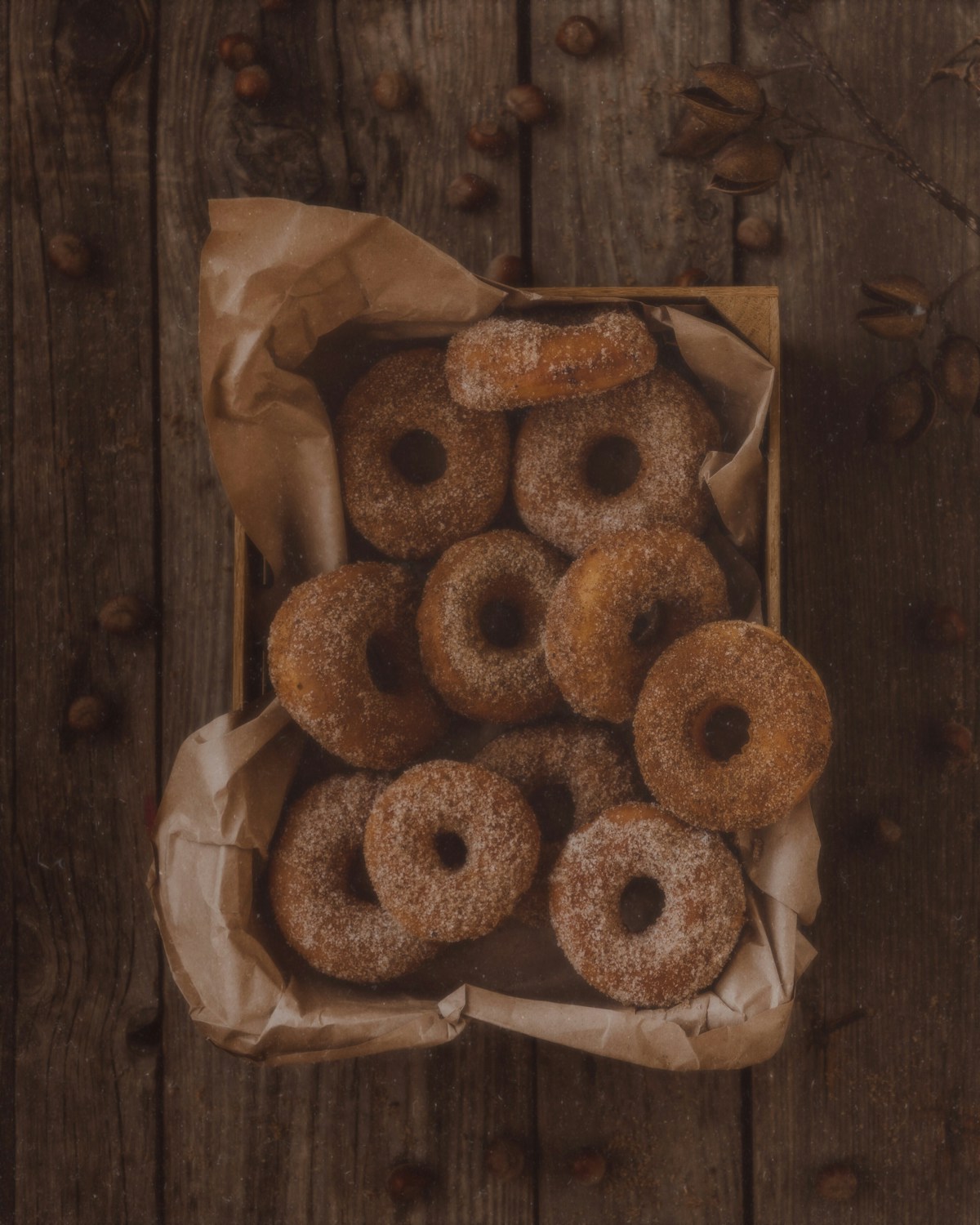
Baked apple cider donuts get their flavor from cider that has been simmered down to one-eighth of its volume — two cups of fresh cider reduced to a quarter cup of dark, concentrated syrup — rather than from apple flavoring or a larger pour of sugar. Built on white whole wheat flour, applesauce, yogurt and egg, baked in a donut pan at 350°F, they come out at roughly 10 grams of added sugar and 160 calories per donut with about 5 grams of fat, because nothing goes in the fryer.
The reduction is the whole trick, and it is worth understanding why it works: concentrating cider does not remove any sugar. It multiplies the flavor per gram of sugar you were going to eat anyway. That distinction is the honest version of this recipe, and the rest of this piece explains it — along with what a commercial cider donut actually contains (harder to answer than it should be), and what a 2025 synchrotron imaging study revealed about when frying oil actually enters a donut.
This article is educational, not medical or nutrition advice. Talk to your doctor before making dietary changes, especially if you're pregnant, nursing, managing blood sugar, or taking medication.
Key statistics at a glance
Cider was preservation before it was a flavour
Worth knowing, because it explains why the reduction step in this recipe is doing real work rather than being a fussy extra.
Pressing apples was how you kept an orchard's harvest from rotting. Fresh apples last weeks; cider lasts, and fermented cider lasts far longer — which is why it was a staple drink across medieval England and colonial America, often in preference to water. Boiling cider down further was the same instinct taken one step: reduce it, and you get a thick, keeping syrup that was a household sweetener long before refined sugar was cheap enough for ordinary kitchens.
So the cider reduction here is not a modern trick to cut sugar. It is closer to the original use of the apple — concentrating the fruit's own sweetness and acidity into something with enough flavour to carry a whole batch. What changed in the commercial version is that cane sugar was added on top of a thing that was already sweet, and then the reduction step was dropped because it takes twenty minutes and sugar is cheaper.
Commercial versus homemade
The uncomfortable part of building this table is that one column cannot be filled in honestly.
| Per donut | Chain cider donut (Dunkin') | USDA generic cake doughnut, 60 g | This baked version, 1 of 12 |
|---|---|---|---|
| Calories | 320–380, sources disagree | 260 | ~160 |
| Total fat | 18–22 g | 15 g | ~5 g |
| Total sugars | not published | 11 g | ~11 g |
| Added sugars | not published | not reported | ~10 g |
| Fiber | ~1 g | ~1 g | ~2 g |
| Fried | yes | yes | no |
Homemade figures are calculated from USDA values for the listed ingredients, not laboratory-analyzed. They are estimates, and they are the only numbers here you can actually change.
Why nobody can tell you the sugar in a store cider donut
This is a small story about transparency, and it is more interesting than a scary number would have been.
Dunkin' publishes downloadable nutrition and allergen documents but does not display per-item sugar detail for its seasonal Apple Cider Donut on the menu page. So the figures circulating online come from third-party aggregators — and they disagree with each other. One widely cited database lists the donut at 380 calories, 22 g fat, 41 g carbohydrate, with no sugar line at all and a page last updated in 2020. Another lists 320 calories, 18 g fat, 37 g carbohydrate and 15 g total sugars. Neither reports added sugars, the line the FDA requires on packaged food precisely because it is the number that matters.
Restaurant menu items are not packaged foods, so that added-sugars disclosure does not apply. The practical result: for a food whose entire identity is sweetness, the sweetness is the one thing you cannot look up. Orchard and farmstand donuts — the ones most people actually associate with the phrase — have no published nutrition data at all.
We are not going to invent a figure to fill the gap. What is documented is the category: a plain 60-gram cake doughnut carries about 260 calories, 15 g fat and 11 g total sugars per USDA's database, before any cinnamon-sugar coating. Cider donuts are coated. So the real answer is "more than that, by an amount nobody has published."
What the 2025 X-ray study found about frying
Here is the part of donut science that changed recently, and it reframes what "baked instead of fried" is actually buying you.
Verma, Riley, Lukić and colleagues at KU Leuven imaged deep-frying as it happened, using fast synchrotron tomography at the European Synchrotron Radiation Facility in Grenoble — a beam roughly 100 billion times brighter than hospital X-rays — and published the results in Nature Communications in March 2025. Their model food was wheat flour dough rather than a finished donut, imaged in three spatial dimensions across time, both during frying and through the cooling that followed. The finding: most oil does not enter while the food is in the fryer. It enters afterward, as the food cools. Escaping steam holds oil out during frying; once the dough leaves the pot and its interior vapor condenses, the resulting pressure drop pulls oil inward through the crust by capillary action.
The temperature result is the counterintuitive one. Final oil content came out at 14.4% at 180°C, 12.2% at 150°C, and 1.3% at 120°C — hotter frying absorbed roughly eleven times the oil of the coolest condition. The mechanism is pore size: a hotter oil bath sets a harder crust with smaller pores, and smaller pores generate stronger capillary suction during cooling. "Fry it hot so it doesn't get greasy" is folk wisdom this imaging does not support in the way it is usually meant.
| 120°C | 1.3% |
| 150°C | 12.2% |
| 180°C | 14.4% |
None of that is an argument that fried food is dangerous. It is an argument about where the fat in a fried donut comes from — a physical process during cooling, not an inherent property of dough. A baked donut skips the process entirely, which is why the fat column above drops from roughly 20 grams to roughly 5. The 15-gram difference is not virtue. It is capillary pressure that never happened.
About the sweetener
Both versions use real sugar. That is not the difference, and saying otherwise invites an easy correction — the commercial product is sweetened with cane sugar, not an artificial sweetener.
What differs is the amount, and what the sugar arrives inside. Pure maple syrup and coconut sugar are minimally processed foods rather than refined syrup blends, and they carry trace minerals — but their fiber is gone, and FDA counts both as added sugars. We are not going to tell you they are metabolically free. Coconut sugar in particular is roughly 70–80% sucrose, and its widely repeated low-GI figure rests on a single small analysis that has not replicated well.
Where a recipe can use whole dates instead, the fiber stays attached and that genuinely does change the glycemic response — five date varieties tested in healthy and diabetic subjects measured a glycemic index of about 44 to 55 despite being over 70% sugar (Alkaabi et al., Nutrition Journal, 2011). Full breakdown of which sugar substitute is actually healthiest.
Ingredients
- 2 cups fresh apple cider (reduces to about 1/4 cup)
- 1 3/4 cups white whole wheat flour
- 1 1/2 teaspoons ground cinnamon
- 1/2 teaspoon freshly grated nutmeg
- 1/4 teaspoon ground allspice
- 1 teaspoon baking powder
- 1/2 teaspoon baking soda
- 1/2 teaspoon fine sea salt
- 1/4 cup pure maple syrup
- 1/2 cup unsweetened applesauce
- 1/4 cup plain whole-milk Greek yogurt
- 3 tablespoons melted unsalted butter, or extra-virgin olive oil
- 1 large egg, room temperature
- 2 teaspoons vanilla extract
- 2 tablespoons melted butter, for the coating
- 2 tablespoons coconut sugar, for the coating
- 1 1/2 teaspoons ground cinnamon, for the coating
Instructions
- Pour the cider into a wide saucepan and simmer over medium heat, uncovered, until it reduces to about 1/4 cup — roughly 25 to 35 minutes. A wide pan matters more than high heat; surface area drives evaporation. It should coat a spoon and smell like concentrated apple, not caramel.
- Cool the reduced cider to room temperature. Hot cider will scramble the egg and melt the leavening's timing.
- Heat the oven to 350°F and grease a 12-cavity donut pan thoroughly, including the center posts.
- Whisk the flour, cinnamon, nutmeg, allspice, baking powder, baking soda and salt in a large bowl.
- In a second bowl, whisk the cooled cider reduction, maple syrup, applesauce, yogurt, melted butter, egg and vanilla until completely smooth.
- Pour the wet mixture into the dry and fold with a spatula just until no dry flour remains. Stop there — overmixing develops gluten and turns cake donuts rubbery.
- Transfer the batter to a piping bag or a zip-top bag with a corner cut off, and fill each cavity about two-thirds full. Spooning works but leaves lumpy tops.
- Bake 11 to 13 minutes, until the donuts spring back when pressed lightly and a tester comes out clean.
- Cool in the pan 4 to 5 minutes, then turn out onto a rack. They must be warm, not hot, for the coating to stick without melting into a glaze.
- Stir the coconut sugar and cinnamon together in a shallow bowl. Brush each warm donut lightly with melted butter, then press both sides into the cinnamon sugar.
- Serve the same day. Store leftovers airtight at room temperature up to 2 days; the coating softens overnight.
Does reducing cider make it healthier?
No, and this is where most recipes quietly mislead.
One cup of 100% apple cider or juice contains about 24 grams of sugar per USDA data. Simmer eight cups down to one and you have not removed a single gram — you have removed water. A tablespoon of properly reduced cider carries roughly 10 to 12 grams of sugar, which puts it in the same neighborhood as a tablespoon of maple syrup (about 12 g).
The FDA is explicit about this in its labeling rules. Sugars from concentrated fruit juice count as added sugars when they exceed what you would expect from the same volume of 100% juice of that type — that is, when the concentrate is functioning as a sweetener rather than as juice. Boiled cider used to sweeten a donut is functioning as a sweetener.
So what does the reduction actually buy? Flavor density. Apple flavor lives in volatile aromatic compounds and acids that survive concentration, while the sweetness stays proportional. A quarter cup of reduced cider delivers the aroma of two cups of cider while occupying a quarter cup of the recipe's liquid. That is why the maple syrup here can stay at a quarter cup instead of the half or three-quarters cup a typical cake donut recipe calls for: the donut tastes strongly of apple, so it does not need to lean on sweetness to taste like something.
Maple syrup, coconut sugar, honey, agave and date syrup are all added sugars, and the FDA counts them as such. Nothing in this recipe is metabolically free. What changes is that you set the number. Our guide to inflammatory foods and what to eat instead covers where added sugar sits among the patterns worth adjusting, and the food chart breaks down where common sweeteners land.
How much sugar is 10 grams per donut, in context?
The 2025–2030 Dietary Guidelines for Americans keep the recommendation to hold added sugars under 10% of daily calories and, for the first time, add practical per-occasion framing around roughly 10 grams of added sugar per meal or snack. The American Heart Association's separate limits are 25 grams a day for women and 36 for men.
One donut here lands at about 10 grams — a real snack, counted honestly, that fits inside those numbers rather than consuming most of the day's allowance in one bite. Two donuts is 20 grams, and that is a choice rather than an accident, which is the entire point of controlling the recipe.
For broader context: CDC's National Center for Health Statistics reported that ultra-processed foods supply 53.0% of calories for US adults. A donut you baked from cider, flour, egg and yogurt is not ultra-processed food. It is a dessert. Those are different categories, and conflating them is how people end up believing that dessert is the problem.
Why do baked donuts taste different from fried ones?
Because they are, structurally, small cakes — and pretending otherwise sets you up for disappointment.
Frying at around 175–190°C drives rapid surface dehydration and Maillard browning in under two minutes, producing that thin, crisp shell with an abrupt transition to soft interior. A 350°F oven works slower and from all sides at once, so the crust is thinner, softer and more uniform. You get tenderness and warm spice; you do not get the crackle.
Three things narrow the gap:
- Coat while warm. The cinnamon sugar must go on when the donut is warm enough for butter to cling but cool enough not to dissolve the sugar into syrup — roughly the 4-to-5-minute window in step 9.
- Use the butter, not oil, for the coating. Butter's milk solids brown slightly on contact with the warm surface and contribute the aroma a fried crust would have delivered.
- Do not skip the salt. Salt suppresses bitterness perception, which raises perceived sweetness — a documented effect in taste research, and the reason a half teaspoon of salt lets you use less sweetener without the donut tasting flat. Vanilla does similar work: odors associated with sweetness measurably increase sweetness ratings of the same solution.
Can you make them dairy-free or gluten-free?
Dairy-free is straightforward. Swap the yogurt for a thick unsweetened coconut or almond yogurt and use extra-virgin olive oil or melted unrefined coconut oil in the batter and for brushing. You lose the browning contribution of milk solids in the coating step, so add an extra pinch of salt to the cinnamon sugar.
Gluten-free is harder and worth being honest about. A 1:1 gluten-free baking blend containing xanthan gum works, but the batter needs to rest 15 minutes before piping so the starches hydrate, and the donuts are noticeably more fragile coming out of the pan. Let them cool a full 8 minutes before turning out rather than 4.
The whole wheat flour is doing real work beyond fiber here. Whole-grain intake is one of the better-supported associations in nutrition epidemiology — large meta-analyses link higher consumption with lower cardiovascular and all-cause mortality — though these are observational studies, and a donut is not where anyone's whole-grain intake should be decided. It contributes about 2 grams of fiber per donut. That is a genuine improvement over 1, and it is not a health claim.
Nobody actually craves corn syrup. What people want on an October morning is warm spice, a soft crumb and something that tastes like an orchard. All of that survives the swap — you just decide the number instead of inheriting it. The Sakred app is where we track seasonal swaps like this one.
Frequently asked questions
How long does boiled cider keep?
Refrigerated in a clean sealed jar, reduced cider keeps for several months — its sugar concentration and acidity make it inhospitable to microbial growth, the same principle that preserves syrup and jam. Make a double batch while the pan is already going; it is excellent stirred into oatmeal, vinaigrettes, or a cup of hot water. If it crystallizes or thickens in the cold, warm the jar in hot tap water before measuring.
Can I use apple juice instead of cider?
You can, but it will taste flatter. Fresh unfiltered cider carries suspended apple solids and more of the tannins and organic acids that give the reduction its depth; filtered, pasteurized juice has been stripped of much of that. Both contain about the same sugar. If juice is what you have, add a teaspoon of apple cider vinegar to the reduction near the end to restore some acidity.
Can I make these without a donut pan?
Yes — the batter bakes well as muffins, 12 to 14 in a standard tin at 350°F for 16 to 18 minutes. They are not donuts, and the surface-to-volume ratio that makes a donut work is exactly what you lose, so the cinnamon-sugar coating covers proportionally less of each one. A mini muffin tin gets closer, at 9 to 11 minutes.
Is 10 grams of added sugar per donut actually low?
It is roughly half of a typical published cake donut recipe and a fraction of a coated commercial one, but it is not low in absolute terms — it is about 40% of the AHA's daily limit for women. The honest framing is that this is a dessert with a known number rather than an unknown one. Anyone managing blood sugar should treat it as dessert and talk to their clinician, not treat it as a health food because it contains applesauce.
Sources
- Nature Communications — Verma, Riley, Lukić et al., High-speed computed tomography to visualise the 3D microstructural dynamics of oil uptake in deep-fried foods (March 2025)
- European Synchrotron Radiation Facility — Scientists find ways to reduce oil intake in deep fried foods (2025)
- KU Leuven — Researchers capture how oil is absorbed in our deep-fried snacks (2025)
- FDA — Nutrition and Supplement Facts Labels: Questions and Answers Related to the Compliance Date, Added Sugars, and Declaration of Quantitative Amounts of Vitamins and Minerals (final guidance)
- FDA — Guidance for Industry: Declaration of Added Sugars on Honey, Maple Syrup, Other Single-Ingredient Sugars and Syrups, and Certain Cranberry Products (2019)
- HHS & USDA — Dietary Guidelines for Americans, 2025–2030 (January 2026)
- American Heart Association — How Much Sugar Is Too Much? (reviewed May 2026)
- CDC/NCHS — Data Brief 536, Ultra-processed Food Consumption in Youth and Adults: United States, August 2021–August 2023 (2025)
- USDA FoodData Central — Doughnut, cake type, plain (nutrient profile)
- USDA FoodData Central — Apple juice, canned or bottled, unsweetened (nutrient profile)
- Dunkin' — Nutrition and allergen information
- MyFoodDiary — Dunkin' Apple Cider Donut nutrition facts
- FastFoodNutrition — Dunkin' Apple Cider Donut nutrition facts (updated 2020)
- Wikipedia — Boiled cider (history and 7:1 reduction convention)
- King Arthur Baking — Vermont Boiled Cider
- Nature — Breslin & Beauchamp, Salt enhances flavour by suppressing bitterness (1997)
- Perceptual and Motor Skills — Sakai et al., Enhancement of Sweetness Ratings of Aspartame by a Vanilla Odor (2001)
- BMJ — Aune et al., Whole grain consumption and risk of cardiovascular disease, cancer, and all cause and cause specific mortality (2016)