Date Caramel Apples, and the Food Safety Story Behind the Stick
A four-ingredient date caramel with no corn syrup and no added sugar — plus the CDC outbreak and the mBio study that explain why a caramel apple with a stick in it belongs in the refrigerator.

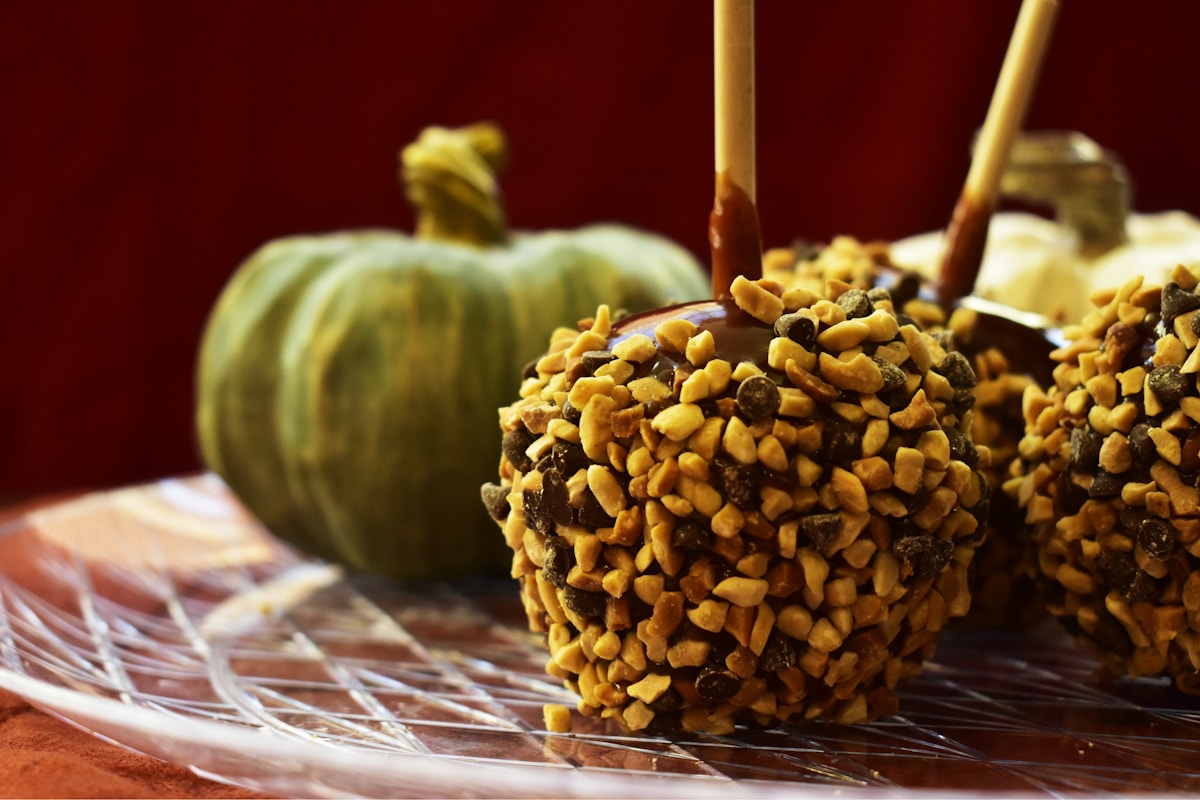
Date caramel apples are made by blending soaked Medjool dates with nut butter, coconut oil, vanilla and salt into a thick, glossy caramel, then dipping chilled small apples on sticks. The coating contains no corn syrup, no hydrogenated oil, and zero added sugar by the FDA's definition, since whole dates keep their fruit matrix intact. Each apple lands around 33 grams of total sugar and 5 grams of fiber.
Read that number again, because most recipes in this category will not print it: this is not a low-sugar food. It is a fruit dessert with real fiber and no industrial sweetener, which is a different and more defensible claim. There is also a second thing almost nobody covering caramel apples mentions, and it is the more important half of this article — the reason a caramel apple with a stick in it needs to live in your refrigerator.
This article is educational, not medical or nutrition advice. Talk to your doctor before making dietary changes, especially if you're pregnant, nursing, managing blood sugar, or taking medication.
Key statistics at a glance
Commercial versus homemade
| Per apple | Happy Apple caramel apple | Tastee caramel apple, 3.5 oz | This date caramel version |
|---|---|---|---|
| Calories | 240 | 210 | ~230 |
| First caramel ingredient | corn syrup | corn syrup | Medjool dates |
| Added sugars | yes — corn syrup, sugar, sweetened condensed milk | yes — corn syrup, cane sugar, sucrose | none |
| Hydrogenated oil | yes | yes | no |
| Fiber | ~2 g | ~2 g | ~5 g |
| Needs refrigeration | yes | yes | yes, more so |
Homemade figures are calculated from USDA values for the listed ingredients, not laboratory-analyzed.
The date was the caramel, long before caramel existed
Caramel, strictly, is sugar cooked past about 120°C until it browns and thickens. That requires refined sugar in quantity — which for most of human history was either unavailable or too expensive to boil down for texture. The caramel apple is a modern confection built on cheap industrial sugar.
The thing it imitates is much older. Across the Middle East and North Africa, dates and date syrup were the default sweetener for thousands of years — the "honey" referred to in many ancient texts is date honey, not bee honey. Dates gave you the same things caramel is prized for: deep sweetness, a dark toffee note, and a thick sticky body that clings to whatever you dip in it. They gave you those things as a fruit, with fibre and potassium and magnesium still attached, and without a pan or a thermometer.
So date caramel is not a substitute for the real thing. It is closer to the original solution to the same problem — how do you get something sweet and sticky onto a piece of fruit — arrived at by people who did not have a sugar refinery and did not need one.
The texture difference below follows directly from that, and it is worth understanding rather than fighting: sugar caramel sets hard because cooked sucrose forms a glassy matrix. Date caramel stays soft because it is fruit purée thickened by chilled coconut oil. You are not getting a shatter. You are getting something closer to dulce de leche, on an apple, made of apples' older companion.
The part about the stick
In late 2014, CDC investigated a multistate outbreak of listeriosis that eventually counted 35 cases across 12 states. Thirty-four of those patients — 97% — were hospitalized. Listeriosis contributed to at least three of seven reported deaths. The source was traced to commercially produced, prepackaged caramel apples made from Granny Smith and Gala apples packed by Bidart Bros. of Bakersfield, California, which recalled its 2014 apples after environmental testing at the packing facility found Listeria monocytogenes.
The obvious question at the time was why caramel apples, of all things. Whole apples are acidic and low in available water; caramel is a high-sugar, low-water-activity confection. Neither should be a good home for bacteria. Researchers at the University of Wisconsin–Madison answered it the following year in mBio.
Glass and colleagues inoculated Granny Smith apples with outbreak strains of Listeria monocytogenes, then dipped them in hot caramel at 95°C. Half of the apples had wooden sticks inserted about 5 cm into the core first; half were left intact. Both groups were stored at either 25°C (room temperature) or 7°C (refrigeration) for up to four weeks — 144 apples across three trials.
| Room temp, stick — 3 days | 3.6 |
| Refrigerated, stick — 4 wks | 1.9 |
| Room temp, no stick — 3 days | 0.3 |
| Refrigerated, no stick — 4 wks | 0 |
At room temperature with a stick, Listeria increased by more than 3 log₁₀ CFU — over a thousandfold — within three days. Without a stick, the same apples at the same temperature gained only 0.3 log₁₀ over three days. Refrigerated and stick-free, there was no detectable growth at all across four weeks.
The mechanism the authors proposed is elegant and slightly unsettling: pushing the stick in accelerates juice migration from the apple's interior out to the surface, where it is sealed under the caramel. That thin film of apple juice trapped at the caramel–apple interface has raised water activity, and the caramel buffers the apple's acidity. The two ingredients are each inhospitable. The interface between them is not.
Their conclusion is the line worth keeping: interfaces between food components can create unexpected growth niches. A caramel apple is not a caramel plus an apple. It is a third thing.
What this means for the recipe below
Everything above applies more to homemade date caramel, not less. Commercial caramel is a cooked, high-sugar, low-moisture confection. Date caramel is blended fruit purée thinned with water — its water activity is considerably higher, and it has not been heated to 95°C. It is a better environment for microbial growth than the commercial coating in the study.
So the rules here are firm, and they are not garnish:
- Refrigerate immediately after dipping, and keep them refrigerated until eaten.
- Eat within two days. Not two weeks.
- Do not leave them out on a table at a party for hours. This is the exact scenario the room-temperature arm of that study modeled.
- Wash and dry apples thoroughly before dipping. Listeria contamination in the outbreak was on the apple surface, from the packing environment — before any caramel touched it.
- If you are pregnant, over 65, or immunocompromised, listeriosis is materially more dangerous for you. CDC's guidance for those groups is worth reading directly.
None of this makes caramel apples dangerous to make at home. It makes them a refrigerated food, which is how the FDA and state agencies have treated commercially produced ones since 2015.
About the sweetener
Both versions use real sugar. That is not the difference, and saying otherwise invites an easy correction — the commercial product is sweetened with cane sugar, not an artificial sweetener.
What differs is what the sugar arrives inside. This recipe sweetens with whole Medjool dates. Dates are more than 70% sugar, which we are not going to pretend away — and yet across five varieties tested in both healthy and type 2 diabetic subjects they measured a glycemic index of roughly 44 to 55, low-to-medium, with no significant post-meal glucose excursions in the diabetic group (Alkaabi et al., Nutrition Journal, 2011). The fruit's fiber is still attached and still doing its job. Strain it out into a syrup and that advantage leaves with it.
So the claim is not that this sugar is free. FDA counts dates, maple and coconut sugar as added sugars, and so do we. The claim is less sugar, and sugar that still has its fiber. Full breakdown of which sugar substitute is actually healthiest.
Ingredients
- 12 ounces pitted Medjool dates (about 14 large dates)
- 1/4 cup unsalted almond butter or cashew butter
- 2 tablespoons unrefined (virgin) coconut oil, melted
- 2 teaspoons vanilla extract
- 1/2 teaspoon fine sea salt
- 4 to 6 tablespoons hot water, as needed
- 8 small apples, well washed and thoroughly dried
- 8 wooden craft sticks
- 1/2 cup roasted unsalted peanuts, finely chopped (optional)
Instructions
- Wash the apples in warm water, scrubbing the skin, then dry them completely. Any surface water will make the caramel slide off. Refrigerate them while you make the caramel — cold apples hold the coating far better.
- Cover the pitted dates with boiling water and soak 10 minutes, until they yield easily to a spoon. Drain, reserving the soaking liquid.
- Combine the drained dates, nut butter, melted coconut oil, vanilla and salt in a food processor. Blend 2 to 3 minutes, scraping down the sides twice.
- With the motor running, add hot water one tablespoon at a time until the mixture is completely smooth and falls slowly from a spatula — thick, not pourable. Stop adding water the moment it is smooth; every extra tablespoon makes the coating more likely to slide.
- Remove the apples from the refrigerator, twist a wooden stick firmly into the stem end of each, and press a small piece of tape over the puncture point if you like — nothing prevents juice migration entirely, but a clean, dry insertion helps.
- Transfer the caramel to a narrow jar or tall cup. Dip each apple, rotating and letting the excess run off, then scrape the bottom edge against the rim. Use about 2 tablespoons per apple.
- Roll the lower half in chopped peanuts if using, and stand each apple on a parchment-lined tray.
- Refrigerate uncovered for 30 minutes to set, then loosely cover. Keep refrigerated and eat within 2 days.
Will date caramel actually set like real caramel?
No, and any recipe that tells you otherwise is describing a different food.
Sugar caramel sets because sucrose is cooked past 120°C, driving out water and creating a supersaturated, glassy or highly viscous matrix that holds a hard shell at room temperature. Date caramel is never cooked. It is fruit purée: pectin, fiber, fructose and glucose suspended in water. It thickens when chilled because the coconut oil in it crystallizes — coconut oil is solid below about 24°C — but it stays soft and tacky, closer to a thick dulce de leche than to the snap of a candy shell.
That is why the recipe specifies cold apples, a thick blend, and immediate refrigeration. The coconut oil is not there for flavor; it is the only structural element in the coating.
What you gain in exchange is the fiber matrix. Medjool dates carry 66 grams of sugar and 6.7 grams of fiber per 100 grams, along with 696 mg of potassium — more than a banana by weight. That fiber is intact, which is precisely why the FDA does not count whole-fruit sugars as added sugars, while it does count date syrup and date paste used as sweeteners. Our food chart shows where dates and other whole-fruit sweeteners sit relative to refined options, and inflammatory foods and what to eat instead covers the broader pattern.
Are date caramel apples actually healthier?
On three specific measures, yes. On one, no. Being precise about which is which is the whole exercise.
Better: No added sugar by FDA definition, versus corn syrup as the leading caramel ingredient in both major commercial brands. Roughly 5 grams of fiber per apple versus about 2. No hydrogenated soybean oil, no mono- and diglycerides, no artificial flavor. Published ingredient lists for Happy Apple and Tastee Apple caramel apples both begin their caramel with corn syrup, followed by sugar or cane sugar and sweetened condensed milk.
Not better: Total sugar. At roughly 33 grams per apple — about 18 from the date coating and about 15 from the apple itself — this is in the same range as a commercial caramel apple, and it is more than a can of soda. Fiber slows absorption; it does not delete the sugar.
The 2025–2030 Dietary Guidelines for Americans keep added sugars under 10% of daily calories, and the American Heart Association's daily ceilings are 25 grams for women and 36 for men. A date caramel apple uses none of that allowance on paper. It still delivers a substantial fruit-sugar load in one sitting, and anyone managing blood sugar should treat it accordingly and talk to their clinician.
For context on the category rather than the item: CDC's National Center for Health Statistics found ultra-processed foods supply 53.0% of calories for US adults. Swapping a corn-syrup-and-hydrogenated-oil coating for blended fruit and nut butter is a meaningful move inside that statistic. It is not a diet food.
How do you keep the caramel from sliding off?
Four variables, in order of how much they matter:
- Dry apples. Commercial apples are usually coated in food-grade wax, which caramel does not adhere to. A 10-second dip in near-boiling water followed by a firm towel rub removes most of it. Then dry completely.
- Cold apples, room-temperature caramel. The temperature gradient sets the coconut oil on contact. Warm apples and cold caramel is the failure mode.
- Thick caramel. If it pours, it will pool at the bottom of the tray instead of staying on the fruit. Add water a tablespoon at a time and stop early.
- Small apples. A large apple has more surface area and more weight pulling the coating down. Small varieties — Gala, Honeycrisp minis, Pink Lady smalls — hold a coat better and make a more reasonable portion.
Can you make it nut-free?
Yes. Replace the almond or cashew butter with sunflower seed butter or tahini, and skip the peanut coating. Tahini pushes the flavor savory and slightly bitter, so add an extra 1/4 teaspoon of salt and a half teaspoon more vanilla — salt suppresses bitterness perception, which is a documented effect in taste research and the reason it makes the caramel read as sweeter without more sweetener.
For a seed-free version, use 3 tablespoons of coconut butter (not oil) in place of the nut butter, and reduce the added coconut oil to 1 tablespoon.
The ritual here is the stick, the orchard, the first crack through the coating into cold fruit — none of which requires corn syrup or hydrogenated oil to happen. Keep the ritual, rebuild the ingredients, and refrigerate the result. The Sakred app is where we track swaps like this across a season.
Frequently asked questions
How long do homemade date caramel apples keep?
Two days, refrigerated. This is shorter than a commercial caramel apple's shelf life for a real reason: the coating is unheated fruit purée with high water activity, sitting against a punctured apple. The mBio data showed measurable Listeria growth even on refrigerated stick-inserted apples over four weeks, so refrigeration slows the clock rather than stopping it. Make them the day you plan to serve them.
Can I leave the sticks out and serve them as slices instead?
Yes, and it is the safer option. In the study, refrigerated apples without sticks showed no detectable growth over four weeks — the stick was the variable that created the growth niche. Slicing apples, arranging them on a platter and serving the date caramel as a dip alongside removes the interface entirely, uses less caramel per serving, and keeps everything refrigerated until the moment it hits the table.
Does the leftover date caramel keep?
The caramel on its own keeps about 10 days in a sealed jar in the refrigerator, and freezes well for three months. It firms considerably when cold; let it sit at room temperature 15 minutes or stir in a teaspoon of hot water before using. It is good on apple slices, oatmeal, or stirred into plain yogurt.
Is this recipe safe for pregnancy?
Listeria monocytogenes is substantially more dangerous during pregnancy, and CDC lists pregnant people among the groups at elevated risk. The safest form of this recipe during pregnancy is the sliced version with caramel served as a dip, made and eaten the same day, kept refrigerated throughout — no stick, no interface, no holding time. Talk to your obstetric clinician about your own situation rather than relying on a recipe article.
Sources
- CDC — Multistate Outbreak of Listeriosis Linked to Commercially Produced, Prepackaged Caramel Apples Made from Bidart Bros. Apples (2015)
- CDC (archived) — 2014 Outbreak of Listeria Infections Linked to Prepackaged Caramel Apples: Advice to Consumers
- mBio — Glass et al., Growth of Listeria monocytogenes within a Caramel-Coated Apple Microenvironment (2015)
- Epidemiology & Infection — Multistate outbreak of Listeria monocytogenes infections linked to whole apples used in commercially produced, prepackaged caramel apples: United States, 2014–2015
- University of Minnesota Extension — Listeria and candied and caramel-coated apples
- USDA FoodData Central — Dates, Medjool (nutrient profile)
- USDA Branded Foods via MyFoodData — Happy Apple Co., Caramel Apples (ingredients and nutrition)
- USDA Branded Foods via MyFoodData — Tastee Apple, Inc., Tastee Caramel Apple 3.5 oz (ingredients and nutrition)
- FDA — Guidance for Industry: Declaration of Added Sugars on Honey, Maple Syrup, Other Single-Ingredient Sugars and Syrups, and Certain Cranberry Products (2019)
- HHS & USDA — Dietary Guidelines for Americans, 2025–2030 (January 2026)
- American Heart Association — How Much Sugar Is Too Much? (reviewed May 2026)
- CDC/NCHS — Data Brief 536, Ultra-processed Food Consumption in Youth and Adults: United States, August 2021–August 2023 (2025)
- Nature — Breslin & Beauchamp, Salt enhances flavour by suppressing bitterness (1997)