The Healthy Chai Latte: 6 Grams of Sugar Instead of 24
Most cafe chai lattes start from a sweetened concentrate, so the sugar is decided before anyone touches your cup. Here is actual brewed masala chai — whole spices, exact amounts, a batch concentrate that keeps — plus an honest grade for what each spice does.

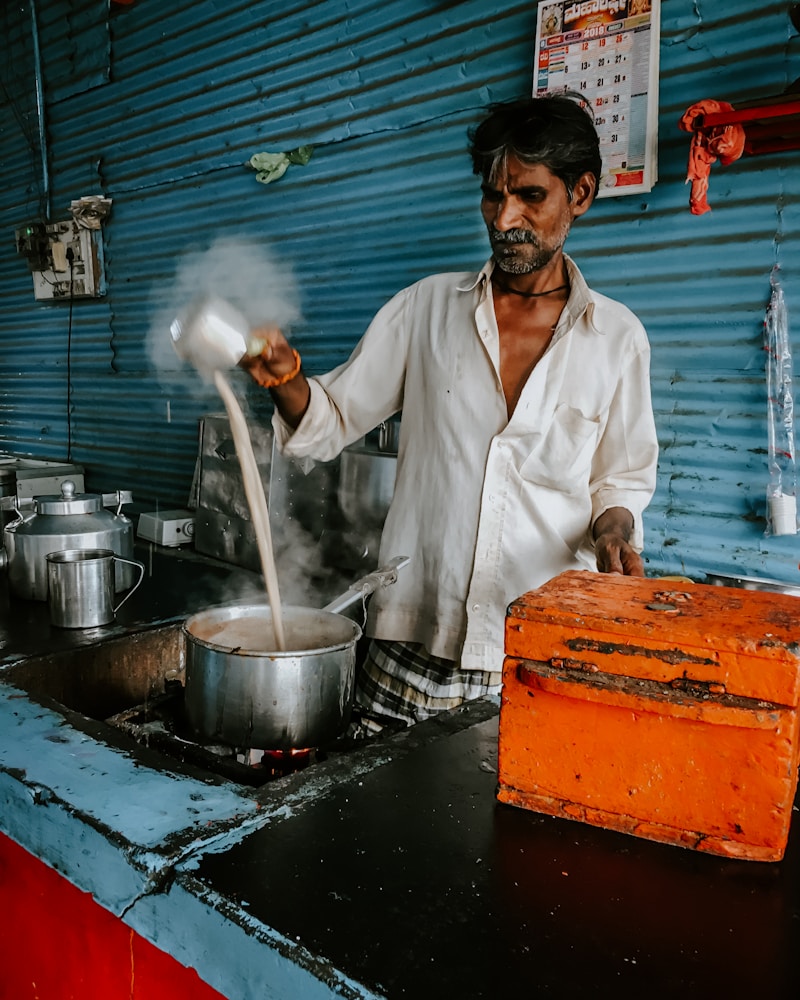
A Grande (16 oz) Starbucks Chai Latte carries 29 grams of sugars, and the concentrates most cafes and most home kitchens pour from carry their own load before anyone touches the cup — Tazo's Classic Chai Latte lists 24 grams of added sugar per 3/4-cup serving, and Oregon Chai's Original lists 28 grams per 6 fluid ounces, both on the manufacturers' own labels. Brewed from whole spices instead, the same drink comes in around 6 grams of added sugar per 12-ounce cup. The sugar was never coming from the chai. It was coming from the bottle the chai arrived in.
That distinction is the whole article, because it changes what the fix is. You are not giving up a sweet drink; you are taking back a dial that a factory set months ago. Built the original way — black Assam tea simmered with crushed fresh ginger, green cardamom, a cinnamon stick, whole cloves, cracked black peppercorns and a fragment of star anise, then finished with milk and about a teaspoon of sweetener per cup — an 8-ounce cup carries roughly 4 grams of added sugar. Nobody craves cane sugar syrup. People crave the spice, the warmth, and the ritual of holding the cup.
One note on the name, said once and without fuss: chai simply means tea, so "chai tea latte" is literally "tea tea latte." Masala chai — spiced tea — is a South Asian preparation with centuries of history behind it, brewed by simmering rather than steeping. Everything below treats that method as the standard. The concentrate is the departure.
This article is educational, not medical advice. It is a recipe, not a treatment for anything. If you are pregnant, nursing, or taking medication, talk to your clinician before adding concentrated spice preparations to your routine.
Key statistics at a glance
- 24 grams of total sugars, all 24 of them added — 50% of the FDA Daily Value — in one 3/4-cup (180 mL) serving of Tazo Classic Chai Latte concentrate, per Tazo's own SmartLabel listing; prepared with milk as directed, the drink comes to 200 calories and 33 grams of total sugars
- 28 grams of total sugars, all 28 added, in one 6-fluid-ounce serving of Oregon Chai Original Chai Tea Latte Concentrate, per Oregon Chai's published nutrition panel — with organic dried cane sugar syrup listed as the second ingredient, ahead of the tea
- 190 calories, 31 grams of carbohydrate, 29 grams of sugars and 55 mg of caffeine in a Grande (16 oz) Starbucks Chai Latte; the Iced Grande lists 31 grams of sugars (Starbucks published nutrition, 2026)
- "Just 2 grams of sugar from honey" in the Premium Chai blend Starbucks introduced on March 3, 2026, moving the sweetness out of the base and into separately pumped Classic Syrup (Starbucks, 2026)
- 25 grams a day for women, 36 grams for men — the American Heart Association's added-sugar ceilings; Americans aged 2 and older average 12–13% of daily calories from added sugars against the AHA's preferred 6%
- 50 grams is the FDA's Daily Value for added sugars, and the FDA's definition explicitly counts sugars from syrups and honey as added — one tablespoon of pure maple syrup carries 12.1 grams (USDA FoodData Central), which is why this recipe measures sweetener in teaspoons
- 53.0% of US adult calories came from ultra-processed foods in August 2021–August 2023, with sweetened beverages among the top five sources (CDC/NCHS Data Brief 536, 2025)
The concentrate problem
Here is the structural issue with the cafe version, and it has nothing to do with the barista. Almost every "chai latte" sold in the United States is assembled from a pre-sweetened liquid concentrate. The sugar was decided months earlier, in a factory, at a ratio you cannot see and historically could not change.
Read the labels, in the manufacturers' own words:
- Tazo Classic Chai Latte: "An infusion (of water, black tea, black pepper, ginger, cardamom, cinnamon, cloves, star anise, natural flavors), cane sugar, honey, ginger juice, natural flavors, vanilla extract, citric acid." Sugar isn't first — but the thing ahead of it is mostly water, and cane sugar plus honey occupy slots two and three. The panel settles the argument: 24 grams of added sugar in a 180 mL serving.
- Oregon Chai Original: "Water, Organic Dried Cane Sugar Syrup, Organic Black Tea, Organic Vanilla Extract, Organic Spice Extracts, Organic Honey, Citric Acid, and Natural Flavors." Here the sweetener genuinely does come second — ahead of the tea, and ahead of the spices, which arrive as extracts rather than as spices.
- Starbucks Chai Latte: "MILK, CHAI TEA CONCENTRATE [AN INFUSION OF (WATER, BLACK TEA, BLACK PEPPER, GINGER, CARDAMOM, CINNAMON, CLOVES, NATURAL FLAVOR, STAR ANISE), HONEY, GINGER JUICE, NATURAL FLAVORS, CITRIC ACID], CLASSIC SYRUP [SUGAR, WATER, NATURAL FLAVORS, POTASSIUM SORBATE, CITRIC ACID]."
That last one is worth sitting with, because it changed recently and in the right direction. On March 3, 2026, Starbucks moved to a Premium Chai blend the company describes as "crafted with just 2 grams of sugar from honey," explicitly so that customers could "add or remove pumps of classic syrup to increase or decrease sweetness" and adjust spice intensity separately. The sweetener is now a distinct line on the ingredient list rather than something dissolved into the base. A Grande still lists 29 grams of sugars as standard — Starbucks does not publish an added-sugar breakdown, and some of that total is lactose from the milk — but for the first time the number is genuinely yours to move.
That is the whole thesis in miniature. The problem was never the spice. It was that someone else held the spoon.
Commercial vs. homemade, honestly
| Starbucks Grande Chai Latte (16 oz) | Tazo concentrate latte, as directed (~12 oz) | This recipe (12 oz) | |
|---|---|---|---|
| Calories | 190 | 200 | ~130 |
| Total sugars | 29 g | 33 g | ~15 g |
| Added sugars | Not published separately | 24 g | 6 g |
| Sweetener | Honey in the concentrate, plus Classic Syrup (sugar) | Cane sugar and honey | 1 tsp jaggery, maple, or honey per cup |
| Spices | In the concentrate, plus natural flavors | In the infusion, plus natural flavors | Whole, cracked, simmered |
| Sweetness you control | By the pump, since March 2026 | No | By the half teaspoon |
| Oregon Chai — cane sugar syrup | 28g |
| Tazo — cane sugar + honey | 24g |
| AHA daily limit, men | 36g |
| AHA daily limit, women | 25g |
| This recipe — 1 tsp jaggery, maple or honey | 6g |
One Oregon Chai latte spends 112% of a woman's entire daily added-sugar allowance from the AHA and 78% of a man's. A Tazo one spends 96% and 67%. Neither of those is a dessert; both are what a person drinks at 8 a.m. on a Tuesday because they like cardamom.
Below, the first eleven items make two 8-ounce cups. The last nine make a refrigerator batch of unsweetened concentrate — about four cups, or eight servings.
About the sweetener
Both versions use real sugar. That is not the difference, and saying otherwise invites an easy correction — the commercial product is sweetened with cane sugar, not an artificial sweetener.
What differs is the amount, and what the sugar arrives inside. Pure maple syrup and coconut sugar are minimally processed foods rather than refined syrup blends, and they carry trace minerals — but their fiber is gone, and FDA counts both as added sugars. We are not going to tell you they are metabolically free. Coconut sugar in particular is roughly 70–80% sucrose, and its widely repeated low-GI figure rests on a single small analysis that has not replicated well.
Where a recipe can use whole dates instead, the fiber stays attached and that genuinely does change the glycemic response — five date varieties tested in healthy and diabetic subjects measured a glycemic index of about 44 to 55 despite being over 70% sugar (Alkaabi et al., Nutrition Journal, 2011). Full breakdown of which sugar substitute is actually healthiest.
Ingredients
- 1 1/2 cups (360 ml) water
- 1 cup (240 ml) whole milk, or oat milk
- 2 teaspoons loose-leaf Assam black tea, or 2 black tea bags
- 1 1/2-inch piece fresh ginger (about 15 g), unpeeled, smashed flat with the side of a knife
- 4 green cardamom pods, cracked open
- 1 cinnamon stick (2 inches), preferably Ceylon, snapped in half
- 3 whole cloves
- 4 black peppercorns, cracked
- 1 point broken from a whole star anise pod (about 1/8 of a pod)
- 2 teaspoons jaggery, pure maple syrup, or honey — 1 teaspoon per cup
- 1 pinch fine sea salt, about 1/16 teaspoon
- For the concentrate batch: 4 cups (960 ml) water
- For the concentrate batch: 8 teaspoons loose-leaf Assam black tea
- For the concentrate batch: 4-inch piece fresh ginger (about 40 g), smashed flat
- For the concentrate batch: 12 green cardamom pods, cracked open
- For the concentrate batch: 2 cinnamon sticks (2 inches each), snapped in half
- For the concentrate batch: 8 whole cloves
- For the concentrate batch: 12 black peppercorns, cracked
- For the concentrate batch: 1/2 star anise pod
- For the concentrate batch: 1/4 teaspoon fine sea salt
Instructions
- Crack the spices first: press the cardamom pods, peppercorns and cinnamon stick under the flat of a heavy knife until the pods split and the stick fractures. Smash the ginger the same way rather than mincing it. You want the cell walls broken, not the spice powdered.
- Combine the water, ginger, cardamom, cinnamon, cloves, peppercorns and star anise in a small saucepan. Bring to a boil over high heat.
- Reduce to a steady simmer and cook the spices alone for 5 minutes, uncovered. This is a decoction — hard, woody spices need time and heat that tea leaves cannot survive.
- Add the tea. Simmer 2 minutes only, then take the pan off the heat. Longer extraction here buys you tannin and astringency, not flavor.
- Add the milk, the sweetener and the salt. Return the pan to medium heat and bring it back to a bare simmer — small bubbles at the edge, never a rolling boil, which scalds the milk and dulls the aroma.
- Hold at that bare simmer for 2 to 3 minutes, watching the pan. It will try to climb the sides. Pull it off the heat when it starts to rise.
- Aerate it: pour the chai from the pan into a heatproof jug and back again, three or four times, from as high as you can manage without decorating the counter. This is what a chai wallah is doing when they pull the stream — it cools the drink to drinking temperature and pushes aroma forward.
- Strain through a fine sieve into two cups. Taste before adding anything. If it needs more, add sweetener a half teaspoon at a time.
- For the concentrate batch: combine the water and all the cracked spices in a saucepan, bring to a boil, then simmer uncovered for 10 minutes.
- Add the tea and salt, simmer 3 minutes, then remove from the heat and let it steep 5 more minutes off the burner.
- Strain through a fine sieve, discard the solids, and cool the liquid uncovered for no more than 20 minutes before refrigerating — perishable food should not sit at room temperature for more than two hours (US FDA).
- To serve from the batch: heat 1/2 cup concentrate with 1/2 cup milk and 1 teaspoon sweetener to a bare simmer, aerate, and pour.
Why you crack the spices instead of grinding them
Whole spices hold their volatile oils inside intact plant cells. Cracking ruptures those cells and lets the oils meet hot water; grinding does the same but also multiplies surface area enormously, which is why ground spice smells loud in the jar and tastes flat three months later. The processing literature reflects this — a 2021 review in the Journal of Agriculture and Food Research on the key issues in spice grinding treats particle size distribution and volatile oil retention as the field's two dominant concerns, with grinding heat a known cause of oil loss. For a drink you simmer for fifteen minutes anyway, cracked-and-whole buys the extraction without the oxidation. Evidence: strong as food-processing science.
The order in the pan follows from the same physics. Ginger, cardamom seed and bark are dense and need boiling water and minutes; tea leaf is thin and gives up its polyphenols fast, and past about two minutes at a simmer what you keep extracting is tannin. Spices first, tea second, is two different extraction problems solved at two different times.
Milk is doing chemistry, not just softening the color. Adding milk to black tea forms polyphenol–protein complexes: casein — specifically casein, not whey — binds the catechins and theaflavins so fewer of them reach the bitterness and astringency receptors. That is why masala chai tastes round rather than sharp, and much of why so little sugar is needed: the bitterness sugar usually gets hired to cover has already been removed. The flip side, honestly: the same binding cuts polyphenol bioaccessibility, which a 2011 study in the Journal of Agricultural and Food Chemistry measured directly. Drink chai because it is good, not for its catechins. Evidence: strong for the mechanism, and strong against the "antioxidant tea" framing once milk is in.
Aroma raises perceived sweetness, and chai carries more of it than any other latte. Odor-induced sugar reduction is now a working formulation strategy: a 2024 review in Trends in Food Science & Technology describes work in which 0.2% added vanilla aroma let a low-sugar yogurt shed 25% of its sugar without losing consumer acceptability, and notes the effect runs primarily through retronasal olfaction — aroma reaching the nose from inside the mouth as you swallow. Six spices simmered in milk is a very large retronasal signal. That is the real reason a teaspoon is enough. Evidence: moderate, and specific to perception rather than metabolism.
The pinch of salt is not seasoning. In their 1997 paper in Nature, Breslin and Beauchamp showed that sodium filters flavors selectively, suppressing bitterness more than sweetness so that sweetness is released rather than created. In a cup holding tea tannin, clove and black pepper, that is a real amount of bitterness taken off the top. It is the ingredient most people skip and the one that costs nothing. Evidence: strong, mechanistically well characterized.
What each spice is doing, and what the research can and can't tell you
Two things are true here and most writing on chai picks one.
Masala chai is a formulation, not a random pile of spices. This combination was arrived at across centuries of South Asian kitchens and Ayurvedic practice — ginger and pepper for warmth and digestion, cardamom for the stomach, cinnamon and clove for balance. Nobody designed it in a lab and nobody ran a trial on it. It survived because generations of people kept making it, which is a filter, just not the kind that produces a p-value.
And the Western research on these spices mostly asks a different question. Almost every trial below tests an isolated compound at a supplement dose in a capsule — curcumin extract, ginger concentrate, cardamom powder in grams. That is a legitimate question. It is not the question "what does this drink do," and a null or thin result on the capsule is not a verdict on the pot.
So here is what we are and are not doing. We are giving you every finding honestly, including where it is thin, because you should know what is measured. We are not making clinical claims for a beverage, and we are not going to tell you chai treats anything. We are also not going to write "no evidence" over a practice that predates the randomized controlled trial by roughly three thousand years — nobody funds trials on tea recipes, and a funding gap is not a finding.
Ginger — the best evidence in the pot, at doses you are not drinking. A 2024 umbrella review in Advances in Nutrition scanned seven meta-analyses of ginger in pregnancy. Across studies using 450–2,500 mg/day, all four meta-analyses examining nausea scores against placebo found a reduction, with ginger performing comparably to vitamin B6; three of four found no significant effect on vomiting frequency, so the benefit is specific to nausea. No major maternal adverse effects and no fetal abnormalities were reported. The authors are equally plain about the weaknesses: substantial heterogeneity, and AMSTAR-2 ratings for the included reviews running from low to critically low. The honest translation is that those trials used concentrated capsules, and fresh ginger is 79.5% water by weight (USDA FoodData Central). Fifteen grams of rhizome split across two cups is food, not a dose. Evidence: strong for nausea at supplemental doses; not established at culinary amounts.
Cardamom — real randomized trials, small and geographically narrow. Heydarian and colleagues pooled eight RCTs and 769 participants in Food Science & Nutrition (2023), reporting reductions in hs-CRP (SMD −0.60), IL-6 (WMD −1.25), TNF-α (WMD −2.10), diastolic blood pressure (WMD −0.90 mmHg) and systolic blood pressure (WMD −0.54 mmHg). Note the size of those blood-pressure numbers: under one millimeter of mercury. The authors flag that every included trial was conducted in Iran, that heterogeneity was significant, and that the number of studies is small. Evidence: limited — statistically detectable, practically tiny, from a narrow trial base.
Cinnamon — mixed, and we are not making the blood-sugar claim. A 2025 umbrella review in Frontiers in Nutrition covering 21 meta-analyses and 139 comparisons found cinnamon reduced fasting blood glucose (SMD −0.61, upgraded to "highly suggestive" on reanalysis), but the HbA1c signal across twelve comparisons was smaller (SMD −0.26), rated mostly weak to non-significant, and became non-significant on the authors' own reanalysis; they state that caution is warranted for HbA1c and HOMA-IR. So: cinnamon is in this recipe for aroma and for what aroma does to perceived sweetness. One practical caution if you drink chai daily — cassia cinnamon (the common supermarket kind) averages about 3,000 mg of coumarin per kg with measured peaks near 10,000, and Germany's Federal Institute for Risk Assessment sets a tolerable daily intake of 0.1 mg/kg body weight, which a 60 kg adult reaches at roughly 2 grams of cassia a day. A stick in a two-cup pot sits well under that. Ceylon cinnamon, which contains far less coumarin, is the better default for a daily ritual. Evidence: mixed for glycemic effects and unclaimed here; strong for aroma's role in perceived sweetness.
Clove — almost entirely preclinical. Eugenol performs impressively in a test tube: a 2025 in vitro study in ACS Omega reported roughly 80% DPPH radical scavenging and FRAP values of 200–300 µM Fe²⁺ equivalents for eugenol and clove essential oil at 25 µg/mL. Human clinical trials are thin to absent. In chai, clove is a flavor decision, and a bossy one — three is a quantity, five is a mistake. Evidence: strong in vitro, and untested in humans rather than failed in humans — no clinical trial of culinary clove has been run.
Black pepper — a genuine mechanism, routinely oversold. The famous number comes from Shoba and colleagues in Planta Medica (1998): in human volunteers, 2 grams of curcumin alone produced serum levels that were undetectable or very low, and adding 20 mg of piperine raised bioavailability by 2,000%. Be precise about what that sentence contains — one compound (curcumin, not "nutrients" generally), one isolated dose of piperine, a small volunteer group, and a 1998 result not independently replicated at that magnitude. The mechanism behind it is well documented: Bhardwaj and colleagues showed in the Journal of Pharmacology and Experimental Therapeutics (2002) that piperine inhibits both P-glycoprotein and CYP3A4, with IC50 values of 15.5 µM against digoxin transport and 74.1 µM against cyclosporine A. That is also the reason for caution rather than excitement: the same inhibition means piperine near 20 mg/day can raise plasma levels of CYP3A4 substrates such as carbamazepine and midazolam, CYP2C9 substrates such as diclofenac and phenytoin, and P-glycoprotein substrates such as fexofenadine. Four cracked peppercorns in a pot is nowhere near a supplement dose — but piperine capsules, alongside a narrow-therapeutic-index medication, are a pharmacist conversation. Evidence: strong for the mechanism, narrow for the famous figure, and an interaction pathway as much as a benefit.
Star anise — this one is a safety note, not a benefit. Chinese star anise (Illicium verum) is GRAS. Japanese star anise (Illicium anisatum) contains anisatin and is neurotoxic, and once dried the two cannot be told apart by eye. In September 2003 the FDA advised consumers not to consume star anise teas after roughly 40 reported illnesses, including 15 infants. Buy from a spice merchant you trust, use a fragment rather than a whole pod, and do not give chai to infants. Evidence: no benefit claim made; the adulteration risk is documented.
The honest summary. Where modern trials exist, they mostly tested concentrated extracts at doses far above what is in your cup, and we have said so each time rather than borrowing their credibility. Where they do not exist, that is because nobody funds clinical research on a spice you can buy for two dollars — not because anyone looked and came up empty.
What you are actually drinking is a preparation that a very large number of people refined over a very long time, made from whole spices you could hold in your hand, with a tenth of the sugar of the commercial version. That is a good enough reason on its own. A drink does not have to be a supplement to be worth making well — and it does not need a trial to justify a practice that has already outlasted several centuries of medicine.
Is a homemade chai latte actually healthier?
It contains less added sugar. That is the claim, and it is the only one worth making.
The value is not that a spice is doing metabolic work in your cup. It is that a daily 24-gram habit is a pattern, and patterns are what the population data is about. Ultra-processed foods supplied 53.0% of US adult calories in August 2021–August 2023, with sweetened beverages among the top five contributing categories (CDC/NCHS Data Brief 536, 2025). Rebuilding one daily ritual from whole ingredients moves one line in that ledger — a small, durable change in the terrain you feed most mornings rather than a dramatic one, which is the only kind that survives February. Consistency over intensity.
If digestion is what you are working on, chai is worth running as an investigation rather than an assumption: milk, caffeine and clove are variables you can isolate one at a time. Our guide to daily habits for gut health covers testing rather than restricting — and the 3 p.m. pull toward something sweet is a signal about the day's structure, not a character flaw.
Can you make it without any sugar?
You can make it with far less. You cannot make it sweet without added sugar, and it matters that we say so directly.
Jaggery, honey, maple syrup, coconut sugar and date syrup are all added sugars. The FDA's definition covers sugars added during processing along with sugars from syrups and honey, and the Daily Value is 50 grams. A tablespoon of pure maple syrup carries 12.1 grams of sugar and 52 calories (USDA FoodData Central); a teaspoon carries about 4. Jaggery is unrefined cane sugar with some molasses left in — a different flavor, not a different metabolic category. The advantage here is arithmetic, not alchemy: one measured teaspoon instead of twenty-four premixed grams. There is more on where the sweeteners actually sit in our food chart.
| Oregon Chai latte, as directed | 37g (Total sugars) | 28g (Added sugars) |
| Tazo chai latte, as directed | 33g (Total sugars) | 24g (Added sugars) |
| This recipe, 12 oz | 15g (Total sugars) | 6g (Added sugars) |
The gap between the two bars in each pair is milk sugar — lactose, which is not added sugar and which you cannot avoid without leaving the milk out. That is the part of the total worth ignoring. The dark bar is the part you control.
Two things genuinely reduce how much you need. First, brew the spices longer rather than sweeter — a 10-minute decoction tastes substantially sweeter than a 3-minute one at identical sugar. Second, do not skip the salt. Between those two levers, most people land at 1 teaspoon per cup and stop noticing.
How long does homemade chai concentrate keep?
Five to seven days, refrigerated, in a clean airtight jar — and it is worth knowing why the number is so much shorter than for a spice syrup.
Sugar syrups preserve themselves by lowering water activity — binding free water so microbes cannot use it. Most bacteria need a water activity above 0.91 to grow and most yeasts above 0.88, while molds survive down to roughly 0.65 (UC Master Food Preserver Program, 2025). A maple spice syrup sits far below the bacterial threshold, which is why it keeps for weeks. Chai concentrate is the opposite kind of liquid: essentially brewed tea, mostly water, with nothing dissolved in it at preserving concentration and a water activity near 1.0. It is not preserved. It is refrigerated, which is a delay, not a defense.
So treat it like a cooked leftover, because that is what it is. Strain the solids out (particulates give mold a foothold), use a jar washed in hot soapy water and dried, refrigerate promptly rather than leaving the pan on the stove — perishable food should not sit at room temperature beyond two hours, or one hour above 90°F, per the FDA — and keep it on a middle shelf rather than in the door. Discard at the first sign of cloudiness, ropiness, film, or a sour smell. Frozen in an ice cube tray, it gives you a month of two-minute mornings.
Leaving sweetener out of the batch is deliberate. At these concentrations it would not extend shelf life anyway, and it means every cup gets sweetened to your taste on the day rather than to a decision you made last Sunday.
Can it be made dairy-free?
Yes, with one real adjustment. The casein–polyphenol binding that softens tea astringency is specific to dairy protein, so plant milks will not blunt the tannins the same way. Compensate at the brew, not with sugar: cut the tea simmer to 90 seconds and add 30 seconds to the spice decoction.
- Oat milk is closest for body and froths reliably. Check the added-sugars line first — enzymatic hydrolysis of the oat starch leaves many commercial oat milks measurably sweet, and if yours is, drop to a half teaspoon.
- Whole-fat canned coconut milk, thinned 1:1 with water, is the richest option and carries spice aroma extremely well.
- Almond milk is thinnest and leans hardest on the salt. Use unsweetened.
- Soy milk brings protein and is the most dairy-like structurally, but can separate at a real boil — hold it at a bare simmer.
Caffeine holds steady across all of them: USDA and FDA reference values put brewed black tea near 47 mg per 8-ounce cup, against 55 mg in a Grande Starbucks Chai Latte. If you drink chai in the afternoon and sleep poorly, isolate that variable before blaming the spices.
Keep the ritual, rebuild the ingredients
The commercial chai latte was never a bad idea. It was a good drink with the sweetness decided upstream and locked in — which is exactly the pattern worth noticing across a pantry, not just a cup. Twenty-five minutes and six whole spices gets you the same warmth with a quarter of the added sugar and full control of the dial. If you want the swap tracked alongside the rest of the day's habits, the Sakred app is built for precisely that kind of unglamorous, repeatable consistency.
Frequently asked questions
How much sugar is in a Starbucks chai latte?
A Grande (16 oz) Starbucks Chai Latte lists 190 calories, 31 grams of carbohydrate and 29 grams of sugars; the Iced Grande lists 190 calories and 31 grams of sugars, per Starbucks' published nutrition information in 2026. Starbucks does not publish a separate added-sugar figure, and some of that total is lactose from the milk. The ingredient list shows honey in the chai concentrate plus a separate Classic Syrup whose first ingredient is sugar — and since the March 2026 Premium Chai change, you can order it with fewer syrup pumps or none.
Is a chai tea latte the same as masala chai?
Not in method, which is where the sugar difference comes from. Chai means tea, so "chai tea latte" is redundant; masala chai means spiced tea and is made by simmering whole spices and tea together, then adding milk. A cafe chai latte is typically a pre-sweetened concentrate combined with steamed milk. Same family of flavors, very different construction.
Can I drink masala chai while pregnant?
That is a question for your clinician, not a recipe post. What the evidence shows: ginger has the strongest trial support of anything in the pot for pregnancy-related nausea, with a 2024 Advances in Nutrition umbrella review finding consistent reductions in nausea scores at 450–2,500 mg/day and no major maternal or fetal adverse effects reported — but those are supplement doses, not culinary ones. Chai also contains caffeine, roughly 47 mg per 8-ounce cup of brewed black tea by USDA and FDA reference values, which is a separate consideration in pregnancy.
Do I have to use star anise?
No, and it is the one spice worth leaving out if you are unsure of your source. Chinese star anise is generally recognized as safe, but it can be adulterated with the neurotoxic Japanese species, which is visually indistinguishable once dried — the FDA advised consumers against star anise teas in September 2003 after roughly 40 reported illnesses. Omit it, or use a small fragment from a merchant you trust. The chai will be slightly less licorice-forward and otherwise unchanged.
Sources
- Starbucks — Chai Latte nutrition and ingredients (2026)
- Starbucks — Iced Chai Latte nutrition and ingredients (2026)
- Starbucks Stories — Starbucks introduces Premium Chai crafted for customization (2026)
- Tazo — Classic Chai Latte Concentrate ingredients
- SmartLabel (Unilever/Tazo) — Tazo Classic Chai Latte nutrition facts
- Oregon Chai — Original Chai Tea Latte Concentrate nutrition and ingredients
- American Heart Association — How Much Sugar Is Too Much? (2026)
- US Food and Drug Administration — Fact Sheet: Declaration of Added Sugars for Single-Ingredient Sugars and Syrups
- CDC / National Center for Health Statistics — Data Brief 536: Ultra-processed Food Consumption in Youth and Adults, United States, August 2021–August 2023 (2025)
- Advances in Nutrition — The Use of Ginger Bioactive Compounds in Pregnancy: An Evidence Scan and Umbrella Review of Existing Meta-Analyses (2024)
- Heydarian A. et al., Food Science & Nutrition — Effect of cardamom consumption on inflammation and blood pressure in adults: A systematic review and meta-analysis of randomized clinical trials (2023)
- Frontiers in Nutrition — The effects of cinnamon on patients with metabolic diseases: an umbrella review of meta-analyses of randomized controlled trials (2025)
- German Federal Institute for Risk Assessment (BfR) — FAQ on coumarin in cinnamon and other foods
- ACS Omega — Antioxidant and Anti-inflammatory Activity of Eugenol, Bis-eugenol, and Clove Essential Oil: An In Vitro Study (2025)
- Shoba G. et al., Planta Medica — Influence of piperine on the pharmacokinetics of curcumin in animals and human volunteers (1998)
- Bhardwaj R.K. et al., Journal of Pharmacology and Experimental Therapeutics — Piperine, a Major Constituent of Black Pepper, Inhibits Human P-glycoprotein and CYP3A4 (2002)
- Pharmacy Times — Piperine Drug Interactions
- Wikipedia — Illicium anisatum (Japanese star anise) and the 2003 FDA star anise tea advisory
- Journal of Agriculture and Food Research — Key issues and challenges in spice grinding (2021)
- Journal of Agricultural and Food Chemistry — Effect of Milk and Brewing Method on Black Tea Catechin Bioaccessibility (2011)
- Milk in tea: exploring the chemistry and biological activities (Europe PMC)
- Trends in Food Science & Technology — Unlocking the potential of odor-induced sugar reduction: an updated review of the underlying mechanisms, substance selections, and technical methodologies (2024)
- Breslin P.A.S. & Beauchamp G.K., Nature — Salt enhances flavour by suppressing bitterness (1997)
- UC Master Food Preserver Program — Water Activity and its Role in Food Preservation (2025)
- US Food and Drug Administration — Are You Storing Food Safely?
- USDA FoodData Central — Syrups, maple
- USDA FoodData Central — Ginger root, raw
- USDA FoodData Central — Milk, whole, 3.25% milkfat