The Healthy Apple Crisp Oatmilk Macchiato: What Reducing Cider Actually Does to Its Sugar
A real-cider apple crisp macchiato with espresso, oat milk, and a spiced cider reduction instead of flavored syrup — plus the honest arithmetic on concentrated fruit sugar, the whole-fruit-versus-juice cohort data, and what oat milk's sweetness really is.

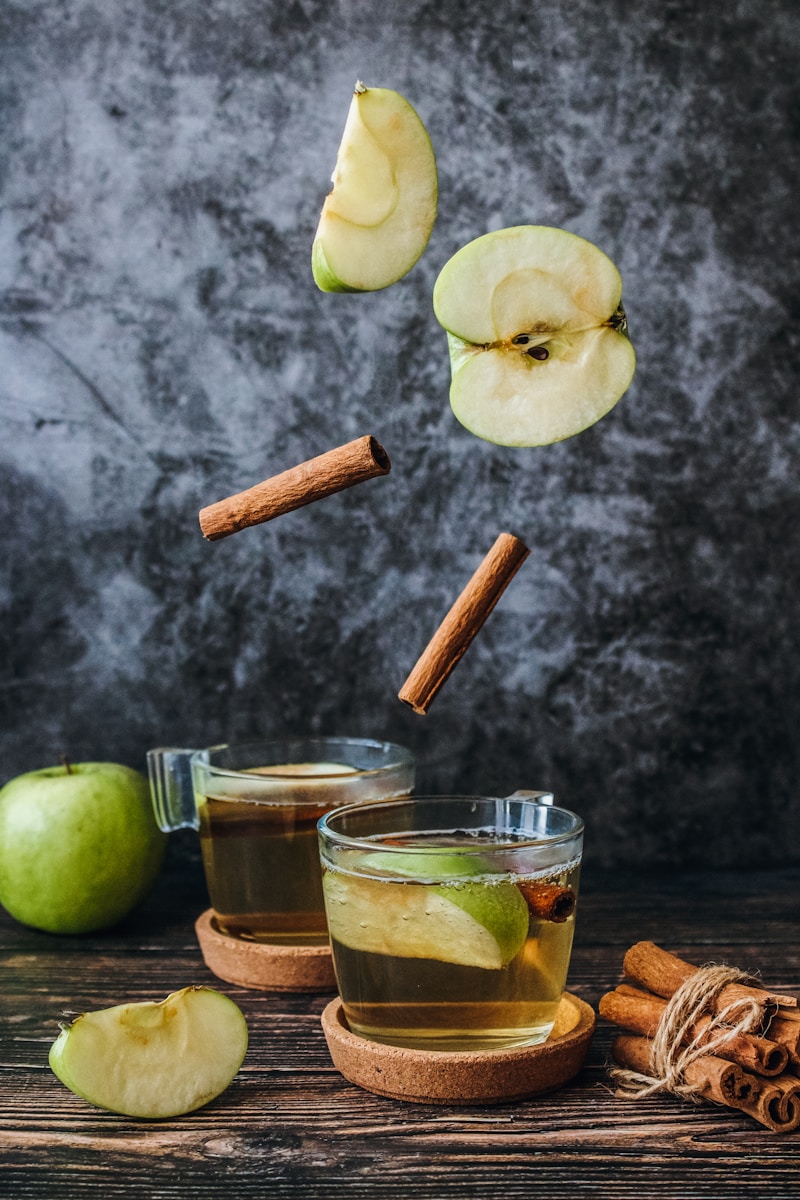
A healthy apple crisp oatmilk macchiato is made from two shots of espresso, three-quarters of a cup of oat milk, and one and a half tablespoons of a spiced apple cider reduction you simmer yourself — real apple cider cooked down with a cinnamon stick, whole cloves, and a strip of orange peel — finished with vanilla off the heat and a few flakes of sea salt. Built this way, a 12-ounce drink carries roughly 13 grams of total sugar, about 7 of which would count as added sugar under the FDA's own rule for concentrated juices, and it contains no flavored syrup, sauce, or drizzle. Nobody craves apple-flavored syrup. People crave the smell of cider on the stove and something warm in their hands in October. That part is entirely reproducible.
This article is educational, not medical or nutrition advice. It is a recipe, not a treatment for anything.
Key statistics at a glance
- Reducing cider 4:1 multiplies its sugar roughly fourfold per unit volume. A tablespoon of plain cider carries about 1.5 grams of sugar; a tablespoon of a 4:1 reduction carries about 6 (calculated from USDA FoodData Central values for unsweetened apple juice: 9.6 g sugars per 100 g)
- The 2025–2030 Dietary Guidelines for Americans, released January 2026, replaced the old "under 10% of daily calories" framing with a per-meal ceiling: no more than 10 grams of added sugars in any one meal, and the statement that no amount of added sugar is considered part of a healthy diet
- 25 grams a day for women, 36 for men — the American Heart Association's added-sugar limits, unchanged as of its May 2026 review, against an average US intake of 12–13% of total daily calories
- Pooled hazard ratio 0.98 (95% CI 0.96–0.99) for whole fruit and 1.08 (1.05–1.11) for fruit juice per three servings a week, across 187,382 people and 12,198 cases of type 2 diabetes (Muraki et al., BMJ, 2013)
- No significant association between 100% fruit juice and type 2 diabetes across 14 prospective cohorts; the elevated risk sat with non-100% fruit drinks, RR 1.15 (1.03–1.28) (Myung et al., The American Journal of Medicine, 2025)
- A commercial oat drink measured 3.35% total sugars, of which 3.34% was maltose — essentially all of it produced by enzymes during processing (Jeske, Zannini and Arendt, Plant Foods for Human Nutrition, 2016)
- 7.92 grams of protein per 240 mL in cow's milk versus 0.96–2.4 grams in three commercial oat milks, with a DIAAS protein-quality score of 116 for milk against 57 for oat (Yu et al., Food Chemistry: X, 2023)
- 53.0% of US adult calories came from ultra-processed foods in August 2021–August 2023 (CDC/NCHS Data Brief 536, 2025)
What we can and can't tell you about the Starbucks version
The commercial drink is built the way most seasonal café drinks are built: an apple-and-brown-sugar flavored syrup, oat milk, blonde espresso, and a spiced apple drizzle over the top. Two of those four components are sugar delivery systems, and they sit on top of whatever sugar the oat milk already brings.
What we are not going to do is print a gram figure for it. As of August 1, 2026, the Apple Crisp Oatmilk Macchiato is not on the Starbucks US menu — it is a seasonal item returning with the fall lineup at the end of August — and the chain publishes per-size nutrition while a beverage is live. The numbers circulating on aggregator sites reference earlier seasons, and this drink has been reformulated before, including the 2022 switch to oat milk. A stale number stated confidently is worse than no number. So the comparison below is structural on the commercial side, which is still useful.
| Café apple crisp macchiato | This recipe, 12 oz | |
|---|---|---|
| Sweetener | Apple-brown-sugar flavored syrup, pumped | 1½ tbsp cider reduction, measured |
| Second sweetener | Spiced apple drizzle on top | None |
| Apple content | Flavoring; apple's position in the ingredient list is not published per drink | 6 tbsp of cider, cooked down |
| Total sugars | Varies by size, syrup pumps, and season | ~13 g |
| Added sugars | Not separately published per beverage | ~7 g by the FDA's concentrated-juice rule |
| Protein | Low — oat milk base | ~1.4 g |
| Sweetness you control | By pump | By the half tablespoon |
Ingredients
- 2 shots (2 oz / 60 ml) hot espresso, or 1/2 cup strong brewed coffee
- 3/4 cup (180 ml) oat milk, unsweetened
- 1 1/2 tablespoons spiced apple cider reduction (made below)
- 1/4 teaspoon pure vanilla extract, stirred in off the heat
- 1 pinch flaky sea salt, for finishing
- 1 pinch ground cinnamon, for dusting
- For the cider reduction batch: 4 cups (960 ml) fresh apple cider, unsweetened
- For the cider reduction batch: 1 cinnamon stick
- For the cider reduction batch: 4 whole cloves
- For the cider reduction batch: 1 strip orange peel, 2–3 inches, no white pith
- For the cider reduction batch: 1/4 teaspoon fine sea salt
- For the cider reduction batch: 1 teaspoon pure vanilla extract, stirred in off the heat
Instructions
- Make the reduction first: combine the cider, cinnamon stick, cloves, orange peel, and fine sea salt in a wide saucepan — wide matters, because surface area is what drives evaporation.
- Bring to a bare simmer over medium heat, then lower it until the surface barely moves. Leave it uncovered.
- Simmer 35 to 45 minutes, until 4 cups have become 1 cup. Judge it by volume, not by clock: pour it into a measuring cup if you are unsure, and return it to the pan if it needs more time.
- Take the pan off the heat, fish out the cinnamon stick, cloves, and orange peel, and stir in the vanilla extract.
- Cool uncovered for 20 minutes, then pour into a clean, dry glass jar and refrigerate. You should have about 1 cup — roughly ten servings.
- For the drink: warm the oat milk in a small saucepan to about 150°F (65°C) — steaming, with small bubbles at the edge, never boiling, which makes oat milk taste scorched.
- Spoon 1 1/2 tablespoons of the cider reduction into a 12-ounce mug and add the 1/4 teaspoon of vanilla.
- Froth the warm oat milk hard for 20–30 seconds with a handheld frother or blender, then pour it over the reduction and stir once to combine.
- Pull the espresso and pour it slowly through the foam so it marks the surface — that mark is what makes a macchiato a macchiato.
- Finish with a few flakes of sea salt and a dusting of cinnamon. Taste before adding anything else; if it needs more, add reduction a half tablespoon at a time.
The honest arithmetic of a cider reduction
Here is the part most copycat recipes skip, and it is the whole reason this post exists.
Simmering cider does not remove sugar. It removes water. Everything else stays and gets closer together. According to USDA FoodData Central, unsweetened apple juice contains 11.3 grams of carbohydrate per 100 grams — 9.6 grams of it sugars, split roughly 5.7 g fructose, 2.6 g glucose, and 1.3 g sucrose — with 0.2 grams of fiber. (USDA has no separate entry for cider; cider is essentially unfiltered juice, so these are the numbers to reason from.)
Four cups of cider weighs about 992 grams and therefore carries about 95 grams of sugar. Cook it down to one cup and you still have about 95 grams of sugar — now in a quarter of the volume. Per tablespoon:
- Plain cider: about 1.5 g of sugar
- 4:1 reduction: about 6 g of sugar
That is a fourfold concentration, and it means the reduction is not a healthier sweetener. It is a more flavorful one. The only reason it helps is that six grams of intensely appley, spiced, slightly tart concentrate does more sensory work than twenty grams of syrup, so you reach for less. That is the entire mechanism. Anyone selling you a cider reduction as a health food is selling you arithmetic they haven't done.
The FDA agrees, incidentally, and in a way worth knowing. Its added-sugars definition covers sugars added during processing, foods packaged as sweeteners, sugars from syrups and honey, and sugars from concentrated fruit or vegetable juices in excess of what would be expected from the same volume of 100% juice of the same type. By that rule, three-quarters of the sugar in a 4:1 reduction counts as added sugar. In this drink, that is about 7 of the 9 grams the reduction contributes.
| This drink, 12 oz | 7g |
| Dietary Guidelines limit, per meal | 10g |
| AHA daily limit, women | 25g |
| AHA daily limit, men | 36g |
Seven grams fits under the new per-meal ceiling with room to spare. It is not zero, and we are not going to pretend otherwise. Where different sweeteners actually sit is laid out in our food chart.
One practical note on the ratio: traditional New England boiled cider goes to about 7:1 and lands near 70 Brix, which is syrup territory. We stop at 4:1 on purpose. It stays pourable straight from the fridge, it tastes like apple rather than like caramel, and the lower sugar concentration is the honest trade for a shorter shelf life — more on that below.
Whole fruit versus juice: what the cohort data actually says
If you are going to put concentrated fruit sugar in a drink, you should know what the evidence base says about fruit sugar without the fruit. It is more interesting than either side of the internet argument.
The landmark analysis is Muraki and colleagues, published in the BMJ in 2013. Pooling the Nurses' Health Study, Nurses' Health Study II, and the Health Professionals Follow-up Study — 187,382 people, 3,464,641 person-years, 12,198 incident cases of type 2 diabetes — they found a pooled hazard ratio of 0.98 (95% CI 0.96–0.99) for every three weekly servings of whole fruit, and 1.08 (1.05–1.11) for the same increment of fruit juice. Apples and pears specifically came in at 0.93 (0.90–0.96); blueberries at 0.74 (0.66–0.83).
Read those numbers carefully, because the headline version of this study ("juice is as bad as soda") is not what it found. These are modest effect sizes from observational cohorts. A hazard ratio of 1.08 per three weekly servings is a real, consistent signal — and nothing like the magnitude reported for sugar-sweetened beverages, where Li and colleagues' 2023 meta-analysis in Frontiers in Nutrition, covering 72 prospective cohort studies, found a relative risk of 1.20 (1.15–1.25) for type 2 diabetes per additional daily serving.
And the juice picture has gotten more nuanced, not less. Myung and colleagues' 2025 systematic review in The American Journal of Medicine pooled 14 prospective cohorts and found no significant association between overall fruit juice and type 2 diabetes (RR 1.06, 95% CI 0.98–1.15, p = 0.170). Split by type, the risk sat with non-100% fruit drinks (RR 1.15, 1.03–1.28), not with 100% juice. Juice is not soda in this literature, and saying it is costs you credibility on the claims that are better supported.
What is better supported is the mechanism, and it is old. Haber and colleagues, in The Lancet in 1977, fed ten people test meals of whole apples, apple purée, and apple juice, each containing 60 grams of available carbohydrate. Juice could be drunk eleven times faster than whole apples could be eaten and four times faster than purée. With ingestion rate held equal, juice was significantly less satisfying than purée and purée less than apples. Plasma glucose rose to similar levels after all three — but there was a striking rebound fall after juice, and to a lesser degree after purée, that did not happen after whole apples. Serum insulin ran higher after juice and purée than after apples.
That is the fiber matrix doing structural work: slowing ingestion, slowing absorption, and blunting the rebound. A whole apple carries 2.4 grams of fiber per 100 grams (USDA). Apple juice carries 0.2. When you reduce cider, you are working at the far end of that spectrum — the sugar without the structure — and the way to respect it is to use the reduction as a flavoring and eat your apples whole. The wider version of that argument is in inflammatory foods and what to eat instead.
Oat milk, specifically: where its sweetness comes from
This is the least honestly covered ingredient in the drink, and the most searched.
Oat milk tastes faintly sweet even when the carton says "no added sugar," and the reason is that the sweetness is manufactured on purpose, by enzymes, from the oats' own starch. In commercial production, α-amylase is used to hydrolyze the oat slurry, breaking starch into shorter chains and simple sugars — chiefly maltose. Yu and colleagues, writing in Food Chemistry: X in 2023, describe the step directly: under optimized conditions their process ran 49 minutes of liquefaction and yielded 2.85 kg of oat milk per kilogram of rolled oats. The same enzyme step is what thins the liquid enough to pour.
The composition data makes the point vividly. Jeske, Zannini and Arendt, in Plant Foods for Human Nutrition (2016), screened 17 commercial plant-based milk substitutes. Their oat sample measured 3.35% total sugars — of which 3.34% was maltose. Not a trace: essentially the entire sugar content. Bovine milk in the same analysis was 3.38% sugars, almost all lactose.
So is oat milk's glycemic profile worse? Here the evidence gets thinner than the confident blog posts suggest, and you should know it. Jeske and colleagues measured an in vitro glycaemic index of 59.6 ± 5.4 for the oat drink against 46.9 ± 0.5 for bovine milk — higher, but only moderately so, and the authors flagged it as an exception worth explaining: "even though it contained mainly maltose it resulted in a moderate GI of 59," which they attributed to oat β-glucan. Those figures are reproduced in Shkembi and Huppertz's 2023 review in Foods. But in vitro GI is a laboratory digestion model, not a measurement in people. We could not find a randomized human trial isolating oat milk's postprandial glucose response against dairy at matched volumes, and until one exists, the honest summary is: oat milk's carbohydrate is more rapidly digestible than dairy's, by a moderate margin, in test-tube models. That is all anyone can say right now.
USDA's own analysis of unsweetened refrigerated oat milk adds a detail worth noticing: 5.1 grams of carbohydrate per 100 grams, of which 1.55 g is maltose and 0.77 g glucose — and 0 grams of fiber. Roughly half of that carbohydrate is neither sugar nor fiber. It is the intermediate starch fragments the same enzyme step leaves behind, and it does not appear on the "Total Sugars" line.
The trade-off nobody mentions is protein. Yu and colleagues' comparison puts cow's milk at 7.92 grams per 240 mL against 0.96 to 2.4 grams for three commercial oat milks, with protein-quality scores (DIAAS) of 116 for milk and 57 for oat, lysine being the limiting amino acid in oats.
| Cow's milk | 7.92g |
| Oat milk A | 2.4g |
| Oat milk B | 1.44g |
| Oat milk C | 0.96g |
This is not an argument against oat milk. It is an argument for knowing what you are choosing. Johnson and colleagues' 2025 analysis in the Journal of the Academy of Nutrition and Dietetics of 219 plant-based milk products from 21 US brands concluded that most are not nutritionally equivalent to dairy milk, that variability between and within categories is high, and that fortified soy products come closest — the same conclusion Jeske's lab reached, where only the soya samples matched cow's milk for protein. If protein is what you want from the milk in your coffee, soy is the plant option that delivers it, and it froths well. If texture and neutrality are what you want, oat wins, and you accept a low-protein, moderately rapid carbohydrate. Both are legitimate. Neither is what the carton implies.
Milk choice is worth treating as an investigation rather than a rule — signals, not flaws. If dairy or a particular plant milk sits badly, that is data, and our post on daily habits for gut health covers running that kind of test properly.
How do you make it taste like the café version?
Four things, in order of leverage.
1. Do not skip the flaky salt. Breslin and Beauchamp showed in Nature in 1997 that adding sodium to a mixture of sugar and a bitter compound increased perceived sweetness — and that adding the same sodium to a sugar solution with no bitterness present changed nothing. Salt does not create sweetness; it suppresses the bitterness that was masking it. Espresso is the bitter compound here. This is the highest-leverage ingredient on the list and the one most people leave out.
2. Add vanilla off the heat. Bertelsen and colleagues, in Foods (2020), tested vanilla aroma against sucrose solutions at 2.5%, 5.0%, and 7.5% with 129 young adults and found significant sweetness enhancement, though the effect varied by sex and age group. Vanillin is volatile: every minute it simmers is perceived sweetness you have to buy back with more reduction.
3. Use a wide pan and go slow. The reduction's depth comes from evaporation plus gentle caramelization of the cider's own sugars. A hard boil in a narrow pot scorches before it concentrates.
4. Orange peel, not orange juice. The peel's oils carry over into the reduction and lift the whole thing; the juice just adds acid and more sugar. Cut the strip with a vegetable peeler and leave the white pith behind, which is where the bitterness lives.
A restraint, while we are here. Cinnamon is in this recipe for aroma and for the sweetness it lets you not add. We are not claiming it controls blood sugar. A 2025 systematic review in Nutrition Reviews by de Moura and colleagues pooled 28 randomized trials and 3,054 people with type 2 diabetes and did report reductions in fasting glucose (WMD −15.26 mg/dL, 95% CI −22.23 to −8.30) and HbA1c (−0.56, −0.99 to −0.13) — but with heterogeneity of I² = 88% and 94%, which is enormous, and a 2023 umbrella review in Diabetology & Metabolic Syndrome found meta-analyses in this space reaching conflicting conclusions. Supplement doses in trials are also nothing like a stick simmered in cider. Cinnamon is here because it smells like October.
How long does the apple cider reduction keep?
About two weeks, refrigerated, in a clean airtight jar — and here is the reason, because "a while" is not useful.
Sugar preserves by lowering water activity, binding free water so microbes cannot use it. According to the UC Master Food Preserver Program (2025), most bacteria need a water activity above 0.91 to grow and most yeasts above 0.88, but molds survive down to roughly 0.65, and it takes something on the order of a 55% sugar solution to pull water activity down to 0.91.
A 4:1 cider reduction lands around 45% solids. That is genuinely concentrated, but it is not a maple-syrup-grade preservative environment, which is precisely why it keeps for weeks rather than months. If you want longer, take it further — toward the traditional 7:1, near 70 Brix — and accept a thicker, more caramelized, less apple-forward result. Otherwise: strain the whole spices out (particulates give mold a foothold), use a jar washed in hot soapy water and dried completely, store it on a middle shelf rather than the door, and discard at the first sign of fuzz, cloudiness, ropiness, or a fermented smell. It also freezes well in an ice cube tray — one cube, one drink, all season.
One note on the raw ingredient: unpasteurized cider must carry a warning statement under FDA's juice HACCP regulation unless it has been processed to a 5-log pathogen reduction. Forty minutes at a simmer handles that here, but don't drink the leftover raw cider casually if the jug carries that label — particularly around young children, older adults, or anyone immunocompromised.
What this drink is, and what it isn't
It is a seasonal coffee drink with about 13 grams of total sugar, roughly 7 of which are added by the FDA's reckoning, made from ingredients you can name. It is not a health drink, it is not low-sugar, and the cider reduction is not a virtuous sweetener — it is a concentrated one that happens to taste like enough at a smaller dose.
That distinction is the whole method for the season. Ultra-processed foods supplied 53.0% of US adult calories in 2021–2023 (CDC/NCHS, 2025); rebuilding one morning ritual out of cider, oats, coffee, and spice does not move that number by itself. Done most mornings for three months, it is the kind of unglamorous, repeatable change that actually holds — consistency over intensity. If you want the swap tracked alongside the rest of your routine, the Sakred app is built for exactly that.
Keep the ritual. Rebuild the ingredients. And do the arithmetic out loud.
Frequently asked questions
How much sugar is in a homemade apple crisp oatmilk macchiato?
About 13 grams of total sugar in a 12-ounce drink: roughly 9 grams from 1½ tablespoons of the 4:1 cider reduction and about 4 grams from ¾ cup of unsweetened oat milk, calculated from USDA FoodData Central values. Applying the FDA's rule that sugars from concentrated juice count as added sugar above what the same volume of 100% juice would contain, about 7 of those grams would be classed as added — under the 10-gram-per-meal ceiling in the 2025–2030 Dietary Guidelines for Americans.
Is a cider reduction healthier than syrup?
Not inherently. Simmering cider removes water, not sugar, so a 4:1 reduction has about four times the sugar per tablespoon that plain cider does — roughly 6 grams versus 1.5. Its advantage is flavor intensity: it does more sensory work per gram, so you use less of it, and you are the one measuring. That is a real advantage. It is not the same as being sugar-free.
Does oat milk spike blood sugar more than dairy milk?
Its carbohydrate is more rapidly digestible, by a moderate margin, in laboratory models. Jeske and colleagues (2016) measured an in vitro glycaemic index of 59.6 for an oat drink against 46.9 for bovine milk, and found that essentially all of the oat drink's sugar was maltose produced by enzymatic hydrolysis of starch during processing. But in vitro GI is not a human trial, and we could not find a randomized study isolating oat milk against dairy at matched volumes. Anyone quoting a precise number for oat milk's effect on your blood sugar is going beyond the evidence.
Can I make this without espresso or a frother?
Yes. Use ½ cup of strong brewed coffee, or dissolve 2 teaspoons of instant coffee in 2 ounces of hot water. Without a frother, heat the oat milk in a sealed jar (filled no more than halfway), shake hard for 30 seconds with the lid on tight, then microwave uncovered for 20 seconds to set the foam. The drink depends on the coffee being strong enough to stand up to ¾ cup of milk; a weak brew tastes like sweetened milk and pushes you toward more reduction.
Sources
- Muraki I., Imamura F., Manson J.E., Hu F.B., Willett W.C., van Dam R.M., Sun Q., BMJ — Fruit consumption and risk of type 2 diabetes: results from three prospective longitudinal cohort studies (2013)
- Myung S.-K. et al., The American Journal of Medicine — Consumption of Fruit Juice and Risk of Type 2 Diabetes Mellitus: A Systematic Review and Meta-Analysis of Prospective Cohort Studies (2025)
- Haber G.B., Heaton K.W., Murphy D., Burroughs L.F., The Lancet — Depletion and disruption of dietary fibre: effects on satiety, plasma-glucose, and serum-insulin (1977)
- Jeske S., Zannini E., Arendt E.K., Plant Foods for Human Nutrition — Evaluation of Physicochemical and Glycaemic Properties of Commercial Plant-Based Milk Substitutes (2016)
- Yu Y. et al., Food Chemistry: X — Oat milk analogue versus traditional milk: Comprehensive evaluation of scientific evidence for processing techniques and health effects (2023)
- Shkembi B. & Huppertz T., Foods — Glycemic Responses of Milk and Plant-Based Drinks: Food Matrix Effects (2023)
- Johnson C. et al., Journal of the Academy of Nutrition and Dietetics — Assessing the Nutrient Content of Plant-Based Milk Alternative Products Available in the United States (2025)
- Li B. et al., Frontiers in Nutrition — Consumption of sugar sweetened beverages, artificially sweetened beverages and fruit juices and risk of type 2 diabetes, hypertension, cardiovascular disease, and mortality: A meta-analysis (2023)
- de Moura S.L. et al., Nutrition Reviews — Effects of cinnamon supplementation on metabolic biomarkers in individuals with type 2 diabetes: a systematic review and meta-analysis (2025)
- Diabetology & Metabolic Syndrome — The effect of cinnamon supplementation on glycemic control in patients with type 2 diabetes or with polycystic ovary syndrome: an umbrella meta-analysis (2023)
- Breslin P.A.S. & Beauchamp G.K., Nature — Salt enhances flavour by suppressing bitterness (1997)
- Bertelsen A.S. et al., Foods — Individual Differences in Sweetness Ratings and Cross-Modal Aroma-Taste Interactions (2020)
- Harvard T.H. Chan School of Public Health, The Nutrition Source — Dietary Guidelines for Americans 2025-2030: Progress on added sugar, protein hype, saturated fat contradictions (2026)
- American Heart Association — How Much Sugar Is Too Much? (reviewed 2026)
- US Food and Drug Administration — Added Sugars on the Nutrition Facts Label
- US Food and Drug Administration — Juice HACCP
- CDC / National Center for Health Statistics — Data Brief 536: Ultra-processed Food Consumption in Youth and Adults, United States, August 2021–August 2023 (2025)
- UC Master Food Preserver Program — Water Activity and its Role in Food Preservation (2025)
- USDA FoodData Central — Apple juice, canned or bottled, unsweetened, without added ascorbic acid (FDC ID 173933)
- USDA FoodData Central — Apples, raw, with skin (FDC ID 171688)
- USDA FoodData Central — Oat milk, unsweetened, plain, refrigerated (FDC ID 2257046)