Healthy Pumpkin Cream Cold Foam: 8 Grams of Sugar, and the Physics of Why It Holds
A pumpkin cream cold foam from real purée, cold cream, vanilla, spice and salt — 8 grams of added sugar, three ways to froth it without special equipment, and the food science of why cold foam works at all and why it eventually collapses.

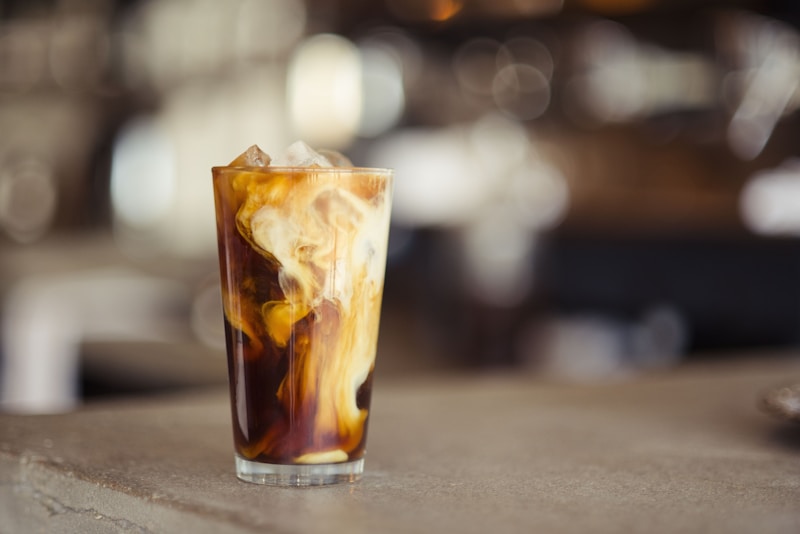
A healthy pumpkin cream cold foam is made from cold heavy cream, cold milk, a spoonful of real pumpkin purée, vanilla, cinnamon, nutmeg, a pinch of salt, and two teaspoons of maple or date syrup — frothed cold, never heated. Built this way it carries 8 grams of added sugar and about 12 grams of total sugars, against the 31 grams of sugar in a Grande Starbucks Pumpkin Cream Cold Brew as analyzed by the Center for Science in the Public Interest in 2025. It takes about two minutes, and it works with a $15 handheld frother, a French press, or a jar with a lid. Nobody craves pumpkin sauce. People crave the cold, the aroma, and the pale ribboned layer sitting on top of dark coffee — and every one of those is a physics problem you can solve at home.
This article is educational, not medical advice. It is a recipe, not a treatment for anything.
Key statistics at a glance
- Cold drinks accounted for about 75% of Starbucks' beverage sales in its fiscal 2024 third quarter, up from 37% in 2013 (CNBC, November 2024)
- Americans spent about $17.7 billion on out-of-home cold coffee in 2023, more than double the $8.5 billion spent in 2016, according to the foodservice research firm Technomic (via CNBC, 2024)
- Flavored cold foams now account for one-third of all beverage customizations at Starbucks, Dana Pellicano, who oversees global product experience at the company, told Yahoo Finance in July 2026; the add-on typically costs about $1.25
- Cold foam sales grew 23% in Starbucks' fiscal third quarter of 2025, CEO Brian Niccol told analysts, and add-ins as a category generate more than $1 billion in revenue a year (Restaurant Business, July 2025)
- A Grande (16 oz) Pumpkin Cream Cold Brew has 250 calories and 31 grams of sugar — "much of it added sugar," per the Center for Science in the Public Interest's analysis of Starbucks data (updated September 2025)
- 25 grams for women, 36 grams for men — the American Heart Association's daily added-sugar ceilings, against a typical US intake of 12–13% of daily calories (American Heart Association, updated May 2026)
- 53.0% of US adult calories and 61.9% of youth calories came from ultra-processed foods in August 2021–August 2023 (CDC/NCHS Data Brief 536, 2025)
- At equal protein, a fat-free milk dispersion produced 16 times the foam volume of whole milk, and a more stable foam (Ho, Xiong, Bhandari and Bansal, Food and Bioprocess Technology, 2024)
Commercial versus homemade, honestly
| Grande Pumpkin Cream Cold Brew | This recipe, foam + 12 oz cold brew | |
|---|---|---|
| Calories | 250 | ~215, calculated |
| Total sugars | 31 g | ~12 g, calculated |
| Added sugars | Not published by Starbucks | 8 g (2 tsp maple syrup) |
| Sweetener | Vanilla syrup, plus the sweetened cream base | 2 tsp pure maple or date syrup |
| Real pumpkin | In the foam base; amount not published | 1 tbsp purée |
| Fat | Cream base | 3 tbsp heavy cream, or coconut cream |
| Sweetness you control | No | Yes, by the teaspoon |
| Cost of the topping | About $1.25 as an add-on | Pennies |
| AHA daily added-sugar limit, men | 36 g |
| AHA daily added-sugar limit, women | 25 g |
| Grande Chocolate Cream Protein Cold Brew | 24 g |
| Grande Iced Banana Cream Protein Matcha | 21 g |
| Grande Iced Vanilla Cream Protein Latte | 10 g |
| This recipe — maple, measured | 8 g |
One note on that chart, because it is the honest part. Those Starbucks figures are for whole drinks, not for the foam alone. Nobody publishes the foam alone — more on that below.
The recipe below makes about a cup of finished foam, which is enough to cap one tall glass generously. Everything goes in cold and stays cold.
Ingredients
- 3 tablespoons (45 ml) heavy cream, straight from the refrigerator
- 3 tablespoons (45 ml) milk of choice, also cold
- 1 tablespoon (15 g) unsweetened pumpkin purée, canned or roasted
- 2 teaspoons (about 13 g) pure maple syrup, or 2 teaspoons date paste
- 1/4 teaspoon pure vanilla extract
- 1/8 teaspoon ground cinnamon
- 1 pinch freshly grated nutmeg, about 1/16 teaspoon
- 1 pinch fine sea salt, about 1/16 teaspoon
- For the dairy-free version: 3 tablespoons (45 ml) chilled coconut cream, spooned from the solid top of a refrigerated can of full-fat coconut milk
- For the dairy-free version: 3 tablespoons (45 ml) cold unsweetened soy milk, in place of the dairy milk
- To serve: 12–16 oz unsweetened cold brew or iced coffee, over ice
Instructions
- Chill the cream, the milk and the mixing vessel for at least 30 minutes; refrigerator temperature is a technical requirement here, not a preference.
- In a tall, narrow jar or measuring cup, whisk the pumpkin purée, maple syrup, cinnamon, nutmeg and salt into a completely smooth slurry before any liquid goes in — purée added to cold cream will stay lumpy.
- Stir in the vanilla extract, then the cold cream and cold milk. The mixture should look like thin, pale orange cream.
- Handheld frother method: submerge the whisk just below the surface, run it for 25–35 seconds, and lift it slowly toward the surface for the last five seconds to fold in the final air.
- French press method: pour the mixture into a cold French press, and plunge briskly 25 to 40 times, about 30 seconds. Keep the screen below the liquid line so you are shearing, not splashing.
- Sealed jar method, no equipment: pour into a jar filled no more than one-third full, seal tightly, and shake hard for 45 to 60 seconds. The empty headspace is the air supply, so do not overfill.
- Stop when the volume has roughly doubled and the foam ribbons off a spoon, holding the ribbon for about two seconds before smoothing out. Past that point you are churning butter, not building foam.
- Pour slowly over the back of a spoon onto the surface of the iced coffee so the layer settles rather than plunges, then dust with cinnamon and serve immediately.
Why cold foam works at all: the actual food science
This is where most recipe posts stop and say "shake it up." The interesting part is that foam is an unstable object you are temporarily talking out of collapsing, and knowing which forces are on your side tells you exactly which mistakes to stop making.
A foam is air held apart by a film. Whip a liquid and you create an enormous new air–water interface. Water alone will not hold it; the surface pulls itself flat within seconds. What holds it is surface-active molecules that migrate to the interface and build a skin. As the 2023 open-access review by Deotale and colleagues in Discover Chemical Engineering puts it, soluble proteins "quickly get adsorbed at the air–water interface during the formation of aqueous foam owing to their strong surface activity and capacity to create thick viscoelastic films," which sterically stabilizes bubbles against merging and coarsening.
Milk's proteins do most of that work, and they do not all do it the same way. Milk protein is roughly 80% casein and 20% whey. Whey proteins — β-lactoglobulin and α-lactalbumin above all — are compact globular molecules that adsorb and partially unfold to form an elastic film. Caseins are floppier and reach the interface faster. In the 2025 IntechOpen review by Lajnaf, Attia and Ayadi, the interfacial layer of milk foam is described as being maintained by β-lactoglobulin, α-lactalbumin and β-casein together. The practical consequence: protein content, not fat content, is what makes a foam at all. If your dairy-free milk foams badly, protein is usually the missing ingredient, which is why soy behaves so differently from almond.
And here is the part that reverses everyone's intuition: a little fat wrecks foam, a lot of fat builds it. Ho, Xiong, Bhandari and Bansal, writing in Food and Bioprocess Technology in 2024, found that at a matched 0.5% protein concentration, skim milk powder dispersions produced 16 times the foam volume of whole milk dispersions, with more stable foam. Kamath, Huppertz, Houlihan and Deeth, in the International Dairy Journal in 2008, reported the same direction: "Milk fat had a detrimental effect on foam formation and stability of whole milk," and bubbles in whole milk foams "were smaller and showed a higher degree of rupture as a result of coalescence than those in skim milk foams."
Yet cold foam is made with cream. Both things are true, and the crossover is the whole trick. At low concentration, liquid fat droplets act as saboteurs — they reach the film, spread, and displace the protein network that was holding it together. At high concentration and low temperature, fat stops being a contaminant and becomes the architecture. Whipping cream works by partial coalescence: crystalline fat globules pierce each other's membranes and link into a network that armors the bubbles. That mechanism has thresholds. As summarized in Ghorbani-HasanSaraei and colleagues' 2019 paper in Food Science & Nutrition, the minimum fat content of cream must be 30% to give a rigid foam structure (Graf and Muller, 1965), and at least 40% of the fat must be crystalline to promote the partial coalescence that stiffens the air-bubble interface (Darling, 1982).
Your cold foam sits deliberately between those worlds. Three tablespoons of heavy cream (about 36% milk fat, per USDA FoodData Central) diluted with three tablespoons of milk lands at roughly 14% fat overall — comfortably above milk, comfortably below the 30% that gives whipped cream its stand-up rigidity. That is precisely why cold foam pours. Push the cream ratio up and you get a topping that sits on the glass like a hat; push it down and you get a fragile lace that vanishes into the coffee.
Why cold matters here, when hot matters for cappuccino
Steamed milk foam and cold foam are not the same object made at different temperatures. They are two different stabilization strategies.
Kamath and colleagues (2008) tested milk from 5 °C to 85 °C and found skim milk foams were most stable when formed at 45 °C — hot enough that fat is fully liquid, and where protein does the job unopposed. Milk fat was detrimental "especially in the temperature range 15–45 °C." Oetjen, Bilke-Krause, Madani and Willers, publishing in Colloids and Surfaces A in 2014, measured a clear minimum in both foamability and foam stability at 25 °C across pasteurized and UHT milk at 1.5% and 3.5% fat. Room-temperature milk is the single worst milk to foam.
The reason is that milk fat is not simply solid or liquid — it passes through a wide semi-crystalline zone. Below roughly 5 °C the fat is essentially solid and whole milk behaves much like skim; above roughly 40 °C it is fully liquid; in between, partly crystallized globules are at their most destructive to a thin film.
Cold foam cannot use heat, so it uses the other end of that curve. Refrigerator-cold is not an aesthetic choice — it is the condition under which the fat crystals exist that make cream foam at all. Warm cream has too little crystalline fat to build the network (Darling's 40% threshold), and lukewarm cream sits in the worst zone on both counts. This is the single highest-leverage instruction in the recipe, and it is the one people skip.
Why it eventually collapses
Every foam is on a clock. Food scientists describe three destabilization routes, and Deotale and colleagues (2023) note that they "occur simultaneously, and can thereby strengthen one another."
- Drainage. Liquid runs out of the thin films and Plateau borders under gravity and capillary pressure. The films thin, and thinner films rupture more easily. In the Annual Review of Food Science and Technology, Narsimhan and Xiang (2018) note that syneresis — this liquid separation — often precedes visible collapse. On your drink, drainage is what turns a crisp boundary into a blurry one.
- Coalescence. The film between two bubbles ruptures and they merge. This is the mechanism Kamath and colleagues implicated when whole milk foams showed a higher degree of bubble rupture than skim.
- Disproportionation, the foam counterpart of Ostwald ripening in emulsions. Gas diffuses through the film from small bubbles into large ones, because smaller bubbles have higher internal Laplace pressure. Small bubbles shrink and vanish; large ones grow. Deotale and colleagues describe the vicious cycle plainly: coarsening thins the Plateau borders, which "creates larger films resulting in quick drainage of foam."
So: how long does cold foam hold? Honestly, minutes, not hours, and we are not going to publish a stopwatch figure we cannot defend — half-life depends on your cream's fat, your ingredients' temperature, and how fine your bubbles are. What you can control is the direction. Finer bubbles slow disproportionation. Colder cream slows drainage, because a stiffer fat network resists it. And pouring the foam gently over the back of a spoon preserves the layer far longer than dropping it in, because you are not shearing your own bubbles on the way down. A café builds these to order for exactly this reason.
How do you make cold foam without a frother?
You need shear and you need air. A handheld frother is simply the cheapest way to deliver both — and it is what the professionals use: Starbucks baristas make cold foam with a handheld, portable frother, as Restaurant Business reported in July 2025. Starbucks' own at-home recipe for vanilla sweet cream cold foam tells you to "use a handheld milk frother or froth your milk by hand."
But two things you already own will work.
A French press is the best no-frother option. The mesh screen forces liquid through fine holes on every stroke, which is a very efficient way to shear big bubbles into small ones — and small bubbles are what resist disproportionation. Twenty-five to forty brisk plunges, roughly 30 seconds. Keep the screen submerged.
A sealed jar works, and it is the most forgiving. The rule that matters is headspace: fill the jar no more than one-third, because the empty two-thirds is the air you are incorporating. Shake hard for 45 to 60 seconds. The foam will be slightly coarser than the French press version, so drink it sooner.
An immersion blender or small blender also works, but it is easy to overshoot. At 15% fat, more energy is not more foam past a certain point — you are driving partial coalescence toward butter granules. If the surface goes from glossy to grainy, you have gone too far.
Is homemade pumpkin cream cold foam actually healthier?
It has substantially less added sugar. That is the claim worth making, and it is the only one we will make.
It is not a low-calorie topping, and anyone telling you otherwise is selling something. Three tablespoons of heavy cream carry about 153 calories and 16 grams of fat at USDA FoodData Central's figure of 51 calories and 5.4 grams of fat per tablespoon. Add the syrup, the purée and the milk and this recipe lands around 215 calories on top of an essentially calorie-free cold brew — genuinely comparable to the 250-calorie Grande. What changes is the sugar: about 12 grams total and 8 grams added, against 31 grams of sugar in the commercial drink.
That is the trade, stated plainly: you are swapping a syrup-forward topping for a fat-forward one. Fat and protein also carry aroma and give a drink body, which is the mechanism by which a smaller amount of sweetness registers as enough. Where different sweeteners and fats sit relative to each other is laid out in our food chart, and the broader pattern — that the ultra-processed share of the American plate reached 53.0% of adult calories in 2021–2023 (CDC/NCHS, 2025) — is the reason rebuilding one daily ritual from real ingredients is worth the two minutes.
The sugar nobody counts
Here is the structural problem with cold foam, and it has nothing to do with whether it tastes good.
Cold foam is a topping, so its sugar is additive. It does not replace the sweetener in the drink underneath; it stacks on top of it. A Pumpkin Cream Cold Brew is cold brew sweetened with vanilla syrup and then topped with sweetened pumpkin cream foam. Two sweeteners, one order, one line on the menu.
Now the honest part. We could not confirm a published figure for the pumpkin cream cold foam topping on its own, because Starbucks does not appear to publish one. This is not for lack of trying by people with more leverage than us: when the Center for Science in the Public Interest asked Starbucks' corporate office for nutrition data on unsweetened Protein Cold Foam as a customization, in an article updated in November 2025, the answer it published was that Starbucks "weren't able to get full nutritional information for that customization." We are not going to invent a number to fill that hole.
What can be said structurally is quite a lot:
- The coffee underneath contributes essentially nothing. Cold brew is coffee and water. Whatever sugar appears in the finished drink came from the syrup and the foam.
- The finished-drink figures are published and they are not small. CSPI's 2025 analysis puts a Grande Pumpkin Cream Cold Brew at 250 calories and 31 grams of sugar. In its November 2025 review of Starbucks' protein line, CSPI reported a Grande Chocolate Cream Protein Cold Brew at 330 calories and 24 grams of added sugar, an Iced Banana Cream Protein Matcha at 430 calories and 21 grams, and an Iced Vanilla Cream Protein Latte at 390 calories and 10 grams — figures CSPI obtained from Starbucks' corporate office and published nutrition information. The American Heart Association's entire daily ceiling is 25 grams for women and 36 for men.
- The chain's own consumer recipe shows the ratio. Starbucks' at-home vanilla sweet cream cold foam recipe calls for a quarter cup of 2% milk, a quarter teaspoon of vanilla extract, and one tablespoon of powdered sugar — about 8 grams, or roughly 7.8 grams of sugar per USDA FoodData Central. That is a tablespoon of sugar dissolved into a couple of ounces of milk, in a single serving of topping, before the drink underneath is sweetened at all.
That third point is the whole argument for making it yourself. The commercial topping's sweetness was decided in advance; yours is two teaspoons you can measure, taste, and cut to one.
Cold drinks are the format now, and cold foam is how sugar rides along
This matters commercially, not just personally. Cold drinks accounted for about 75% of Starbucks' beverage sales in its fiscal 2024 third quarter, up from 37% in 2013, CNBC reported in November 2024, and 45% of coffee drinkers aged 18 to 24 said they had had a cold coffee in the past day in a July 2024 National Coffee Association survey. Hot coffee is now the minority format in American coffeehouses.
Cold foam is the fastest-growing thing riding that wave. Introduced at Starbucks' Seattle shops in 2014 and expanded nationwide in 2018, it now accounts for one-third of all beverage customizations, Starbucks told Yahoo Finance in July 2026, at about $1.25 a pour. Cold foam sales rose 23% in the company's fiscal third quarter of 2025, CEO Brian Niccol told analysts, and 40% year over year in the second quarter, he said at an investor conference; add-ins as a whole bring in more than $1 billion a year.
| 2013 | 37% |
| Fiscal Q3 2021 | 74% |
| Fiscal Q3 2024 | 75% |
None of that is an indictment of cold coffee. It is context: the fastest-growing add-on in American coffee is a sweetened topping whose sugar is not separately disclosed, sold onto drinks that are already sweetened. Cravings are signals, not flaws — the craving here is for cold, cream and aroma, and you can have all three without the second helping of syrup.
Can it be made dairy-free?
Yes, and the mechanism tells you exactly which substitution to make.
Use chilled coconut cream for the fat. Refrigerate a can of full-fat coconut milk overnight and spoon the solid layer off the top. Coconut fat is unusually saturated, so at refrigerator temperature a large fraction of it is crystalline — the same condition that makes cold dairy cream foam, arriving by a different route.
Use soy milk for the protein. Soy is the plant milk with protein content in the neighborhood of dairy, and protein is what builds the interfacial film. Oat milk is the next best choice for body, though many commercial oat milks contain added sugars generated by enzymatic hydrolysis of the oat starch — check that line on the label and cut your maple syrup accordingly. Almond milk is the weakest performer here; it is short on both protein and fat, which is a foam problem, not a taste problem.
If you are working through how dairy sits with you, treat it as an investigation rather than a rule — our post on daily habits for gut health covers running that kind of test without turning it into restriction.
Can you make it without refined sugar?
You can make it without refined sugar. You cannot make it sweet without added sugar, and it matters that we say so.
Maple syrup, honey, coconut sugar, agave and date syrup are all added sugars by the FDA's definition, which covers sugars added during processing as well as sugars from syrups and honey. One tablespoon of pure maple syrup carries about 12 grams of sugar and 52 calories (USDA FoodData Central), so the two teaspoons in this recipe are 8 grams of added sugar — real, counted, and yours to reduce.
Date paste is the one genuinely different case, because the fruit's fiber matrix is intact rather than pressed out. It also behaves differently in a foam. Date paste is a purée rather than a concentrate, so it carries insoluble fiber and raises the viscosity of the mixture — and higher viscosity slows the diffusion of protein to the air–water interface, which is one reason thicker mixtures are harder to aerate. Blend it as smooth as you can get it, and give the foam a little longer to build. To make it, soak 10 pitted Medjool dates in just-boiled water for 20 minutes, then blend with 1/3 cup of the soaking liquid and a pinch of salt.
And use the salt. Coffee is bitter, cold suppresses aroma volatility, and salt suppresses bitterness — that pinch is the reason two teaspoons of syrup taste like more. The same sensory logic, with the underlying studies, is laid out in the sibling post on the healthy pumpkin spice latte.
What to do with the rest of the can
A 15-ounce can of pumpkin holds roughly 28 tablespoons of purée — nearly thirty batches of this foam. Per USDA FoodData Central, a cup of plain canned pumpkin supplies 17,003 micrograms of beta-carotene, 1,906 micrograms RAE of vitamin A, and 7.1 grams of fiber for 83 calories — but once opened it keeps only about 5 to 7 days refrigerated in a sealed container, since it is a low-acid food. Freeze it in tablespoon portions in an ice cube tray and you have a season's worth of mornings that cost you two minutes each.
That is the method for the whole season: keep the ritual, rebuild the ingredients, and let cold, fat and salt do the work syrup used to do. Consistency over intensity — if you want the swap tracked alongside the rest of your routine, the Sakred app is built for exactly that kind of daily, unglamorous follow-through.
Frequently asked questions
How much sugar is in a Starbucks pumpkin cream cold foam?
Starbucks does not appear to publish nutrition for the cold foam topping on its own. The Center for Science in the Public Interest reported in November 2025 that when it requested figures for an unsweetened Protein Cold Foam customization, Starbucks' corporate office said it "weren't able to get full nutritional information for that customization." What is published is the finished drink: a Grande Pumpkin Cream Cold Brew has 250 calories and 31 grams of sugar, per CSPI's 2025 analysis of Starbucks data. Because the cold brew underneath is unsweetened coffee, essentially all of that comes from the vanilla syrup and the foam together.
Can you make cold foam without a frother?
Yes. A French press is the best substitute — 25 to 40 brisk plunges, about 30 seconds, with the screen kept below the liquid line — because the mesh shears bubbles finer than shaking does. A jar with a tight lid also works: fill it no more than one-third full so there is air to incorporate, and shake hard for 45 to 60 seconds. Starbucks' own at-home recipe says you can "use a handheld milk frother or froth your milk by hand."
Why won't my cold foam thicken?
Almost always one of three things. The cream was not cold enough — milk fat is only partly crystalline at room temperature, and research by Oetjen and colleagues (Colloids and Surfaces A, 2014) found milk's foamability and foam stability both hit a minimum at 25 °C. Or the fat content is too low, in which case there is no fat network to build. Or you used a low-protein plant milk such as almond, which lacks the protein needed to form the film that holds air. Chill everything, keep the cream ratio at or above half, and choose soy over almond.
Is heavy cream or milk better for cold foam?
Neither alone. Milk foams more readily — at equal protein, a fat-free dispersion produced 16 times the foam volume of whole milk in a 2024 study by Ho and colleagues in Food and Bioprocess Technology — but that foam is light and drains fast. Cream builds a fat-crystal network that holds, but pure cream at 30%-plus fat whips rigid rather than pouring (Graf and Muller, 1965, via Ghorbani-HasanSaraei et al., 2019). Roughly half cream and half milk lands between the two, which is why cold foam pours in a layer instead of sitting on top like whipped cream.
Sources
- Center for Science in the Public Interest — How much sugar is in a pumpkin spice latte? (updated 2025)
- Center for Science in the Public Interest — Which Starbucks protein drinks have the most—or least—sugar? (updated November 2025)
- CNBC — Cold coffee grows more popular in the U.S. (Ryan Baker, November 2024)
- Restaurant Business — At Starbucks, cold foam is a big bright spot (Jonathan Maze, July 2025)
- Yahoo Finance — Starbucks and other coffee shop menus are leaning into fruits and foams (Brooke DiPalma, July 2026)
- Yahoo Finance — Starbucks' cold beverages are massively outselling hot coffee in the US (Julia La Roche, July 2021)
- Starbucks Coffee At Home — Vanilla Sweet Cream Cold Foam recipe
- American Heart Association — How Much Sugar Is Too Much? (updated May 2026)
- US Food and Drug Administration — Added Sugars on the Nutrition Facts Label
- CDC / National Center for Health Statistics — Ultra-processed Food Consumption in Youth and Adults, United States, August 2021–August 2023, Data Brief 536 (2025)
- Kamath S., Huppertz T., Houlihan A.V., Deeth H.C., International Dairy Journal — The influence of temperature on the foaming of milk (2008)
- Oetjen K., Bilke-Krause Ch., Madani M., Willers Th., Colloids and Surfaces A — Temperature effect on foamability, foam stability, and foam structure of milk (2014)
- Ho T.M., Xiong X., Bhandari B.R., Bansal N., Food and Bioprocess Technology — Foaming Properties and Foam Structure of Milk Determined by Its Protein Content and Protein to Fat Ratio (2024)
- Deotale S.M., Dutta S., Moses J.A., Anandharamakrishnan C., Discover Chemical Engineering — Foaming and defoaming: concepts and their significance in food and allied industries, a review (2023)
- Narsimhan G. & Xiang N., Annual Review of Food Science and Technology — Role of Proteins on Formation, Drainage, and Stability of Liquid Food Foams (2018)
- Lajnaf R., Attia H., Ayadi M.A., IntechOpen — Milk Proteins: Foaming and Emulsifying Properties in Dairy Processing (2025)
- Ghorbani-HasanSaraei A., Rafe A., Shahidi S.-A., Atashzar A., Food Science & Nutrition — Microstructure and chemorheological behavior of whipped cream as affected by rice bran protein addition (2019)
- USDA FoodData Central — Cream, fluid, heavy whipping
- USDA FoodData Central — Syrups, maple
- USDA FoodData Central — Sugars, powdered
- USDA FoodData Central — Pumpkin, canned, without salt