Healthy Pumpkin Spice Coffee Creamer — and What Is Actually in the Bottle
Most commercial coffee creamer contains no cream. It is water, sugar, and vegetable oil held together by emulsifiers, labeled at a one-tablespoon serving almost nobody pours. Here is what the labels say, and a batch pumpkin spice creamer that keeps a week.

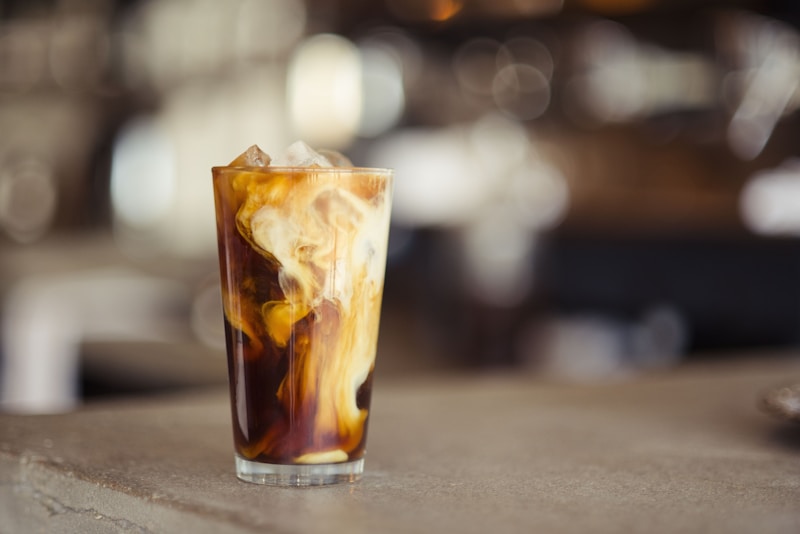
A healthy pumpkin spice coffee creamer is made from real pumpkin purée, milk and cream (or full-fat coconut milk), vanilla, cinnamon, nutmeg, ginger, clove, a pinch of salt, and a measured three tablespoons of maple syrup for the whole batch. It takes twenty minutes, yields about 2½ cups, keeps five days in the fridge, and delivers roughly 1.8 grams of added sugar in a 2-tablespoon pour. The reason to bother is what the alternative turns out to be: read the ingredient panel on the two best-selling creamers in an American grocery store and you will not find cream. You will find water, sugar or corn syrup solids, vegetable oil, and a short list of emulsifiers and buffering salts.
This article is educational, not medical advice. It is a recipe and a label investigation — not a treatment for anything.
Key statistics at a glance
- Coffee mate The Original (32 oz liquid) lists: water, corn syrup solids, soybean oil, and less than 2% micellar casein (a milk derivative), mono- and diglycerides, dipotassium phosphate, natural flavor, and carrageenan (Nestlé product labeling). No cream appears on the list.
- International Delight French Vanilla lists: water, sugar, palm oil, and less than 2% sodium caseinate, dipotassium phosphate, carrageenan, mono and diglycerides, natural and artificial flavors, sodium stearoyl lactylate, and salt — 35 calories and 5 grams of added sugar per 1 tablespoon, which the label puts at 10% of the Daily Value (International Delight, 2026)
- 1 tablespoon (15 mL) is the reference amount the FDA assigns to "cream or cream substitutes, fluid" under 21 CFR 101.12 — the figure every creamer panel is built on
- Under 0.5 grams of trans fat per serving may be declared as "0 g" under 21 CFR 101.9 — a rule that mattered enormously when partially hydrogenated oils were standard in liquid creamers
- June 16, 2015: the FDA determined there is "no longer a consensus among qualified experts" that partially hydrogenated oils are generally recognized as safe, with a primary compliance date of June 18, 2018 (FDA, 2015)
- 66% of American adults drink coffee every day, averaging nearly three cups, with 82% of past-day drinkers having it at home (National Coffee Association, 2025)
- At least 17 teaspoons of added sugar a day for the average American aged 20 and over (CDC), against the American Heart Association's ceilings of 25 grams for women and 36 grams for men
Commercial vs. homemade, per 2 tablespoons
| International Delight French Vanilla | Coffee mate The Original | This creamer | |
|---|---|---|---|
| Calories | 70 | 40 | ~41 |
| Added sugars | 10 g | under 2 g | ~1.8 g |
| Fat source | Palm oil | Soybean oil | Milk fat and cream |
| Dairy | Sodium caseinate (milk protein) | Micellar casein (milk protein) | Milk and cream |
| Emulsifiers / stabilizers | Carrageenan, mono and diglycerides, sodium stearoyl lactylate, dipotassium phosphate | Mono- and diglycerides, dipotassium phosphate, carrageenan | None |
| Real pumpkin | Not an ingredient | Not an ingredient | 1/3 cup per batch |
| Separates in the jar | No | No | Yes — shake it |
| Keeps | Months, sealed | Months, sealed | 5 days |
| Flavored creamer, 1 tbsp (the labeled serving) | 5g |
| Flavored creamer, 3 tbsp | 15g |
| Flavored creamer, 4 tbsp | 20g |
| This creamer, 3 tbsp | 2.7g |
About the sweetener
Both versions use real sugar. That is not the difference, and saying otherwise invites an easy correction — the commercial product is sweetened with cane sugar, not an artificial sweetener.
What differs is what the sugar arrives inside. This recipe sweetens with whole Medjool dates. Dates are more than 70% sugar, which we are not going to pretend away — and yet across five varieties tested in both healthy and type 2 diabetic subjects they measured a glycemic index of roughly 44 to 55, low-to-medium, with no significant post-meal glucose excursions in the diabetic group (Alkaabi et al., Nutrition Journal, 2011). The fruit's fiber is still attached and still doing its job. Strain it out into a syrup and that advantage leaves with it.
So the claim is not that this sugar is free. FDA counts dates, maple and coconut sugar as added sugars, and so do we. The claim is less sugar, and sugar that still has its fiber. Full breakdown of which sugar substitute is actually healthiest.
Ingredients
- 1 1/2 cups (360 ml) whole milk
- 1/2 cup (120 ml) heavy cream
- 1/3 cup (80 g) unsweetened pumpkin purée, canned or homemade
- 3 tablespoons (60 g) pure maple syrup, or 1/4 cup date paste
- 1 1/2 teaspoons ground cinnamon
- 3/4 teaspoon freshly grated nutmeg
- 3/4 teaspoon ground ginger
- 1/8 teaspoon ground clove
- 1/4 teaspoon fine sea salt
- 2 teaspoons pure vanilla extract, stirred in off the heat
- Dairy-free version: replace the milk and cream with 1 can (13.5 oz) full-fat coconut milk plus 1/2 cup (120 ml) oat milk
Instructions
- Whisk the pumpkin purée, cinnamon, nutmeg, ginger, clove, and salt together in a small saucepan over medium heat for 60 seconds, until the paste darkens slightly and smells toasted rather than raw.
- Add the maple syrup and whisk until the mixture is smooth and glossy.
- Add the milk and cream a splash at a time at first, whisking each addition in completely before adding more — this is what prevents grainy lumps of unblended purée.
- Heat, whisking often, until the creamer reaches 165°F (74°C). It should steam with small bubbles at the edge; do not let it boil.
- Take the pan off the heat and stir in the vanilla extract.
- Blend the hot mixture for 30 seconds with an immersion blender or in a standing blender, venting the lid. This breaks the pumpkin fiber into finer particles so it stays suspended longer.
- Strain through a fine sieve if you want a texture closer to commercial creamer; skip this if you want the fiber.
- Cool uncovered for 20 minutes, then pour into a clean glass jar, seal, and refrigerate.
- Chill at least 4 hours before the first pour — the spices keep infusing and the flavor sharpens noticeably.
- Shake hard for five seconds before every single use. Real pumpkin settles.
Why it separates, and why that is the point
Shake the jar. You have to; the commercial bottle next to it does not. That difference is this entire article expressed as a physical fact.
Pumpkin purée is insoluble fiber and starch suspended in water. Cream is fat droplets suspended in water. Left alone, both obey gravity: fiber sinks, fat rises. Commercial creamer does not do this because it is engineered not to. Mono- and diglycerides sit at the boundary between oil and water and keep the oil dispersed as fine droplets instead of letting it coalesce into a slick on top. Carrageenan, extracted from red seaweed, thickens the water phase so particles move through it slowly. Dipotassium phosphate does something more specific: coffee is acidic, and milk proteins coagulate near their isoelectric point, so the phosphate buffers the pH upward and prevents "feathering" — the white flecking you sometimes see when real dairy hits very hot, very acidic coffee. Sodium stearoyl lactylate, in the International Delight list, is a second emulsifier that also improves foam stability.
None of that is sinister chemistry. It is competent engineering for a product that must survive months on a shelf and a temperature shock in a mug. It is also, precisely, why a bottle of creamer can contain no cream: once you can hold oil and water together indefinitely, the cream becomes optional. The homemade version has neither trick, so shake it before every pour — and if it ever feathers in a very hot, very acidic brew, put the creamer in the mug first and the coffee on top.
What is actually in coffee creamer?
We read the current published ingredient lists for three products in three different market positions.
Coffee mate The Original, the category's biggest name, lists water, corn syrup solids, soybean oil, and less than 2% micellar casein (a milk derivative), mono- and diglycerides, dipotassium phosphate, natural flavor, and carrageenan. The single-serve cups use a different formula — water, coconut oil, sugar, sodium caseinate, dipotassium phosphate, mono- and diglycerides, artificial flavor, beta carotene color. Both are marketed as non-dairy and lactose-free, and both contain a protein derived from milk. Casein is the reason the product whitens coffee at all: it is the same protein that makes milk opaque.
International Delight French Vanilla lists water, sugar, palm oil, and under 2% sodium caseinate, dipotassium phosphate, carrageenan, mono and diglycerides, natural and artificial flavors, sodium stearoyl lactylate, and salt. Water, sugar, and oil are the first three lines.
Coffee mate natural bliss, the "natural" position in the same portfolio, is a genuine exception and deserves to be reported as one. The Sweet Cream variety is milk, cream, cane sugar, and natural flavor. The Coconut Milk variety is coconut milk (water, coconut cream), cane sugar, coconut oil, pea protein, baking soda, and gellan gum. Chobani's creamer line is likewise built on cream, milk, and cane sugar. If you want a commercial product that contains what the word "creamer" implies, these exist — you will pay for them, and they still carry cane sugar as the third ingredient.
One note against overclaiming: polysorbate 60, an emulsifier frequently named in discussions of creamer, did not appear on any of the three liquid labels we read. It shows up in whipped toppings and in some other creamer formulations. Check your own bottle rather than assuming.
Why does the label say one tablespoon?
Because the FDA told it to. Under 21 CFR 101.12, the Reference Amount Customarily Consumed for "cream or cream substitutes, fluid" is 15 mL, declared on the label as 1 tbsp (15 mL). Every creamer nutrition panel in the country is anchored to that number.
RACCs are meant to reflect what people actually consume, not what they should. But a scoping review in Nutrients (2019) found that most consumers read "serving size" as a recommendation rather than a reference amount, and the same body of work notes that labeled serving sizes influence how much people then serve themselves.
Here is where we have to be straight with you: we could not find published survey data on how much creamer Americans actually pour. Coffee industry blogs assert two to four tablespoons per mug; none of them cite a source, and we are not going to launder a marketing estimate into a statistic. What we can do is arithmetic, which is unambiguous. International Delight French Vanilla carries 5 grams of added sugar per labeled tablespoon:
| Pour | Added sugar, one mug | % of AHA daily limit (women) | Three mugs a day |
|---|---|---|---|
| 1 tbsp | 5 g | 20% | 15 g |
| 2 tbsp | 10 g | 40% | 30 g |
| 3 tbsp | 15 g | 60% | 45 g |
| 4 tbsp | 20 g | 80% | 60 g |
The National Coffee Association's 2025 National Coffee Data Trends report found that 66% of US adults drink coffee daily and that coffee drinkers average nearly three cups a day, with 82% of past-day drinkers having it at home. So the right-hand column is not a stunt. It is a plausible Tuesday.
| Flavored creamer, 3 tbsp x 3 mugs | 45g added sugar |
| AHA daily limit, men | 36g added sugar |
| AHA daily limit, women | 25g added sugar |
| This creamer, 3 tbsp x 3 mugs | 8.1g added sugar |
The 2025–2030 Dietary Guidelines for Americans, released in January 2026, went further than any previous edition: as summarized by Harvard's Nutrition Source, the new guidance states that no amount of added sugars is recommended as part of a healthy diet, and that no single meal should exceed 10 grams of added sugars. Three tablespoons of flavored creamer clears that per-meal figure by itself, before breakfast exists.
That is the actual argument for making your own. Not that a mug of coffee is dangerous — it is that creamer is not an occasional treat. It is a habit with 365 iterations a year, which is the kind of small recurring input that shapes terrain. Where individual foods sit on that spectrum is what our food chart is for, and the broader pattern is covered in inflammatory foods and what to eat instead.
What about the "0 grams trans fat" on the label?
This one has a real history and an honest ending, and both halves matter.
Under 21 CFR 101.9, if a serving contains less than 0.5 gram of trans fat, the declaration "shall be expressed as zero." Combine that rounding allowance with a 1-tablespoon reference amount and you get a label that can read "0 g" while a four-tablespoon pour delivers up to about 1.8 grams. For creamers this was not hypothetical. Liquid non-dairy creamers were commonly built on partially hydrogenated soybean or cottonseed oil, and a Center for Science in the Public Interest review of coffee creamers in 2008 reported products carrying up to 0.46 grams of trans fat per serving while declaring zero.
That specific problem is closed. On June 16, 2015 the FDA issued its final determination that "there is no longer a consensus among qualified experts that partially hydrogenated oils (PHOs) are 'generally recognized as safe' (GRAS) for any use in human food." The primary compliance date was June 18, 2018; certain petitioned uses ran to June 18, 2019, with January 1, 2021 allowed for existing product to clear distribution. A further FDA rule effective December 22, 2023 revoked the remaining authorizations, including pre-1958 sanctioned uses in margarine, shortening, and bread. The FDA estimated that removing trans fat from the food supply would prevent roughly 20,000 heart attacks and 7,000 coronary deaths a year.
So: partially hydrogenated oils are no longer permitted in the US food supply, and the creamer in your fridge does not contain them. Anyone telling you otherwise in 2026 is recycling a 2008 article. The soybean and palm oils on today's labels are not partially hydrogenated.
What survives is the structural lesson. The rounding rule is still in the regulation, the 1-tablespoon reference amount is still the anchor, and the gap between a labeled serving and a real pour still quietly multiplies everything on the panel by three or four. Trans fat was the case where that gap did visible damage. Sugar is the case where it still does.
Are the emulsifiers in creamer a problem?
Honest answer: the research is genuinely interesting, genuinely early, and mostly not about these specific compounds at these doses. Anyone who tells you emulsifiers are proven harmful, or proven harmless, is ahead of the evidence.
The strongest human data is a small randomized controlled feeding trial, and it studied a compound that is not in these creamers. Chassaing and colleagues, publishing in Gastroenterology in 2022, randomized 16 healthy adults in an inpatient setting to an emulsifier-free diet or the identical diet with 15 grams per day of carboxymethylcellulose for 11 days. The CMC group showed depletion of microbiota-related metabolites including short-chain fatty acids, evident by day 3, and two participants showed bacteria encroaching into the normally sterile inner mucus layer. That is a real controlled result. It is also 16 people for 11 days at a dose far above ordinary dietary exposure, and CMC does not appear on any creamer label we read.
A randomized trial does exist for carrageenan, which is in these creamers. Wagner and colleagues, in BMC Medicine (2024), ran a double-blind placebo-controlled crossover in 20 healthy young men, 250 mg of carrageenan twice daily for two weeks per arm. Intestinal permeability increased during the carrageenan phase (p = 0.03), but whole-body insulin sensitivity was unaffected in these metabolically healthy participants. Twenty young men, two weeks, one biomarker moving — that is a signal worth following, not a conclusion.
The large studies are observational. Sellem and colleagues, in The BMJ (2023), followed 95,442 French adults in the NutriNet-Santé cohort for a median 7.4 years and found positive associations between cardiovascular disease and several emulsifiers, including celluloses, carboxymethylcellulose, mono- and diglycerides of fatty acids, citric acid esters, lactic esters, and trisodium phosphate. The same group's 2024 analysis in PLOS Medicine followed roughly 92,000 adults for a mean 6.7 years and 2,604 incident cancers, reporting mono- and diglycerides (E471) associated with overall cancer (HR 1.15), breast cancer (HR 1.24), and prostate cancer (HR 1.46), and carrageenan associated with breast cancer (HR 1.32). The authors are explicit about the limits: exposure measurement error, residual confounding, a health-conscious and mostly female cohort that limits generalizability, and no established causality. Their own words are that the results "need replication in other populations."
And the regulators have not moved. The FDA treats food-grade carrageenan as generally recognized as safe, and the FAO/WHO Joint Expert Committee on Food Additives maintains an acceptable daily intake "not specified" for carrageenan and processed Eucheuma seaweed — the designation used when a substance appears safe at normal use levels.
Where that leaves a reasonable person: not alarm, but curiosity. Investigative, not restrictive. If you are already working on digestion, an emulsified daily beverage is a sensible thing to test rather than assume — remove it for two weeks, reintroduce, watch what your body reports. Bloating, cravings, and fog are signals, not flaws. Our post on daily habits for gut health covers how to run that as an investigation.
Can you make it without refined sugar?
You can make it without refined sugar. You cannot make it sweet without added sugar, and it matters that we say so.
Maple syrup, honey, coconut sugar, agave, and date syrup are all added sugars. The FDA's definition explicitly covers sugars from syrups and honey, and even single-ingredient products like pure maple syrup must declare a percent Daily Value for added sugars. One tablespoon of pure maple syrup carries about 12 grams of sugar and 52 calories (USDA FoodData Central). Three tablespoons across a 2½-cup batch works out to roughly 1.8 grams of added sugar per 2-tablespoon pour — real sugar, in a quantity you chose, measured with a spoon you were holding.
Whole dates are a genuinely different case, though not a free one. In date paste the fruit's fiber matrix is intact, and pectin and fiber change the physics: the paste thickens as it cools and clings rather than thinning out, which suits a creamer well. To make it, soak 8 pitted Medjool dates in just-boiled water for 20 minutes, then blend with 1/4 cup of the soaking liquid and a pinch of salt until completely smooth, and use 1/4 cup in place of the maple syrup. It is still sugar. It is sugar arriving with structure.
A note of restraint on the spices: cinnamon is in this recipe for aroma and perceived sweetness. We are not claiming it controls blood sugar — clinical evidence on that is mixed, and it is not why it's here.
How do you make it taste like the store version?
Four adjustments, in descending order of impact.
- Toast the purée and spices dry, first. Sixty seconds before any liquid enters the pan. Raw canned pumpkin tastes vegetal and flat; heat drives the browning reactions that produce the roasted note commercial formulas get from flavor systems.
- Do not skip the salt. Breslin and Beauchamp showed in Nature (1997) that salts selectively suppress bitterness more than they suppress sweetness, so that adding sodium to a sugar-plus-bitter mixture raised perceived sweetness. Coffee is the bitter compound. A quarter teaspoon of salt across the batch is the highest-leverage ingredient on the list and the one people skip.
- Add the vanilla off the heat. Bertelsen and colleagues, across studies in Chemical Senses (2020) and Food Quality and Preference (2021) with 159 Chinese and 161 Danish consumers, found that samples with added vanilla aroma were rated significantly sweeter than identical samples without it. Vanillin is volatile; every minute it simmers is perceived sweetness you have to buy back with syrup.
- Keep the fat. Whole milk and cream carry aroma compounds and give body, and body is why a smaller amount of sweetness registers as enough. A skim version tastes thin and pushes you toward more syrup — which is the same reason the commercial product is built on oil.
Can it be made dairy-free?
Yes, and this is the version that most resembles a commercial non-dairy creamer while containing none of the additives.
Replace the milk and cream with one 13.5-ounce can of full-fat coconut milk plus ½ cup of oat milk. Coconut's fat content does the work cream was doing, and it carries the spice aroma well; the oat milk thins it to a pourable consistency. Expect more separation, not less — coconut fat solidifies when cold, so let the jar sit on the counter for five minutes and shake hard, or run it briefly under warm water.
Two cautions. Many commercial oat milks contain sugars produced by enzymatic hydrolysis of the oat starch, so check the added-sugars line and drop your maple syrup accordingly. And several oat and nut milks contain gellan gum or carrageenan themselves — if avoiding emulsifiers is the point of the exercise, the milk is where the exercise usually fails.
How long does it keep, and why?
Five days, refrigerated, in a clean sealed glass jar. The reasoning matters more than the number.
The commercial bottle lasts months because it is heat-treated, emulsifier-stabilized, and sealed. This creamer is none of that: it is fresh dairy blended with a low-acid vegetable purée, which is a hospitable environment for microbes. The USDA's Food Safety and Inspection Service puts opened low-acid canned goods such as pumpkin at three to four days refrigerated, while USDA FoodKeeper data gives opened heavy cream about ten days and opened milk about a week. Five days sits sensibly between those — heating the batch to 165°F in a properly washed jar buys you past the pumpkin's solo window — and it should never outlast the date on the milk you started with.
Store it on a middle shelf, not the door. Never pour used creamer back into the jar. Discard at the first sign of sourness, ropiness, fizzing, or mold. If you want a month instead of a week, freeze the batch in an ice-cube tray and re-blend each cube after thawing, since the emulsion will have broken.
The rest of the can
A 15-ounce can of pumpkin holds enough for roughly three batches, and per USDA FoodData Central a cup of plain canned pumpkin supplies 7.1 grams of fiber, 1,906 micrograms RAE of vitamin A, and 17,003 micrograms of beta-carotene for 83 calories. Portion the remainder into a covered container and use it inside three to four days, or freeze it in 1/3-cup portions — one portion, one batch, all season.
That is the method for autumn: keep the ritual, rebuild the ingredients, and let fat, salt, and aroma do the work the sugar and emulsifiers were doing. Consistency over intensity — one drink you make the same way every morning beats a perfect week followed by nothing. If you want the swap tracked alongside the rest of your routine, the Sakred app is built for exactly that kind of unglamorous daily follow-through.
Frequently asked questions
Does coffee creamer actually contain cream?
Often, no. Coffee mate The Original lists water, corn syrup solids, soybean oil, micellar casein, mono- and diglycerides, dipotassium phosphate, natural flavor, and carrageenan; International Delight French Vanilla lists water, sugar, palm oil, sodium caseinate, and a similar additive set. Neither contains cream. Both contain a milk-derived protein — casein — which is what whitens the coffee, even though the products are marketed as non-dairy and lactose-free. Some brands do use real dairy: Coffee mate natural bliss Sweet Cream is milk, cream, cane sugar, and natural flavor, and Chobani's creamers are built on cream, milk, and cane sugar.
How much sugar is really in a cup of coffee with flavored creamer?
That depends entirely on the pour, which is the point. International Delight French Vanilla declares 5 grams of added sugar per 1-tablespoon labeled serving. At three tablespoons — a common home pour, though we could not find published survey data confirming a national average — that is 15 grams in one mug, and 45 grams across three mugs. The American Heart Association's daily added-sugar limits are 25 grams for women and 36 grams for men.
Do coffee creamers still contain trans fat?
No. The FDA determined in June 2015 that partially hydrogenated oils are not generally recognized as safe, with a primary compliance date of June 18, 2018 and a final rule effective December 22, 2023 closing the remaining authorizations. PHOs are no longer permitted in the US food supply. The labeling rule that once hid small amounts — 21 CFR 101.9 allows amounts under 0.5 gram per serving to be declared as "0 g" — is still on the books, but the ingredient that made it consequential for creamers is gone.
Why does homemade pumpkin creamer separate when store-bought doesn't?
Because store-bought contains emulsifiers and stabilizers engineered to prevent it — mono- and diglycerides to keep oil dispersed, carrageenan to thicken the water phase, and dipotassium phosphate to buffer coffee's acidity so milk proteins do not flock. This recipe has none of them, so pumpkin fiber sinks and fat rises. Shake the jar hard for five seconds before every pour. The separation is not a defect; it is the receipt.
Sources
- International Delight — French Vanilla Coffee Creamer, ingredients and Nutrition Facts (2026)
- Nestlé / Coffee mate — The Original Liquid Coffee Creamer product page (2026)
- Nestlé Professional — Coffee mate Original Liquid Creamer Singles, ingredient statement
- Nestlé USA — natural bliss Almond & Coconut Milk Creamers
- Chobani — Coffee Creamer product line
- Cornell Legal Information Institute — 21 CFR 101.12, Reference amounts customarily consumed per eating occasion
- Cornell Legal Information Institute — 21 CFR 101.9, Nutrition labeling of food
- US Food and Drug Administration — Final Determination Regarding Partially Hydrogenated Oils (Removing Trans Fat) (2015)
- Federal Register — Revocation of Uses of Partially Hydrogenated Oils in Foods; Confirmation of Effective Date (2023)
- Keller and Heckman LLP — FDA Announces Final Determination that Partially Hydrogenated Oils Are Not GRAS (2015)
- Center for Science in the Public Interest — Coffee creamers review (2008)
- Chassaing B. et al., Gastroenterology — Randomized Controlled-Feeding Study of Dietary Emulsifier Carboxymethylcellulose Reveals Detrimental Impacts on the Gut Microbiota and Metabolome (2022)
- Wagner R. et al., BMC Medicine — Carrageenan and insulin resistance in humans: a randomised double-blind cross-over trial (2024)
- Sellem L. et al., The BMJ — Food additive emulsifiers and risk of cardiovascular disease in the NutriNet-Santé cohort: prospective cohort study (2023)
- Sellem L. et al., PLOS Medicine — Food additive emulsifiers and cancer risk: Results from the French prospective NutriNet-Santé cohort (2024)
- American Heart Association — How Much Sugar Is Too Much? (2025)
- CDC — Get the Facts: Added Sugars
- Harvard T.H. Chan School of Public Health, The Nutrition Source — Dietary Guidelines for Americans 2025–2030 (January 2026)
- US Food and Drug Administration — Added Sugars on the Nutrition Facts Label
- National Coffee Association — More Americans Drink Coffee Each Day Than Any Other Beverage (National Coffee Data Trends, 2025)
- Kliemann N. et al., Nutrients — Consumer Understanding, Perception and Interpretation of Serving Size Information on Food Labels: A Scoping Review (2019)
- USDA Food Safety and Inspection Service — After you open a can, how long can you keep the food in the refrigerator?
- USDA Food Safety and Inspection Service — FoodKeeper storage data
- Breslin P.A.S. & Beauchamp G.K., Nature — Salt enhances flavour by suppressing bitterness (1997)
- Bertelsen A.S. et al., Chemical Senses — Sweetness Enhancement by Aromas: Measured by Descriptive Sensory Analysis and Relative to Reference Scaling (2020)
- Bertelsen A.S. et al., Food Quality and Preference — Cross-modal Effect of Vanilla Aroma on Sweetness of Different Sweeteners among Chinese and Danish Consumers (2021)
- Hydrite — Dipotassium Phosphate, buffering function in casein-based coffee creamers
- USDA FoodData Central — Pumpkin, canned, without salt
- USDA FoodData Central — Syrups, maple