Sweet Potato Casserole Without Marshmallows — and Why You Should Boil, Not Roast
About 7 grams of added sugar per serving against 27 in a commercial version, a pecan-oat topping instead of marshmallows, and the published glycemic data showing that how you cook the sweet potato matters more than what you put on it.

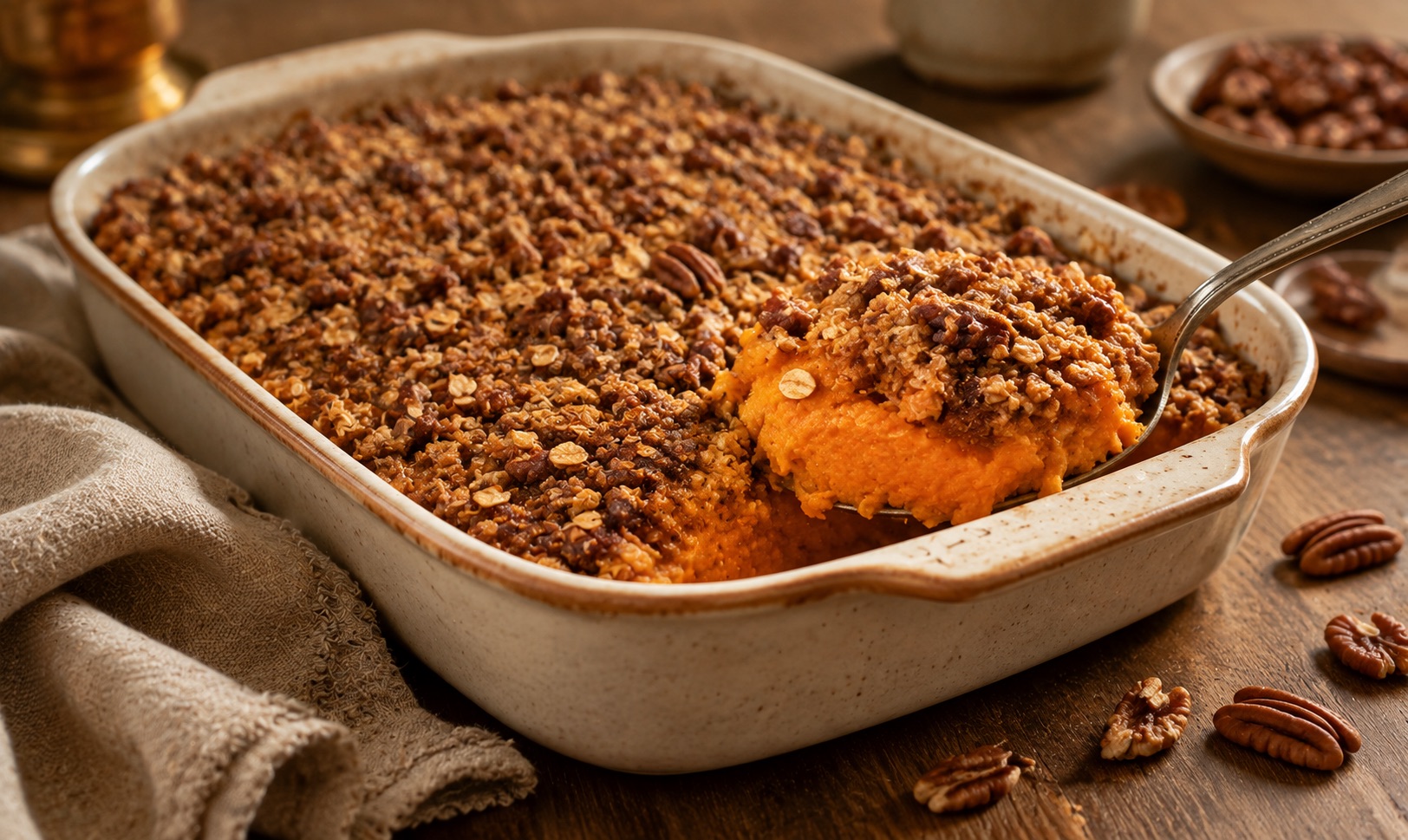
Sweet potato casserole is built on one of the most nutrient-dense vegetables on the Thanksgiving table and then loaded until that stops mattering. A half-cup of a commercially prepared version — Member's Mark — carries 27 grams of added sugar, which is more than the American Heart Association's entire 25-gram daily ceiling for women, in a side dish nobody counts as dessert. The sweet potato underneath is doing real work: one cup of the finished casserole still supplies 157% of the Daily Value for vitamin A along with several grams of fiber. The vegetable is not the issue. The quarter-inch of marshmallow on top and the sugar stirred through the mash are.
There is a second answer that almost nobody mentions, and published data says it matters more than the topping: how you cook the sweet potato moves its glycemic index further than what you put on it. Boiled, ten cultivars tested in a randomized cross-over trial ranged from 41 to 50. Baked, the same cultivars ranged from 82 to 94 — roughly double. Nearly every recipe tells you to roast.
Rebuilt on both findings, the dish lands at roughly 7 grams of added sugar per serving: boiled sweet potatoes — not roasted — mashed with egg, milk, butter, warm spices and a quarter cup of maple syrup, then baked under a topping of pecans, rolled oats and a little coconut sugar, with around 5 grams of fiber and well over a day's worth of vitamin A.
And the marshmallow topping most people treat as an inherited family tradition was, documentably, a marshmallow company's 1917 advertising campaign.
This article is educational, not medical or nutrition advice. Talk to your doctor before making dietary changes, especially if you're pregnant, nursing, managing blood sugar, or taking medication.
Key statistics at a glance
Commercial versus homemade
| Per serving | Member's Mark prepared casserole, 1/2 cup (140 g) | USDA generic sweet potato casserole, 1 cup | This version, 1 of 10 |
|---|---|---|---|
| Calories | ~230 | 248 | ~290 |
| Total sugars | 32 g | 20 g | ~16 g |
| Added sugars | 27 g | not reported | ~7 g |
| Fiber | ~3 g | 6 g | ~5 g |
| Topping | marshmallow | varies | pecans and oats |
Homemade figures are calculated from USDA values for the listed ingredients, not laboratory-analyzed. Note the calorie column: this version is not lower in calories. Pecans and butter are dense. What changes is where the calories come from and how much of the sugar was added by somebody.
The tradition was an ad campaign
In 1917, the Angelus Marshmallows company wanted Americans to treat marshmallows as an everyday cooking ingredient rather than an occasional candy. So it hired Janet McKenzie Hill — founder of The Boston Cooking-School Magazine, one of the most credible culinary voices in the country at the time — to write a promotional recipe booklet.
According to the Library of Congress, that booklet contains the first documented appearance of mashed sweet potatoes baked under a marshmallow topping. The pamphlet also introduced marshmallow-studded fudge and marshmallow-topped hot cocoa. Angelus later became Campfire, and its 1930 and 1950 booklets carried the sweet potato casserole forward. By 1918 — one year in — the dish was already appearing in other cookbooks and trade publications.
This is not an exposé. Nobody was deceived, the booklet was openly branded, and Hill was a serious food writer. It is simply a well-documented case of a "traditional" holiday dish that was designed, commissioned and distributed by the manufacturer of its most distinctive ingredient — and it worked so well that a century later it reads as heritage.
Which is worth knowing mostly because it lowers the stakes. If the marshmallows are genuinely part of your family's memory of the meal, keep them; food carries more than macronutrients. But nobody is violating an ancestral custom by putting pecans on top instead. The custom is 109 years old and it started as a print ad.
Why boiling beats roasting here
Most recipes tell you to roast the sweet potatoes, on the reasonable theory that roasting concentrates flavor. It does. It also changes the glycemic response substantially, and there is direct published data on the size of the effect.
Bahado-Singh and colleagues, writing in the Journal of Nutrition and Metabolism in 2011, tested ten sweet potato cultivars commonly eaten in Jamaica across four cooking methods, in a randomized cross-over design with ten non-diabetic subjects and glucose as the reference food. The spread was not subtle.
| Boiled | 46 |
| Fried | 70 |
| Roasted | 86 |
| Baked | 88 |
Boiled sweet potatoes came in at a glycemic index of 41 to 50. Baked ran 82 to 94. Roasted, 79 to 93. Frying landed in between at 63 to 77 — the authors attributed that to fat slowing gastric emptying. Chart values above are midpoints of each published range.
The authors' explanation is a starch story. Boiling gelatinizes starch in water, and as the potato cools, some of that starch retrogrades into resistant starch, which resists digestion. Dry heat does the opposite: baking and roasting with the skin intact increase the availability of free sugars, which are hydrolyzed immediately. Anyone who has bitten into a slow-roasted sweet potato and found it almost candy-sweet has tasted this happening — beta-amylase converts starch to maltose during the long climb through its active temperature range.
Two honest caveats. Ten subjects is a small study, and it used Jamaican cultivars, not the Beauregard variety that dominates US supermarkets — the direction of the effect is well supported and consistent with in vitro starch digestion work, but the exact numbers should not be treated as precise for a specific American sweet potato. And glycemic index is measured on a food eaten alone. This casserole contains butter, egg and pecans, and a mixed dish with fat and protein behaves differently from a plain boiled potato. GI is a useful signal about the ingredient, not a prediction about the plate.
What survives both caveats: if you are going to choose one cooking method for the potatoes in a sweet dish, boiling is the better-supported choice, and it is free. Our guide to inflammatory foods and what to eat instead covers the broader pattern, and the food chart shows where sweet potatoes and other starchy vegetables sit.
About the sweetener
Both versions use real sugar. That is not the difference, and saying otherwise invites an easy correction — the commercial product is sweetened with cane sugar, not an artificial sweetener.
What differs is the amount, and what the sugar arrives inside. Pure maple syrup and coconut sugar are minimally processed foods rather than refined syrup blends, and they carry trace minerals — but their fiber is gone, and FDA counts both as added sugars. We are not going to tell you they are metabolically free. Coconut sugar in particular is roughly 70–80% sucrose, and its widely repeated low-GI figure rests on a single small analysis that has not replicated well.
Where a recipe can use whole dates instead, the fiber stays attached and that genuinely does change the glycemic response — five date varieties tested in healthy and diabetic subjects measured a glycemic index of about 44 to 55 despite being over 70% sugar (Alkaabi et al., Nutrition Journal, 2011). Full breakdown of which sugar substitute is actually healthiest.
Ingredients
- 3 pounds sweet potatoes (about 4 medium), peeled and cut into 2-inch chunks
- 1/4 cup pure maple syrup
- 2 large eggs, lightly beaten
- 1/3 cup whole milk or unsweetened oat milk
- 3 tablespoons unsalted butter, melted
- 2 teaspoons vanilla extract
- 1 teaspoon ground cinnamon
- 1/2 teaspoon freshly grated nutmeg
- 1/4 teaspoon ground ginger
- 3/4 teaspoon fine sea salt
- 3/4 cup pecan halves, roughly chopped
- 1/2 cup old-fashioned rolled oats
- 2 tablespoons coconut sugar
- 2 tablespoons unsalted butter, melted, for the topping
- 1/2 teaspoon ground cinnamon, for the topping
- 1/4 teaspoon fine sea salt, for the topping
Instructions
- Put the sweet potato chunks in a large pot, cover with cold water by an inch, add a generous pinch of salt and bring to a boil. Simmer 20 to 25 minutes, until a knife slides through with no resistance.
- Drain thoroughly and let the potatoes sit in the colander for 5 minutes to steam off surface water. Wet potatoes make a loose casserole.
- Heat the oven to 350°F and butter a 2-quart baking dish.
- Mash the potatoes by hand with a masher or potato ricer until smooth. Do not use a food processor — high-speed blades rupture starch granules and turn the mash gluey.
- Beat in the maple syrup, eggs, milk, 3 tablespoons melted butter, vanilla, cinnamon, nutmeg, ginger and 3/4 teaspoon salt until the mixture is uniform and slightly glossy.
- Spread the mixture in the prepared dish and smooth the top.
- In a bowl, toss the pecans, oats, coconut sugar, 2 tablespoons melted butter, 1/2 teaspoon cinnamon and 1/4 teaspoon salt until everything is evenly coated and clumping slightly.
- Scatter the topping evenly over the casserole, leaving a half-inch border so the edges do not scorch.
- Bake 30 to 35 minutes, until the center is set and no longer wobbles and the pecans smell toasted. Tent with foil at 25 minutes if the topping is browning fast.
- Rest 10 minutes before serving. The egg-set custard continues to firm as it cools.
Can you make it ahead?
Yes, and this is the version worth planning around if you are cooking a large meal.
Assemble through step 6 — mash in the dish, no topping — cover tightly and refrigerate up to two days. Mix the topping separately and keep it in a sealed container at room temperature; adding it early makes the oats go soft. Pull the dish out 45 minutes before baking, add the topping, and bake as directed, adding 10 to 12 minutes for the cold start.
There is an incidental benefit. Cooked starch that is chilled retrogrades — the same process the glycemic study described — so a casserole assembled Tuesday and baked Thursday has formed some resistant starch in the interval. The effect in a real dish is modest and has not been quantified for this specific preparation, so treat it as a small bonus rather than a reason to make it ahead. The actual reason to make it ahead is that your oven is busy on Thursday.
Is sweet potato casserole healthy?
It depends almost entirely on how much sugar someone put in it, and the range is enormous.
USDA's generic entry for sweet potato casserole or mashed sweet potato reports 248 calories, 43 g carbohydrate, 20 g total sugars and 6 g fiber per cup. A commercially prepared version sold at retail runs 32 g total sugars per half cup, 27 of them added. That is a fourfold difference in added sugar between two dishes with the same name.
The vegetable underneath is genuinely excellent. USDA's casserole entry carries 1,412 mcg RAE of vitamin A per cup — 157% of the 900 mcg Daily Value — because sweet potatoes are among the densest common food sources of provitamin A carotenoids. Six grams of fiber per cup is real. Potassium is substantial.
| Retail casserole — sugar + marshmallow | 27 g |
| This version — maple + a little coconut sugar | 7 g |
So the honest answer: sweet potato casserole is a vegetable dish that is often served as a dessert wearing a vegetable's name. Bringing it back to roughly 7 grams of added sugar per serving — inside the per-occasion framing the 2025–2030 Dietary Guidelines introduced, and well under the American Heart Association's 25 g and 36 g daily limits — makes it a side dish again. It does not make it a health food, and it is still 290 calories.
One naming note, since it causes confusion at the store: most "yams" sold in US supermarkets are sweet potatoes. USDA requires that sweet potatoes labeled as yams also carry the term "sweet potato" on the label. True yams are a different genus and are rarely stocked in mainstream American grocery stores.
How do you get it sweet enough without more sugar?
Three levers, none of which involve adding sweetener.
- Salt. Three-quarters of a teaspoon in the mash and a quarter in the topping is more than most recipes use. Salt suppresses bitterness perception, which raises perceived sweetness — a documented effect in taste research. An undersalted sweet potato dish tastes flat, and the usual fix people reach for is sugar.
- Vanilla and warm spice. Odors associated with sweetness measurably increase sweetness ratings of the same solution. Two teaspoons of vanilla is doing sweetener's job through the nose. The cinnamon, nutmeg and ginger work the same way. To be clear about what is not being claimed: there is no reliable evidence that cinnamon controls blood sugar, and it is not in this recipe for that reason.
- Toasting the pecans. Baking them under dry heat on top of the casserole develops Maillard products that read as richness and caramel. That is why the topping goes on raw rather than pre-toasted — it toasts in place, over the moisture of the mash.
A dish invented by a marshmallow company in 1917 is not a heritage you owe anything to. The warmth, the spice, the orange spoonful next to the turkey — that part is real, and it survives being cooked deliberately. The Sakred app is where we track swaps like this across a season.
Frequently asked questions
Can I still use marshmallows?
Yes. Nothing here is a rule. A standard marshmallow is roughly 4 grams of sugar, essentially all added, so a layer of ten adds about 40 grams of added sugar across the dish — around 4 grams per serving on top of the 7 already there. That is a knowable number rather than a mystery, which is the point of cooking it yourself. If it matters to your family's memory of the meal, use them and skip the coconut sugar in the topping.
Is canned sweet potato okay?
It works, with one caution: read the label. Canned sweet potatoes packed in syrup — often sold as "candied yams" — arrive pre-sweetened, and a single 45-gram piece of candied sweet potato carries about 13 grams of sugar per USDA data. Look for sweet potatoes canned in water with no added sugar, drain them well, and skip the boiling step. You will lose the resistant starch advantage, since they were cooked and canned by someone else.
Can I make it dairy-free and egg-free?
Dairy-free is easy: unsweetened oat milk and a good plant butter behave nearly identically here. Egg-free is a bigger change, because the eggs are what set the custard. Replace them with 3 tablespoons of ground flaxseed whisked into 1/2 cup warm water and rested 10 minutes; the result is softer and more like mashed sweet potato than custard. Reduce the milk to 2 tablespoons to compensate.
Does the glycemic index study mean I can eat this if I have diabetes?
No, and that is not what the data shows. The study compared cooking methods for plain sweet potatoes in ten non-diabetic subjects. It tells you boiling is preferable to roasting for the ingredient; it says nothing about whether a maple-sweetened, pecan-topped casserole fits into any individual's blood sugar management. If you are managing diabetes, this is a dish to discuss with your clinician or dietitian, and to portion deliberately.
Sources
- Journal of Nutrition and Metabolism — Bahado-Singh, Riley, Wheatley & Lowe, Relationship between Processing Method and the Glycemic Indices of Ten Sweet Potato (Ipomoea batatas) Cultivars Commonly Consumed in Jamaica (2011)
- Current Research in Food Science — Boiling vs. baking: Cooking-induced structural transformations drive differences in in vitro starch digestion profiles consistent with in vivo glycemic indexes of white and sweet potatoes (2023)
- Smithsonian Magazine — How Marshmallow-Topped Sweet Potato Casserole Became a Thanksgiving Classic (2017)
- Atlas Obscura — The Savvy Marketing That Put Marshmallows on Your Sweet Potato Casserole
- USDA FoodData Central — Sweet potato, casserole or mashed (nutrient profile)
- USDA FoodData Central — Sweet potato, candied (nutrient profile)
- USDA SNAP-Ed Connection — Sweet Potatoes & Yams, Seasonal Produce Guide
- NIH Office of Dietary Supplements — Vitamin A and Carotenoids, Fact Sheet for Health Professionals
- HHS & USDA — Dietary Guidelines for Americans, 2025–2030 (January 2026)
- American Heart Association — How Much Sugar Is Too Much? (reviewed May 2026)
- CDC/NCHS — Data Brief 536, Ultra-processed Food Consumption in Youth and Adults: United States, August 2021–August 2023 (2025)
- Nature — Breslin & Beauchamp, Salt enhances flavour by suppressing bitterness (1997)
- Perceptual and Motor Skills — Sakai et al., Enhancement of Sweetness Ratings of Aspartame by a Vanilla Odor (2001)